
The spring semester begins today, Wednesday 1/23. Please make sure to check into your courses promptly, today or tomorrow preferably, and see what awaits you. Here’s to a wonderful semester of exploration, inquiry, contemplation, conversation, and study. -CL
All posts by madirector
Important Notice for Students in “Working Women in the USA”
The following book previously required for the Working Women in the USA course is now not a required purchase:
- Working Women in American Literature 1865-1950, ISBN 9781498546782
Dr. Gogol will still be using that book for the class this semester, but will now be providing scans of relevant sections of it during the semester. This change is due to the unusually high cost of the book, and the valid concerns about the cost raised by a number of students.
Upcoming Course Info & Tentative Schedules
The spring semester begins on Wednesday, January 23. Your Blackboard sections will actually become visible much sooner than that, on the 9th, but keep in mind that in most cases prior to 1/23 your course sections will look like a work in progress, at best. The college makes the sections visible ahead of time to give you a look at the syllabus so to secure the course readings well ahead of the first week of class. But professors aren’t actually obligated to put up a syllabus or get their Blackboard sections in order until the start of the semester. So just be aware that while some professors will have their courses looking sorted on 1/9, others will not and do not have to. Keep in mind that some professors go away between the semesters for research or other activities and don’t even return to focus on their semester courses until right before the start of the semester.
The summer and fall 2019 course schedules are close to being finalized. Descriptions for these will be forthcoming once we have the schedules 100% settled and have a registration-opening date to report. At the moment those schedules look like this:
Summer 2019:
- ENGL 510 – Theory and Practice of Expository Writing
- ENGL 514 – Animals in Literature
- ENGL 560 – Latino Literature
Fall 2019:
- ENGL 500 – Theory**
- ENGL 509 – Perspectives on the Essay
- ENGL 521 – Medieval Literature
- ENGL 540 – Magic in Literature
- ENGL 545 – Literature of the Left Bank, Paris
- ENGL 5xx – [Course To Be Determined]
** Note that 500 runs each fall semester, and only in the fall semester. Note also that every student must take 500 at some point during her or his time in the program. 500 and the 599 final thesis tutorial are the only two courses in the MA program for which there is no alternative or substitute. And so students must be aware of their projected timeline in the program and make sure to enroll in 500 when it’s needed, and to enroll promptly when registration for it opens. Any student who has not completed 500 and is on schedule to complete the MA program in Fall 2019, spring 2020, or summer 2020 must complete 500 during this upcoming fall 2019 instance. Any student who has questions about this or anything else should contact the program director at cloots@mercy.edu.
Some Books for your spring courses
Below are some of the book orders for the spring courses. Because professors are still in the process of determining their reading lists, you should consider this a list-in-progress. Works listed below are a certainty but more works might be added. Ultimately the syllabus your professors share in class will mark the definitive list, but this here will allow you to start securing at least some of your books ahead of the semester. I will update this list throughout December and January if/as I receive more book info from the different professors. The Mercy College bookstore will list the book orders too, but they purposefully don’t give you specific edition information or ISBN numbers in order to “dissuade” you from buying the books for cheaper elsewhere. Search by the ISBN to ensure you are securing the right edition for your courses. I recommend Alibris for finding inexpensive used copies and Powell’s for fairly-priced new books, but of course you can buy your books anywhere.
505 Transformations of the Epic
- Beowulf, ISBN 9780451530967
- The Divine Comedy, ISBN 9780142437223
- The Epic of Gilgamesh, ISBN 9780140441000
- Sir Gawain and the Green Knight, ISBN 9780393930252
- The Iliad, ISBN 9780140275360
- Nibelungenlied, ISBN 9780140441376
- Song of Roland, ISBN 9780486422404
514 Sam Shepard
- Sam Shepard: Seven Plays, ISBN 9780553346114
- Spy of the First Person, ISBN 9780525521563
- Fool for Love and Other Plays, ISBN 9780553345902
- Great Dream of Heaven, ISBN 9780375704529
- Hawk Moon, 9780933826236
522 Humanism in Renaissance Texts
- The Cambridge Companion to Renaissance Humanism, ISBN 9780521436243
540 Ulysses
Required:
- Ulysses, ISBN 9780394743127. This is the single-volume Gabler edition. Dozens of used copies are currently available at Alibris for under $5. Powell’s is selling new copies for $10.50. Almost every edition of Ulysses is different than the others, and so if you have a copy of Ulysses already it will be different than this Gabler edition. Everyone should secure this assigned edition.
- Ulysses Annotated, ISBN 9780520253971.
Recommended:
- If you have the time, you’d do well to read A Portrait of the Artist as a Young Man (and perhaps some or all of Dubliners) before the spring semester begins, but it is not required. The protagonist of Portrait carries over into and plays an essential role in Ulysses so your experience with Ulysses will be fuller if you’ve read Portrait.
542 Classics of African-American Lit.
- Clybourne Park, ISBN 9780865478688
- Intimate Apparel, ISBN 9781559362795
- Sweat, ISBN 9781559365321
- Jitney, ISBN 9780573627958
- Venus, ISBN 9780822215677
- Topdog/Underdog, ISBN 9781559362016
- Gloria, ISBN 9780822234333
- A Mercy, ISBN 9780307276766
- An American Marriage, ISBN 9781616208776
546 Working Women in the US
- Dr. Breen’s Practice, ISBN 9781981189427
- Very Much a Lady, ISBN 9781416509592
Recommended but not required (scans of sections of this will be provided as needed during the semester):
- Working Women in American Literature 1865-1950, ISBN 9781498546782
Please complete the “blue course survey” for each course before 12/14
Mercy College’s semester-end feedback surveys aka the “Blue Course Surveys” are now active for each of your MA courses. You should see links to the surveys in the left-hand side of your main Blackboard screen after you login. Please complete the survey for each MA course you are in. These are 100% anonymous and remain anonymous forever. Your professors don’t see the anonymous results until after final grades are locked in (likewise, the survey closes on 12/14 before professors finalize and submit your grades). Your professors are currently able to see the response-percentage for each course, but that’s it. These surveys are your VOICE and provide you with a way to express your thoughts, positive or negative, about your MA courses and professors. These are taken very seriously by the college.
After the semester, each of your professors will read your anonymous feedback for their class. The MA program director, the Dean of the School of Liberal Arts, and the Associate Dean will review all of the surveys for all MA courses. The college’s President and Provost will review the response-percentages for the MA program and for the School of Liberal Arts and may review some of your particular responses too. Your voice and feedback matter and influence the courses we run, how we run them, and who runs them. The response-percentages matter and can effect things such as the college’s investment in and even respect for our graduate program and the School of Liberal Arts overall.
So please, complete the survey for each of your MA courses before the surveys close on 12/14. Your voice and your feedback are critically important to helping us measure if our MA English students are being well-served in their MA courses, and how we might improve as a faculty and a program. Thank you.
If Spring is to be Your Last Semester, It’s Time to Think about 599
Those needing to take ENGL 599 in the spring (meaning, those for whom the spring semester will be their last in the program) take note:
You enroll in 599 in a different way than you do for any other class (process detailed here). The first step of the process is securing a thesis mentor. The way you secure a mentor is by thinking about which professor in the program you would like to lead your 599 thesis tutorial, and then contacting that professor to ask. That’s it. It is normal for professors to field 599 mentoring requests, so don’t be worried that you are imposing by asking. Professors are almost invariably grateful to be asked, and I don’t think any of us ever say no, so it’s almost certain that your preferred professor will say yes. Read the full 599 instructions in the linked post above, and as always let me know if you have any questions at cloots@mercy.edu
Creative Writers Take Note: Our College Literary Journal Still Needs Prose, Re-Opens Submission Window through 12/3.
Mercy College’s literary journal, Red Hyacinth, is re-opening its submission window through Monday December 3rd in hopes of securing more student submissions in the area of prose (fiction and nonfiction). The editors are full-up with poetry submissions but there’s been a dearth of prose submissions, and so the editors are hoping that students (particularly our graduate English students) will rise to this new call for prose and submit something before the end of Monday 12/3. So, if you have a short story, or an excerpt from a longer creative work, or an experimental prose-piece, or any sort of creative non-fiction (really any prose other than scholarship as this is a creative journal and not a scholarly one) well get it together this weekend and send it to the journal editors at:
RedHyacinthJournal@gmail.com.
Further details about the submission requirements can be found by clicking here but basically if you’ve got a piece of short fiction or creative non-fiction the MA program faculty strongly encourage you to send it to the editors and see what happens.
Keep in mind that getting a work published in a collegiate literary journal would provide you with a line-item to list in the publication section of your curriculum vitae.
ENGL 599 students take note: Front-End Format for the final Thesis Paper
Students currently working on their 599 thesis papers please take note. Although the thesis paper follows MLA style for elements like quoting and citing, and the Works Cited, the front-end of the final draft of your paper needs to follow a unique in-house style. Click here to see a PDF of the way the front of the paper needs to be formatted. You can’t actually manipulate that PDF, it’s provided here only as a format-locked view of how the front of the final draft of your thesis should look. Click here to access a Word (.docx) template which you can manipulate and use when formatting the final draft of your thesis paper. Formatting of the .docx might break when opened in different versions of word-processing software, and across different computer platforms. So after opening it, check the format of the .docx template against the PDF and adjust as necessary so that the final draft of your paper looks correct.
Note that only the final draft of your thesis requires this special format.
The easiest way to use the .docx template is to copy and paste your thesis into the appropriate place (the fourth page, which is the first regularly-numbered page: this will make sense once you look at the actual template). Be sure to complete the necessary fields in brackets [ ] on the title page (the paper title, your name, the date). The brackets themselves should be removed after you have entered the necessary information. Do nothing on the faculty signature page. Replace the text on the acknowledgement page with whatever you want; and if you don’t want to put anything there you can just leave the page blank. Then on the fourth page, which again is the first regularly-numbered page, make sure you’ve put your last name into the [Last Name] field in the top-right corner. Again, the brackets themselves should be removed after you’ve entered the necessary information.
You do not have to use the actual .docx template provided here and can just re-create this front-end format on your own, if you know how to, and if it’s easier for you to do so (using page-breaks and other Word tools to create different sections and headers in your own document). Just make sure that the final draft of the thesis paper that you send to your mentor is formatted as you see in the PDF linked above. If you have any questions speak to your mentor and/or email cloots@mercy.edu.
Spring Registration Opens Today 11/7: Any Questions?
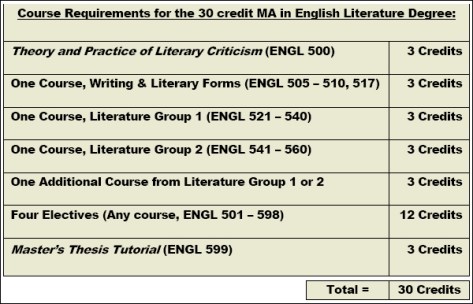
So it looks like registration is going to open on-schedule this Wednesday the 7th. If anyone has questions about the courses or their schedules, let me know at cloots@mercy.edu. You can read the course descriptions on this post from a short time ago. Note that at the bottom of each description it tells you how the course works toward your MA course requirements. Just as a reminder, here are your course requirements (table taken from page 5 of the handbook available in the left-hand column of this blog):
Tentative Spring Registration Date – November 7.
Currently spring registration is scheduled to open on November 7, usually at 9am eastern (literally when the Registrar shows up to work and flips the switch). The registration date can change, and some of you probably remember the time it changed something like three times before it finally settled down, but as of now that’s the date they’re telling me. Point is, registration is coming up, so be thinking about your course selections for the spring, and for those who really want to make sure they’re in any particular course(s) be sure and register promptly once registration opens. Some classes fill up fast.
 Program Director's Blog for the Mercy University MA in English Literature Program