All posts by madirector

Spring 2019 Course Schedule

The fall semester hasn’t yet begun but the MA course schedule for spring 2019 is already set. We don’t yet know when registration will open for spring but as soon as I learn it I will post the information here. Some courses fill up very quickly when registration opens, so remember that the only way to ensure you get your first-pick of courses is to pay attention to the registration dates and to get registered for courses when registration opens. The six graduate English courses for spring 2019 are:

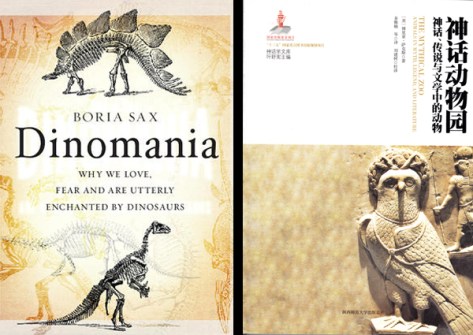
  • ENGL 505 Transformations of the Epic (Dr. Sax)

This course is based on the conception of the epic as an encyclopedic narrative of substantial length featuring a central figure who reflects the values of a particular culture. It will proceed chronologically, studying the taxonomy and transformations of the epic, from its earliest Classical manifestations, through its emergence in Medieval and Renaissance texts, to its incorporation after the Renaissance into modern writing. 3 credits. Fulfills the Writing & Literary Forms field requirement or an elective.

  • ENGL 514 Sam Shepard: Playwright, Poet, Novelist, Memoirist and Rock Star (Dr. Medoff)

Samuel Shepard Rogers III (November 5, 1943 – July 27, 2017), known professionally as Sam Shepard, was an American actor, playwright, author, screenwriter, and director whose body of work spanned half a century. He won 10 Obie Awards for writing and directing, the most given to any writer or director. He wrote 44 plays as well as several books of short stories, essays, and memoirs. Shepard received the Pulitzer Prize for Drama in 1979 for his play Buried Child. He was nominated for an Academy Award for Best Supporting Actor for his portrayal of pilot Chuck Yeager in The Right Stuff (1983). Shepard received the PEN/Laura Pels International Foundation for Theater Award as a master American dramatist in 2009. New York magazine described him as “the greatest American playwright of his generation.” Shepard’s plays are chiefly known for their bleak, poetic, often surrealist elements, black humor, and rootless characters, such as cowboys and rock stars, living on the outskirts of American society. This semester, in light of Shepard’s recent passing, we will experience and study a selection of his works and consider his lifetime of artistic achievement. 3 credits. Fulfills an elective by default, but can be made to meet the Literature Group 2 field requirement for students approaching graduation who still need that field requirement met.

  • ENGL 522 Humanism in Renaissance Texts (Dr. Fritz)

This course will focus on humanism and the concepts arising from it in relation to the production and appreciation of literature during the Renaissance. The revival of interest in the arts and ideas of Greco-Roman antiquity and the dependence of Renaissance thought on classical themes will be among the issues discussed. Readings could include (but aren’t limited to) works by Shakespeare, Marlowe, Machiavelli, More, Spenser, among others. 3 credits. Fulfills a Literature Group 1 field requirement or an elective.

  • ENGL 540 Ulysses – James Joyce (Dr. Loots)

This course will examine one of the most famous, famously difficult, famously banned, and (arguably) profound modern novels of the twentieth century: James Joyce’s Ulysses. Much like Tolstoy’s War and Peace and Pynchon’s Gravity’s Rainbow, Joyce’s 1922 modernist masterpiece occupies a rare position of being a work almost universally lauded for its achievement and significance (for those who like lists, the academically-sound Modern Library calls it the greatest novel of the twentieth century) and yet one which for a variety of reasons most people haven’t read. In this class we will experience together the entirety of the work, first word to last. We will throughout the semester journey through Ulysses until, come the end of the semester, we find ourselves standing together at the absolutely brilliant end of this modern epic tale. While reading and exploring Ulysses we will as well discuss some of the people, culture, history, and events surrounding the creation of, publication of, and outrageous reception to the novel. 3 credits. Fulfills a Literature Group 1 field requirement or an elective.

  • ENGL 542 Classics of African-American Literature (Dr. Morales)

This course will study classic works of African-American literature in light of Toni Morrison’s statement that “my parallel is always the music because all of the strategies of the art are there.” The course will involve considerations of how in Richard Powell’s words the blues provides “much contemporary literature, theater, dance, and visual arts with the necessary element for defining these various art forms as intrinsically African-American.” Informed by the concept that music is the trope that best illuminates contemporary African American writing, the course will study selections that could include, but are not limited to, Jean Toomer Cane, Zora Neale Hurston Spunk, James Baldwin Go Tell It on the Mountain, Ralph Ellison Invisible Man, Langston Hughes Ask Your Mama: 12 Moods for Jazz, John Wideman My Brother’s Keeper, Toni Morrison Jazz, August Wilson Joe Turner’s Come and Gone, and Maya Angelou Selected Poetry. 3 credits. Fulfills a Literature Group 2 field requirement or an elective.

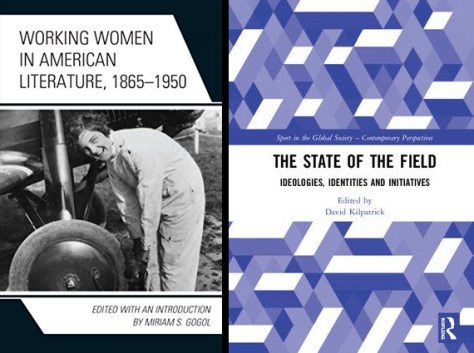
  • ENGL 546 Working Women in the US: 1865 to Present (Dr. Gogol)

This course will examine writings about working women from the post-Civil War era to the present. We will review key changes in the American work force, and social, economic, and racial factors since 1865, with attention to movements leading up to changes in the second half of the 19th century. In this multi-genre course, we will read literature (fiction, short stories, poetry, memoirs, biographies, and essays) to help us deconstruct the definitions of “women,” “working,” and “The United States” from the Civil War era to present writings about the millennial generation. We will inquire into the shifting definitions of the term “gender.” We will start with gender as a concept, a social construction reflecting differentials of power and opportunity, breaking what the feminist writer Tillie Olsen calls the “habits of a lifetime.” An important goal of the course is for students to know the literature, history, and benchmarks of major events in the lives of women. 3 credits. Fulfills a Literature Group 2 field requirement or an elective.

Quick FYI: All Aspects of the MA Degree Requirements Can Be Completed At Distance/Online

This is just a quick FYI to all current and prospective students who might be reading the blog, and hopefully just repeats information which is already well known, but to be completely clear: students can complete all aspects of the MA degree through our MA English program remotely, meaning through distance learning, meaning online, meaning how current students are doing it already, meaning from wherever it is you are located in the world. This includes the coursework, the comp exam, the final thesis paper: everything. No one will ever need to travel to Mercy’s physical campus in NY, or to any testing center, in order to complete any of the degree requirements or to receive the actual degree. Some grad students do voluntarily travel to our physical campus at various times for various reasons (to attend the spring symposium, to talk with profs, if they happen to be in the area, etc.) but this is not required for the degree.

I’m posting this note because it’s been brought to my attention that Mercy College periodically sends out some sort of generic form-letter to all graduate students taking online coursework informing them that they might need to travel or make other arrangements to complete some degree requirements. That is not the case for the MA English degree. Again, you can complete all requirements through distance learning and will never have to travel or make special testing arrangements. We’ve got that all figured out here in the program. As always if you have any questions drop me a note at cloots@mercy.edu.

Call for Papers: NEMLA 2019 Panel

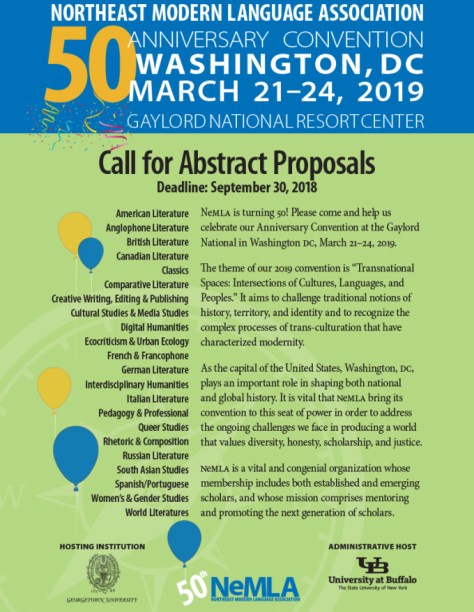
Mary Reading, a colleague of our Dr. Fritz, is chairing a panel at the 2019 NEMLA convention on the topic of: “In, Beyond, Between Bodies: Transgender Identity through Interpersonal Spaces in Visual Media.” The call for papers (CFP) for potential panelists is open until September 30. You can learn more about the CFP, including contact info and submission guidelines, here on the UPENN bulletin board (which if you didn’t know is pretty much where everyone in the profession goes to look for CFPs since the UPENN board collates CFPs from around the country and world.) You can learn more about the 2019 NEMLA convention here. Any Mercy grad students working in this area of inquiry (or interested in working in this area of inquiry) and who can be in Washington DC in March 2019 to attend the convention should put together a paper proposal and submit it before the deadline. Any questions about the panel should be directed to Mary Reading at: m.a.reading@iup.edu.

A Reminder About the Incomplete “I”

This post duplicates information found earlier in the blog (and accessible by clicking the “The Incomplete ‘I'” category in the right-hand column). But this is critically important information which all students need to keep in view, and so as July turns to August and the fall semester starts to rise on the horizon, let’s just make sure everyone is clear on the policy surrounding the incomplete “I.”

First off an incomplete might be granted by a professor in place of a real course grade to students who have completed most of the required work for a course and who have met attendance requirements. The incomplete is not intended for students who get buried under other work and life-responsibilities and need more time. It is intended for emergency situations, for students who experience an unexpected crisis (such as a debilitating illness or major life-upheaval) at a specific point during the term which unexpectedly interrupts their ability to complete all required work for a course by the end of the semester. Each professor has the right to not grant an incomplete and instead grant some other grade, including an F, based on whatever work the student completed during the regular term.

Students who find themselves in a situation which might warrant an incomplete must request it of the professor. Even if the professor agrees, she or he might still require you to complete a form to initiate the incomplete.

Sometimes an incomplete can be a life-saver for students who experience sudden crisis and find themselves unable to complete the work for course in a timely way, but in just about all cases students should avoid incurring an incomplete. Many students who take an incomplete never resolve it: because life goes on, new responsibilities and coursework come along, and it just becomes very difficult to find time to go back and do work on past requirements. It is also difficult for your professors to deal with incompletes because your professors’ work, responsibilities, and lives move forward too. It is a big deal for everyone when a student takes an incomplete, which is one reason why a professor simply might not grant it.

If a student is granted an incomplete for a course, the student should work to complete the missed work and so remedy the incomplete as soon as possible–and prior to the start of the next semester. At the maximum, students have no more than one year in which to remedy the incomplete: after that year the potential credits for the course and tuition for the course are lost, and the incomplete cannot be changed into any real grade. The incomplete “I” is thereafter locked permanently on your transcript.

So for example students who have an incomplete from any fall semester have at the most until the end of the subsequent fall semester to remedy the incomplete. Once that subsequent fall semester ends, if the incomplete hasn’t been fixed it becomes locked permanently as an incomplete and the student loses the potential credits for it.

In all cases it is the responsibility of a student who receives an incomplete to pay attention to deadlines and do what is necessary to fix the incomplete well before the one-year window closes: to stay in touch with the professor, to know what work needs to be done, to keep the one-year maximum deadline in view. It is not the responsibility of any professor to keep track of incompletes granted in the past, or of the one-year deadline for any incomplete. If anyone has any questions about this please, as always, contact the program director at cloots@mercy.edu

[UPDATED 6/7] Update Regarding ENGL 500 for the Fall

Update 6/7: A second section ENGL 500 is now open. Some of those on the waitlist for the original section have already gone and registered for the new section (which is the right thing to do). All those still on the waitlist should now go and grab a seat in the newly opened section. Mercy’s staff advisors will be reaching out to everyone on the waitlist encouraging you to go register for a seat in the new section, just as I am doing here.

Some Books for Fall 2018 Courses

Below are some of the books that professors have indicated will be included in their fall semester syllabuses. This isn’t meant to be comprehensive and some of this could change. Titles and missing ISBNs will be updated as I received them over the spring and summer. Ultimately the book orders sent to the Mercy College bookstore mark the definitive list.

Before I list the books I want to just give a word of caution as to why you might not want to read ahead in some cases. When you’re reading a book on your own it will be a different experience from when you’re reading it in-time with a class, in the structure and flow of a class. You’ll be seeing works in certain ways when reading them in the flow of the semester, ways which might not be apparent when reading ahead. Also, in some instances you might find a work confusing, even off-putting, and be wondering “what in the world is this?” when reading it ahead of time on your own, without the context of the class to frame it and provide an immediate platform for studying it together. Only consider that there’s a reason why professors choose certain works and schedule them in a certain pattern, and in some cases it might be better to not read ahead so that you’re experiencing a work for the first time, or for the first time in a long time, in-time with the class.

On the other hand, there are some reasons you might read ahead. There is an advantage to re-reading things, so it can be a good strategy to read some works (particularly large works) ahead of time so that you’re re-reading them later in-time with the class. For people who read slowly, or who expect to have a lot of other responsibilities in the fall, it might also be to your advantage to get ahead on some of the larger readings. Some courses (like Narrative Strategies) have larger reading lists than others and for these classes it might be practical to get at least a few of the books read beforehand, to balance the semester workload out. And it’s often a good idea to read around a syllabus ahead of time: e.g., reading off-syllabus works from an author or era, or perhaps biographies of authors, or critical/historical studies of the culture and era you’re about to study, so to prepare for the semester ahead. This is all only to say to be conscious and critical of why and what you might be reading ahead of time, if you are, in preparation for the fall.

ENGL 500 Theory
  • For Dr. Reissig Vasile’s 500 DLA section the book is: Literary Criticism: An Introduction to Theory and Practice. 5th Edition, 2011 ISBN 9780205212149. Dr. Sax’s book order is different and can be located by checking for his 500 DLB book order on the Mercy College Bookstore website. Note that you don’t have to purchase the books through the college bookstore and might be able to find them cheaper elsewhere; but the bookstore is also coy about listing some of the specifics of the book orders in order to try and force you to purchase the books through them. You can check with Dr. Sax at BSax@mercy.edu if you have any questions about his book orders for the fall.
ENGL 507 Narrative Strategies in the Novel

Note: Any edition of the following works will do so specific ISBNs aren’t provided or necessary here. Also note: some of these will be read in their entirety, others will only be read in part.

  • Defoe, Daniel. Robinson Crusoe.
  • Dickens, Charles. Great Expectations (selected chapters only).
  • Eliot, George. Middlemarch. (“Miss Brooke” section only).
  • Hurston, Zora Neale. Their Eyes Were Watching God.
  • James, Henry. Daisy Miller.
  • Lawrence, D.H. Lady Chatterley’s Lover.
  • McCarthy, Cormac. All the Pretty Horses.
  • Rowson, Susanna. Charlotte Temple.
  • Twain, Mark. Pudd’nHead Wilson.
  • Wharton, Edith. Ethan Frome.
  • Woolf, Virginia. Mrs. Dalloway.
  • Zusak, Markus. The Book Thief.
ENGL 515 Graphic Novel
  • Bechdel, Alison. Fun Home: A Family Tragicomic. ISBN: 0618871713.
  • Eisner, Will. The Contract with God Trilogy. ISBN: 0393061051.
  • Gaiman, Neil. The Sandman: Brief Lives. ISBN: 1563891387.
  • Moore, Alan and Dave Gibbons. Watchmen. ISBN 9780930289232.
  • Spiegelman, Art. Maus I and Maus II. ISBNs: 1435262352 and 0141014083.
  • Tomine, Adrian. Killing and Dying. ISBN: 9781770462090.
  • Ware, Chris. Jimmy Corrigan: The Smartest Kid on Earth. ISBN: 0375714545.
ENGL 524 Reason to Imagination
  • Bacon, Frances. Francis Bacon: The Major Works (Oxford World’s Classics). ISBN: 0199540799.
  • Blanning, Tim. The Romantic Revolution: A History. ISBN: 9780812980141.
  • Clarke, Susanna. Jonathan Strange & Mr. Norrell. ISBN: 0765356155.
  • Sax, Boria. City of Ravens: The True History of the Legendary Birds in the Tower of London. ISBN: 9781590207772.
  • Shelley, Mary. Frankenstein. ISBN: 0486282112.
  • Thomas, Keith. Religion and the Decline of Magic. 2 ed. ISBN: 0140137440.
ENGL 525 Victorian Age in Lit.
  • Dickens, Charles. Hard Times. ISBN: 9680486419206.
  • Eliot, George. Mill on the Floss. ISBN: 9780486426806.
  • Greenblatt, Stephen, ed. The Norton Anthology of English Literature, 9th ed. Vol. E. The Victorian Age.ISBN: 9780393912531.
  • Wilde, Oscar. The Picture of Dorian Gray. ISBN: 9780486278070.
ENGL 560 Hemingway/Modern Cryptography
  • Hemingway, Ernest. A Farewell to Arms. ISBN: 0684801469.
  • —. The Garden of Eden. ISBN: 0684804522.
  • —. A Moveable Feast. ISBN:  068482499X. (Original Mary Hemingway edition preferred over the “restored” 2010 Sean Hemingway edition, but either will do).
  • —. The Old Man and the Sea. ISBN: 0684801221.
  • —. The Short Stories: The First Forty-Nine Stories with a Brief Introduction by the Author. ISBN: 0684803348.
  • —. The Sun Also Rises. ISBN: 0743297334.

Recommended:

  • Dearborn, Mary. Ernest Hemingway: A Biography. ISBN: 030759467X.
  • Hemingway, Ernest. For Whom the Bell Tolls. ISBN: 0684803356. (The one major novel we’re not covering during the semester).


Wrap-Up: W.I.T 2018 MA English Symposium

On Tuesday 5/15 the graduate English program hosted it’s 2018 Writing Image Text (WIT) symposium. Because most of our MA students live in other parts of the country and even in other countries, we know that it’s impractical for many of our students to travel to attend. Hopefully this post can give those of you at a distance a feel for the event, of which I hope you know that all of you were a part in spirit. Turnout was good as a number of students and alumni (mostly from around the north-east) made it to campus to attend and enjoy some friendly conversation with each other, faculty, and the school Dean.


The picnic area outside Maher Hall. The calm before the storm: literally, our area was hit with a massive storm just a few hours after the event ended.

Our first panel of presenters consisted of Dr. Kristen Keckler, who started the symposium off by reading several of her “flash fiction” pieces. Dr. Keckler (who in addition to teaching in the MA program is also our undergraduate English program director) discussed “flash fiction” a bit and we talked as a group about what we thought one of the stories was really about. After that we switched to hearing some scholarship from two graduate students: Richard Kovarovic presented “The River, the Tiger, the Fire: Borges and the Reimagining of Modernist Time in Ficciones“; and Daniel Campbell then presented “The Literature of the Celtic Periphery: The Commonality of Constituent Elements.”


L-R: Dr. Keckler reading flash fiction; Dr. Loots, Richard, Daniel.

After some lunch (in the picnic area featured above!) Dr. Celia Reissig-Vasile, Chair of the Department of Literature and Language, gave a talk on research activities she recently performed in Argentina while researching the film Tunel de Los Huesos/Tunnel of Bones and the historical events it depicts.


Dr. Reissig-Vasile discussing her on-site research in Argentina. Dr. Dana Horton (right) watches on.

The lights were turned low, and Dr. Dana Horton discussed her poster-presentation “‘Where One Time I Served, Now I Got Others Serving Me’: Women as Post-Neo-Slave Owners in 12 Years a Slave.” Dr. Horton discussed not just the topic of her poster and related research but the whole idea of a poster-presentation, which has long been a standard presentation method in the sciences but has only recently sprung up as a method in literary fields.


Dr. Horton discussing her poster-presentation (the projection was bright and clear in the room, not washed-out as it looks in this photo).

Throughout the event the audience sat enraptured!


L-R: Kari; Dr. Sax (a bit of his shirt at least); Lynne; Richard; Dr. Tamara Jhashi, Dean of the School of Liberal Arts; Dr. Fran Biscoglio (just peeking up above Dean Jhashi’s head); Dr. Keckler. Not depicted: Daniel sitting to the left (sorry Daniel, too far to the left!). Dr. Dugan and Dr. Medoff were present for the event but also out of the frame (alas!).

At this point we switched over to poetry readings. Gloria Buckley, who recently completed her degree as part of the MA English class of 2018, read two selections: “Tide of the Mind” and “November Night Woods.”


Gloria introducing her first poem. Dr. Horton watching on.

After Gloria’s reading Dr. Boria Sax closed out the event with several of his poems, each of which shared a common theme relating to leaves. They included “Which Leaf?,” “Death of a Tree,” and “Sing Sing Prison at Night” (Dr. Sax teaches classes to inmates at Sing Sing as part of Mercy College’s outreach in association with a project called Hudson Link).


Dr. Sax, on the right, having just finished his poetry reading. Gloria, Dr. Reissig-Vasile, and Dr. Horton sit together with Dr. Sax here at the end of the event answering questions related to their presentations.

The symposium was overall just filled with interesting ideas, scholarship, creative fiction, poetry, and research; as well as with good humor, laughter, conversation, and camaraderie. (And food!) In addition, our student-presenters earned a valuable line-item to list on the scholarship section of their CV. Altogether it was a very good day. Thank you, everyone, who attended. And to everyone else in the program who for understandable reasons could not attend (distance, obligations, etc.), please know that you were there with us in spirit, that this event involved each one of you; because we are all in this together, all of us in this graduate English program. This time next year we’ll be having the 2019 symposium. Start planning for it now! We in the faculty hope to see as many of you there as can possibly attend. Until then, cheers to you all.

Summer Book Orders

The book orders for the two summer courses are:

ENGL 510 Theory and Practice of Expository Writing:
  • Fitzgerald, F. Scott. The Great Gatsby. 1999. ISBN: 9780743273565.
  • Miller, Susan. The Norton Book of Composition Studies. 2009. ISBN: 978039393158.
  • Oates, Joyce Carol & Robert Atwan, eds. The Best American Essays of the Century. 2000. ISBN: 9780155873.
  • Shakespeare, William. Hamlet. 2003. ISBN: 9780743477123

RECOMMENDED:

  • Tyson, Lois. Critical Theory Today: A User Friendly Guide. 2006. ISBN: 0415974100.
  • MLA Handbook, 8th Ed. 2016. ISBN: 9781603292627.
ENGL 540 Mastering the Past:
  • Di Lampedusa, Guiseppe. The Leopard. 2007. ISBN: 9780375714795.
  • Faulkner. The Portable Faulkner. 2003. 9780142437285.
  • Ishiguro, Kazuo. The Buried Giant. 2016. 9780307455796.
  • Sebald, W.G. On the Natural History of Destruction. 2004. ISBN: 9780375756573.
  • Solzhenitsyn, Alexander. One Day in the Life of Ivan Denisovich. 2008. ISBN: 9780451228147.

2018 Thesis of the Year, and Christie Bowl Program Honoree.

The MA program now has two distinctions that it awards in May at the end of the annual school-cycle: the Thesis of the Year award, and the just-inaugurated Christie Bowl Program Honoree award.

All theses completed for ENGL 599 Master’s Thesis Tutorial courses during the summer and fall of 2017 and spring of 2018 were eligible for the Thesis of the Year title. The final paper is selected by program faculty who have no thesis students’ papers in the running, and who read over drafts of thesis papers from which the authors’ names as well as mentor’s names have been removed.

The winner of the 2018 Thesis of the Year award is Matthew Christoff for his paper “Surrealism and the Dissociation of Internal and External Experience.” 

The Christie Bowl Program Honoree award is named for the late Joannes Christie who established and for a long time chaired Mercy College’s English Department. The annual awarding of a Christie Bowl (it is an actual bowl) to an undergraduate English program-honoree has long been a tradition at Mercy College. The Dean of the School of Liberal Arts, Dr. Tamara Jhashi, has created this graduate award to extend the distinction into our graduate program. The award, selected by the combined graduate faculty, recognizes one graduating person for her or his outstanding academic excellence and contributions to the MA program, to our graduate learning community, over the course of her or his time in the program.

The winner of the 2018 Christie Bowl is Gloria Buckley.

I hope everyone in the program will join the faculty in congratulating Matthew and Gloria. These were not easy decisions for the faculty to make, as the quality of theses produced across the 599 sections each year is exceptional; and all of our graduating class each year demonstrates excellence. As we recognize Matthew and Gloria let us also recognize all members of the graduating MA class of 2017-18 for their hard work and dedication.

Graduate English Symposium Attendee Info

We’re one week away from our 2018 symposium here at Mercy College’s Dobbs Ferry campus. The event is on Tuesday May 15 in Maher Hall from 11am to 2pm. For those attending here is some info you might find useful:

If you’re driving to campus you have a few options. You can take 287 to Exit 9 (Tarrytown/Sleepy Hollow) and then take Route 9 south to the campus. The college is about three miles directly south of 287. Or you can take the Saw Mill River Parkway to Exit 17 then head about two miles west to campus. In all cases WATCH YOUR SPEED, especially if you’re coming south on Route 9 from 287. That stretch of road goes through three different villages (Tarrytown, Irvington, Dobbs Ferry) and each will have its own speed traps. People get pulled over all the time up and down those three miles between the college and highway. The speed limit is usually 35 but drops to 30 at times.

There is a security booth at the entrance to the college parking lot. Security is aware that people without parking passes will be arriving for this event. Just stop at the gate and tell the guard that you are here attending the Graduate English Symposium at Maher Hall and they will let you in.

For those using Metro North take the Hudson River Line to Ardsley. Once outside the train station turn right and walk up the hill to campus.

The symposium will be in Maher Hall, which is an old mansion on the north side of campus pointed-at by the arrow in the map below. The car entrance is at the bottom-right of that map, and the Ardsley train station is at the top-right. If anyone gets lost you can call me at 914-674-7423 or the English office administrator, Linda Dubiell, at 914-674-7353.


There are numerous hotel options in the area. The hotel the college uses for visitors is the Tarrytown DoubleTree Hilton which is up by Exit 9. A few miles further away on White Plains Road there are three different Marriots (why three?), a Sheraton, and a Hampton Inn. There’s also a very nice boutique hotel, the Castle Hotel & Spa, right nearby in Tarrytown.

If anyone has any questions about the symposium please contact me at cloots@mercy.edu. I and other program faculty (and Dean Jhashi) look forward to seeing all of you who can attend.