All posts by madirector

Wrap-Up: W.I.T (Writing Image Text) 2017 MA English Symposium

This past Tuesday 5/16 we held our 2017 W.I.T. graduate English program symposium here in Maher Hall on our Dobbs Ferry campus. It was a lot of fun, and the audience got to hear a number of scholarly and creative works by graduate students and faculty.

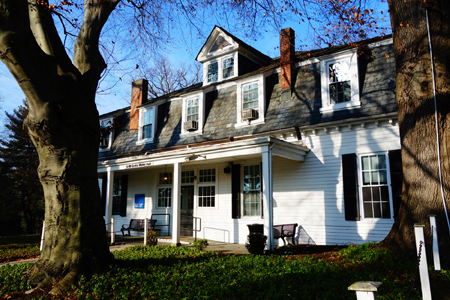
Maher Hall: home of the undergraduate and graduate English programs, English faculty offices, and the office of the Dean of the School of Liberal Arts; location of the graduate English symposium.

For our first panel three graduate students presented scholarly work. Gloria Buckley read her piece titled “Virginia Woolf’s Orlando: A Landscape Love Story Transcending All Borders,” in which she discussed the love and relationship of Virginia Woolf and Vita Sackville-West as bespoken by Orlando. Lynn Leibowitz-Whitehead presented “Hemingway, ‘The Greatest Writer of His Time’; With a Little Help from His Friends: An Examination of Fitzgerald’s Influence on Hemingway’s Writing Career.” Lynn’s study traced out some of the ways that Hemingway’s success was resultant from invaluable support of others, support which Hemingway tried to obscure and erase after gaining fame. Matthew Christoff then presented his study “Symbolism in the Sierra Morena Mountains” in which he unpacked the deep relevance of events taking place in those mountains to understanding the meanings within Cervantes’ Don Quixote.

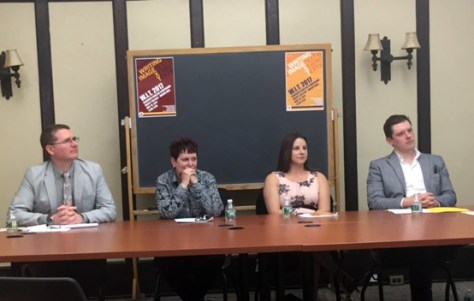
The first panel, left to right: Dr. Christopher Loots (moderator); Gloria Buckley, Lynn Leibowitz-Whitehead, Matthew Christoff.

For our second panel MA program alumna and current Mercy adjunct professor Carol Mitchell was joined by the Chair of the Dept. of Literature & Language, Dr. Celia Reissig-Vasile, and the Head of Undergrad English, Dr. Kristen Keckler, for a panel of creative non-fiction presentations. Carol read her work “On the Car Radio” in which she reflected movingly on her youth, family, father, and the passing of these things through the nodal points of songs heard on the car radio when young. Dr. Keckler then read her piece “Mixology, Metaphor, and Memory: What Bartending Taught Me about Writing,” in which she sounded out the (often hilarious) resonance between life behind the bar and life behind the the pen. Dr. Reissig-Vasile then concluded the panel by reading from her work “Where Oblivion Shall not Dwell,” as published in the collection Home: An Imagined Landscape. Dr. Reissig-Vasile’s piece involved stories of her experiences with movement, emigration, and all around change; with some of the many different referents for “home” that she’s known through her life.

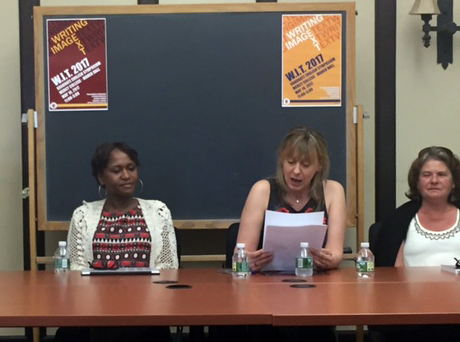
The second panel, left to right: Carol Mitchell, Dr. Kristen Keckler, Dr. Celia Reissig-Vasile.

The Dean of the School of Liberal Arts Dr. Tamara Jhashi attended, as did the Associate Dean Dr. Richard Medoff and several other faculty members both from within the program (Dr. Sean Dugan, Dr. Boria Sax) and from other programs (Dr. Saul Fisher). Graduate students Tara Farber and Lynne Fortunado attended as well, and some friends/family of the presenters were present too. Overall the event evidenced high-quality scholarship and writing, and the presentations engendered much thought and good collegial conversation. On the practical side our presenters earned a line-item to include on the scholarship section of their CV which is an essential pursuit for anyone seeking a PhD or other professional path in higher education beyond the MA program.

Thank you to everyone who attended. I look forward to seeing some/all of you again next year for the 2018 symposium, and encourage anyone who wasn’t there this year to consider attending in 2018 whether to present, or simply to gather with others from your scholarly community.

2017 Thesis of the Year Award

The winner of the 2017 Thesis of the Year award is Kate Oscarson for her paper “What’s so Super about Superman? Heroes and the Quest for Perfection.” All theses completed for ENGL 599 Master’s Thesis Tutorial courses during the summer and fall of 2016 and spring of 2017 were eligible for the Thesis of the Year title this year. The final paper is selected by program faculty who have no thesis students’ papers in the running, and who read over drafts of papers from which the authors’ names as well as mentor’s names have been removed. The award allows the student to list this honor on her or his curriculum vitae (CV). A thesis of the year award is something common to MA English programs and does hold weight on a CV, particularly if a person applies to PhD programs or to jobs within the field. So congratulations, Kate! We will begin a new cycle of consideration starting this summer.

2017 W.I.T. English Symposium Update

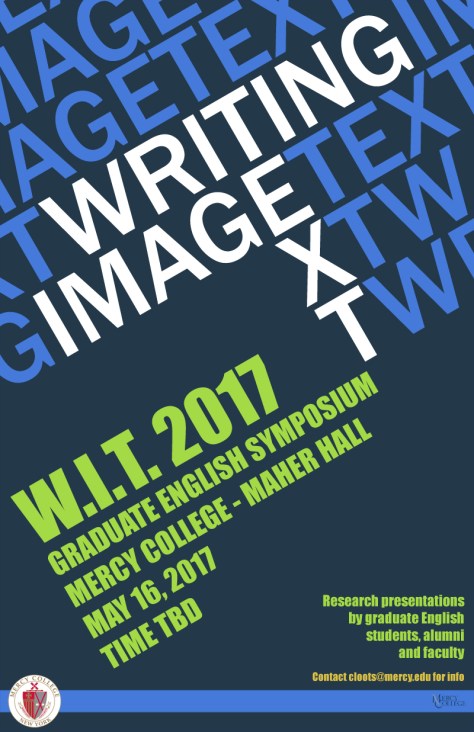
Hi all, just a reminder that in less than a month the MA Program will be hosting the 2017 Writing Image Text (W.I.T) English symposium here in Maher Hall on the Dobbs Ferry campus. Last year’s symposium was a good time all around. This year like last year we’ve got four grad students committed to presenting (Gloria Buckley, Matthew Christoff, Lynn Leibowitz-Whitehead, and Jenelle Luckey). We have a few more grad students who may or may not attend and present depending on other factors. Dr. Keckler plans to be there and to share some of her creative writing. Other professors might read or share something too. I’ll be moderating the event. I imagine a number of other faculty members and even perhaps the Dean might attend just for fun. Without further ado, here is the new very orange poster for the event:

A Reminder About Incomplete Grades (the “I”)

As we near the end of the spring 2017 semester please keep in mind the way that incomplete “I” grades work. Some of you may have received an incomplete for a course in the past (meaning you got an “I” for your grade instead of a real letter grade). I posted about this several years ago here, but let me post on it again just to remind everyone what’s up, and of the things you need to be thinking about if you have any incompletes on your transcript.

First off the incomplete might be granted to students who meet attendance requirements and complete most of the required work for a course. The incomplete is intended for students who experience an unexpected crisis (such as illness) at a specific point during the term which interrupts their ability to complete all required work for a course. Each professor has the right to not grant an incomplete and instead grant some other grade, including an F, based on whatever work the student completed during the regular term. Students who find themselves in a situation which might warrant an incomplete must request it of the professor. Even if a professor agrees to give you an incomplete you should avoid them at all cost. Many students take an incomplete figuring that they will make it up in good time, and then don’t–because life goes on, new responsibilities and work come along, and it just becomes very difficult to find time to go back and do work on past requirements.

If a student is granted an incomplete, the student should work to complete the missed work and so remedy the incomplete as soon as possible–and prior to the start of the next semester. At the maximum, students have one year in which to remedy the incomplete: after that year the potential credits for the course and tuition for the course are lost, and the incomplete cannot be changed into any real grade.

So for example students who have an incomplete from spring 2016 have a little more than two weeks from the day I’m posting this (April 25) to remedy the incomplete (because the last day of the semester is May 9). Once this spring semester ends, all spring 2016 incompletes are locked in and cannot be fixed. And note: sending your professors paperwork at 11pm on the 365th day of the year’s window is not acceptable. Professors might have upwards of a hundred final papers they’re reading for all their regular classes, and your incomplete paper will usually go to the bottom of that stack and be read in proper time–not rushed to the front of the line as some might hope. So, anyone seeking to correct spring 2016 incompletes should be communicating with and working with their professor now to establish the necessary schedule required to remedy the incomplete.


Fall ENGL 500 Update

We already have such waitlist demand for the fall ENGL 500 course that we’re going to open a second section now, within the next week. You aren’t automatically shifted from the waitlist to the registration list, so if you are on the waitlist please make sure to either manually go and register for the new 500 section when it opens, or speak to a Student Services advisor to have them shift you from the waitlist to the course list. We will eventually balance out the student numbers between the two sections so that roughly equal students are in each. Any questions drop me a note at cloots@mercy.edu.

All About the required 500 Course – When to take it, Waitlists, etc.

Let’s talk about ENGL 500, and when you should/must take it, since this is something that a lot of people have questions about.

Everyone must take 500 because it is designated in our NY State Board of Ed license as our program’s core course.

The course runs each fall semester, and only in the fall. It’s impossible for a student to complete their coursework during just a spring and summer semester so every student will be with us for at least one fall semester (and if you’re only with us for one fall semester, then of course you need to take 500 during that fall semester). If a student is with us for two or more fall semesters, though, that student can take 500 during any of those fall semesters. We recommend taking it later rather than sooner in your progress toward the degree, as 500 can be a weird and difficult course, something that might be overly confusing at the start of graduate studies. But you can take it whichever fall semester you want.

Every student who needs to take 500 during any particular fall running of the course will get into that running of the course. Students who need 500 during, say, fall 2017 are students who plan to graduate at the end of fall 2017, spring 2018, or summer 2018. Students who don’t plan to graduate until the fall 2018 semester or later do not need to take it during this fall 2017 (but may take it this fall).

Students who need 500 during any particular fall but don’t get into the course during open registration will still get in. This happens by getting on the waitlist. After the course fills we watch the waitlist for the next several months. If only several students get on the waitlist, we open the existing section of the course and give seats to those students. If, though, a lot of students get on the waitlist, then we consider opening a second section of the course. If that happens we split all of the students, both those registered and those on the waitlist, evenly across the two sections.

This is why you must get on the waitlist if 500 is full but you need to get into it. If you need to get 500 during a particular fall semester in order to graduate on time, you will get in. The one drawback to not getting a seat in 500 when seats were available during open registration is that you must be patient, as again we need several months to determine whether to open more seats in the existing section or to open a second section.

As always, contact me with any questions at cloots@mercy.edu


[Update] Fall 2017 Schedule – Registration Opens March 1 for Fall and Summer.

Summer and Fall 2017 registrations open march 1st, usually around 9am eastern (it opens when the Registrar gets to work and flips the switch that morning). I am listing here the courses we’re running this fall, along with some descriptions of them–some of which will be updated in the near future to better reflect the course content. Summer course descriptions are included down at the bottom of this blog post.

ENGL 500 Theory

Dr. Celia Reissig-Vasile

This is the program’s core course, meaning the course that everyone must take and for which there are no alternative course options. This course runs once each fall semester, so if you’re aiming to graduate at the end of fall 2017, spring 2018, or summer 2018, you must enroll in this course during this instance of fall 2017. The next instance of the course will be fall 2018. Here’s the catalog description for the course:

An introduction to major movements and figures of the theory of criticism, the question, “what is literature?” is the primary concern of this course. Such an inquiry necessarily engages other, closely affiliated signifiers such as work/text, writing, reading, interpretation, and signification itself. After brief encounters with ancient antecedents and seminal moderns, influential contemporary approaches to the question concerning literature and its cultural significance are engaged. An assessment of the relative strengths and weaknesses of current trends in the practice of literary criticism, and their theoretical groundwork, is the ultimate objective of this course. 3 credits.

ENGL 508 History of Drama in English

Dr. David Fritz

This course will study selected dramatic works from the vantage of the cultures of the historical epochs they are embedded in. It will use a chronological approach, beginning with the drama in England: the medieval mystery cycles and morality plays, the emergence of secular drama in the 16th century and earlier 17th century, focusing on the precursors and contemporaries of Shakespeare, Restoration drama, the development of sentimentalism and the adaptation of drama to an increasingly middle class audience in the 18th Century, the closet drama of the Romantic era, 19th-century melodrama in Britain and America, and the emergence of the modern theater in the United Kingdom and the United States. 3 credits. Fulfills the Writing & Literary Forms requirement or works as an elective.

ENGL 526 Modernism

Dr. Boria Sax

This course explores the various “isms” of modernism while questioning if these trends are of the past or remain present and relevant to contemporary intellectual and aesthetic sensibilities It traces the anti-mimetic shift in the arts in the age of mechanical reproduction, as found in the literature of symbolism, expressionism, futurism, dadaism and surrealism. Among the features of modernism that emerge in this course are themes of fragmentation, parody, and irony, the self-conscious retrieval of myth, the collapse of traditional distinctions between subjective and objective reality, and the iconoclastic transgression of Victorian norms of religion, the family, and sexuality. 3 credits. Fulfills a Literature Group 1 requirement or works as an elective. 

ENGL 540 Irish Literature

Dr. Sean Dugan

This course will explore themes prevalent to Irish identity, such as nationalism, rebellion, social class, religion, oppression, gender, and family, among others, by close textual analysis of drama, poetry, fiction, and mythology. The materials will be chronologically arranged, allowing for the study of historical events and cultural influences that shaped the literature of Ireland. Readings will most likely be: Elizabeth Bowen The Last September, Maira Edgeworth Castle Rackrent, Ann Enright The Gathering, Biran Friel Dancing at Lughnasa, Seamus Heaney Opened Ground, stories from James Joyce Dubliners, Bram Stoker Dracula, J.M. Synge Playboy of the Western World, as well as Jonathan Swift “A Modest Proposal” and selected poems of W.B. Yeats. Fulfills a Literature Group 1 requirement or works as an elective. 

ENGL 544 Frontiers of American Lit (theme: Tech-Noir/Cyberpunk)

Dr. Christopher Loots

The readings and focus of this 544 course vary depending on who is teaching it, yet it always tends in one way or another to different “frontiers” of American literature. This instance of the course will read literature that tends to the horizons of technology and humanity. In particular students in this class will read and discuss some “cyberpunk” and related “tech-noir” fiction, meaning, fiction that explores the current and near-future states of social media, technology, artificial intelligence, virtual reality and other immersive online environments (e.g. MMOGs). Students will consider the benefits and dangers of humanity’s increasing interweave with such technology and online/virtual realities—with the way that humanity is becoming post-human or cyborg. In addition to studying literature in the vein of Ready Player One, Neuromancer, Akira, and The Circle (some or all of which we may read, but which are here listed to provide examples of the sort of literature we’ll engage), students might study and discuss other media related to this horizon of humanity and technology: i.e. relevant tech/science media, Technology/Entertainment/Design (TED) talks, and other visual media depicting tech-noir/cyberpunk stories and situations. This will be the first instance of this course on this topic, and so students in this course will have an active role in determining what is or is not working with the course structure. Fulfills a Literature Group 2 requirement or works as an elective. 

ENGL 560 Albee & His Literary Heirs

Dr. David Kilpatrick

[UPDATE: Due to a late professor change this course will now focus solely on the plays of Albee, and not include close study of his followers as originally intended]. The plays of Edward Albee (1928-2016) include The Zoo Story (1958), The American Dream (1960), Who’s Afraid of Virginia Woolf? (1961–62, Tony Award), Tiny Alice (1964), A Delicate Balance (1966, Pulitzer Prize, and Tony Award, 1996), Seascape (1974, Pulitzer Prize, also available from Overlook), Three Tall Women (1994, Pulitzer Prize), and The Play About the Baby (2001, also available from Overlook). He was awarded the Gold Medal in Drama from the American Academy and Institute of Arts and Letters in 1980, and in 1996 he received both the Kennedy Center Honors and the National Medal of Arts.  It was his works that started the Off Broadway movement that includes such playwrights as Lori Suzi Parks. Adirenne Kennedy, and especially Will Eno. In this class, which was inspired by Albee’s recent passing, we will study some of Albee’s works. Fulfills a Literature Group 2 requirement or works as an elective. 

Graduate English Symposium 2017

The 2017 Writing/Image/Text (or W.I.T) Graduate English Symposium will be held this year on Tuesday May 16th, the day before Commencement, in Maher Hall on the Dobbs Ferry Campus of Mercy College. You can read about last year’s symposium here on the blog.

The symposium is just a casual mini-conference at which interested MA English students or alumni gather to read aloud a scholarly paper (a paper that you’ve written for any of your MA courses will do just fine, though it must be edited to no longer than 10 pages), as well as to meet some fellow grad students and program professors. Family and friends are welcome to attend too. Graduate students and professional scholars often attend and read at local, regional, and national conferences, so this symposium provides a friendly small-scale introduction to the conference experience. And for anyone who reads a paper, it becomes a line-item you can list under the scholarship section on your CV (click here to read more about the CV).

We call it “Writing/Image/Text” not just because it makes for a neat acronym, but because it signals that you can present on pretty much any topic, including on topics that involve visual texts and other types of texts.

Anyone interested in attending, and in reading a paper, please let me know by sending a note to cloots@mercy.edu. I won’t need to establish the final list of readers and attendees until the end of April, but now is a good time to start figuring out if you think you can be there. By the end of April I’ll need to know who all is reading, so that I can then schedule the actual start-time and length of the symposium. And I’ll need a fairly good total attendee list by then so that I can order enough catering for everyone (food provided courtesy of the MA program). More info below image…

writing-image-text-2017-poster


Anyone traveling from afar might consider either staying in a hotel near campus, or staying in New York City and taking the Metro North Hudson Line train up from Grand Central Station (there’s a train station right by the campus, and it’s a common train route that many of our faculty, staff, and students take everyday; takes about 45 minutes or so). For those traveling to walk at Commencement, it’s worth noting that if you’re staying in NYC you can take the Metro North Harlem line from Grand Central to the White Plains station which is right near the Westchester County Center, where Commencement is held (our graduation ceremony outgrew our Dobbs Ferry campus some time ago). It’s about a ten minute walk from the train station to the venue, and the majority of that ten minutes is just walking the length of the convention center’s parking lot.

Hotels in the area range from boutique (such as The Castle), to a range of nice chain hotels (such as the Doubletree or The Marriot Springhill Suites). There’s rather a ton of hotel options about three or four miles north of Dobbs Ferry in Tarrytown. Do note that if you’re staying in any local hotel you would need some sort of vehicle to get to campus, and to get to Commencement if that’s part of your trip.

The symposium was a lot of fun last year, and I expect it will be again this year. Think about coming. I’ve already heard from several of you who definitely want to read a paper, and that’s great. I hope to hear from more at cloots@mercy.edu.

Congratulations to Kensie Poor, MA 2013, on her acceptance into University of Georgia’s PhD English Program.

It’s always good to hear from our MA graduates and find out what they’re up to. I recently heard from Kensie Poor, who completed her MA degree with us here in 2013. It’s possible that a few of our current students (those moving at a part-time pace, or who took leave over the past few years) may date back to Kensie’s years and remember her. In any case I am happy to share that she has been accepted into the University of Georgia’s PhD English program. Well done, Kensie! Anyone else, current or former students, who want to share with me and the program any similar news or announcements, scholarship activity, or other academic achievements, please do drop me a line at cloots@mercy.edu.

Spring 2017 Semester Begins on Wednesday January 18.

Just as a reminder, the spring semester begins on Wednesday 1/18. Blackboard sections actually become visible to students on Wednesday 1/4, two weeks ahead of time. Don’t be surprised if you see a Blackboard section in some disarray if you check into it prior to the semester start. Ideally, I suppose, professors will have their online courses either totally built, loaded, and sorted, or will at least have the “behind the scenes” chaos smartly hidden from view (group me in the latter category) some two weeks before the start of the semester. But a number of professors are still be on holiday, and some won’t even be aware that their spring courses are becoming visible to students some two weeks prior to the semester’s start. Rest assured that on 1/18 at the start of the spring semester everything will look as it should. Happy new year, everyone. -CL