
This is it, the final weekend before we start up our fall semester of graduate literary studies and a new school year overall. I hope that everyone has a great Labor Day weekend and that everyone is ready to get back into the groove of exploring literature (and your insights into literature and life) together. Even though the semester doesn’t begin until 9/6 your Blackboard courses are actually visible at this point. Your professors might have their Blackboard section sorted, primed and looking fine or it might still look like a construction zone. Different profs put together their courses in different ways, and on different schedules. But on 9/6 everything starts for real. I’ll be putting up a longer semester-welcome post here after the semester gets going but for now, enjoy the weekend and get ready to get into it all starting next Wednesday.
All posts by madirector
Withdrawing from courses / getting tuition refunded.
Sometimes when nearing a semester you find out that you need to drop a course in which you’re registered, and for which you’ve paid or had aid allocated. It’s important to note that in order to get some or all of your tuition refunded you must officially withdraw from the course. Even if you don’t attend/log into a course after it begins, that isn’t the same as withdrawing and technically you’re still in the course until you officially withdraw. The next thing to note is that the amount that you’ll be refunded depends on when you withdraw. Below is the policy as written in the Graduate Catalog:
- Refunds
When a student officially withdraws from any course or courses by filing a formal withdrawal notice (Drop/Add Form) with the Office of Enrollment Services, refund of tuition will be made according to the below outlined schedule. See the course bulletin for specific refund dates. The date of withdrawal is the date upon which the formal withdrawal notice is received. Withdrawal may be processed at the Office of Enrollment Services or via the Web at Mercy Connect. Fees are non-refundable once courses begin.
Date of Withdrawal / Tuition Refund
Prior to second week of scheduled course meetings /100%
Prior to third week of scheduled course meetings / 80%
Prior to fourth week of scheduled course meetings / 50%
During or after the fourth week of scheduled course meetings / No Refund
Notice that as per those instructions the specific dates for each semester’s refund schedule will be listed in that semester’s bulletin. You can always find full digital versions of the catalog and bulletins here on the Mercy.edu site.
Fall Semester Begins Wed. 9/6. Students taking 599 this fall take note of Comprehensive Exam.
The fall 2017 semester begins on Wednesday 9/6. Even though our online courses run on a weekly unit schedule all students should sign in on the first or second day of the semester to read over the syllabus, get clear on the course policies and schedules, and see what activities your professors require of you that first week. Each professor will run her or his class a bit differently and have different requirements to which you’ll need to adhere.
For your reference you can always find the academic calendars for upcoming semesters published HERE on the Mercy website. MA courses are always “Term A” so refer to the Term A section of the academic calendars.
All students needing to take ENGL 599 this fall should be enrolled in their 599 section at this point. It will appear on your schedule like any other class if you are in fact enrolled in a 599 section. If you plan to take 599 this fall and are not already in a 599 section, contact me right now at cloots@mercy.edu and refer to this post for the procedures for getting into your 599 course. We will get you setup in time for the fall but this needs to get sorted now. Related: all students need to take and pass the program’s Comprehensive Exam before entering 599 and beginning their final semester. So for those taking 599 in the fall, if you have not yet taken and passed the Comp Exam contact me at cloots@mercy.edu now and we’ll get that taken care of.
I will be putting up my annual “welcome to the semester” post here on the blog in several weeks so check back at the start of the semester for that, and for other informational posts that might pop up this and next month.
Recent Faculty Activity (Publications, Presentations, Etc.)
For those curious, here are some of the things that some of your MA faculty have been up to/will be up to soon, professionally speaking:
Dr. Miriam Gogol, Professor of Literature, will be participating in the MS Screen Arts and Culture Forum at the Modern Language Association’s (MLA) 2018 Annual Convention in New York City. This session will examine Lois Weber’s newly restored silent film Shoes (1916) in relation to American naturalism, early-twentieth-century consumer culture, the working girl, and sexual mores. Dr. Gogol, editor of and contributor to Working Women: New Essays in American Realisms (forthcoming 2017) will compare the film to depictions of prostitutes and kept women in the American naturalistic fiction of that day (Stephen Crane’s Maggie: A Girl of the Streets [1893]; Theodore Dreiser’s Jennie Gerhardt [1911]; David Graham Phillips’s Susan Lenox: Her Fall and Rise [1917]; and Rachel Crothers’s Ourselves [1913], the only prostitute play by a woman performed in that era).

Anyone looking for a reason to see New York City and to gain some experience at professional conferences (see the post just below this one for more on why you might want to do that) should look into visiting the MLA conference here during the first week of January 2018 and attending Dr. Gogol’s presentation.
Dr. Celia Reissig-Vasile, Chair of the Dept. of Literature and Language in which the MA program is housed, received sabbatical leave last year to conduct research on historical memory and cultural production in the post-dictatorial period in Argentina and is now in the process of preparing her manuscript for publication. Her book will focus on Argentine film and literature as cultural manifestations of historical memory.
Her most recent publication is a chapter in the book Home: An Imagined Landscape (Solis Press 2016) edited by renowned writer and scholar Dr. Marjorie Agosin. Dr. Reissig-Vasile has also been invited to read her creative work at various events and venues in the past year: e.g. Po’Jazz at the Hudson Valley Writers Center in Sleepy Hollow, NY (May 2016); Art Speak at Blue Door Art Gallery in Yonkers, NY (June 2016); Writing to the Wall at the Hudson Valley Center for Contemporary Art in Peekskill, NY (July 2016); Mercy College Writers Corner at Mercy College (March 2017); and as part of Grupo Quetzal at the Stamford CT Library’s International Women’s Day (March 2017).

Cover art for Home (2016) and The Oxford Handbook of Animal Studies (2017).
Dr. Boria Sax, who teaches a range of courses in the MA program including his self-designed Animals in Literature and Magic in Literature courses, has had a typically busy and prolific year. Recent articles include “Animals in Folklore” which appears in the prestigious Oxford Handbook of Animal Studies (Oxford University Press, 2017). Also: “Animal Models and Utopias: ‘A Bird of Paris’ by J.J. Grandville, George Sand, and P.J. Stahl” which appears in Anglistik – International Journal of English Studies (27.2, 2017). And: “Zootropia, Kinship, and Alterity in the Work of Roberto Marchesini” which appears in Angelaki (21.1, 2016).
Furthermore, his 2012 book City of Ravens was recently published in Chinese translation (鸦之城:伦敦,伦敦塔与乌鸦的故事 , trans. Weng Jiaruo, Beijing: CITIC Press Corporation, 2016). The Chinese Mythological Society at Normal University in Beijing is just finishing up a translation of his 2013 book The Mythical Zoo. That edition is slated for publication in late 2017 and will be Dr. Sax’s third book translated into Chinese. And his 2003 book Crow has just been reissued by Reaktion Books of London. His next book is Lizard forthcoming from Reaktion Books in October 2017.
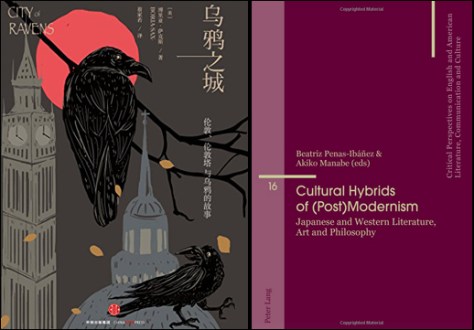 Cover Art for the Chinese translation of City of Ravens (2017) and for Cultural Hybrids of (Post)Modernism (2017).
Dr. Christopher Loots’ article “Nada and Sunyata in ‘A Clean, Well-Lighted Place'” was published as a chapter in Cultural Hybrids of (Post)Modernism: Japanese and Western Literature, Art and Philosophy (2017), as part of the Critical Perspectives on English and American Literature, Communication and Culture series. The book is edited by Beatriz Penas-Ibáñez and Akiko Manabe.
Dr. Sean Dugan, who has long had an interest in so-called “mid-brow” literature and media and popular culture, recently presented his research on Edna Ferber, Calder Willingham, and the Earle Stanley Gardener character Perry Mason as represented in the TV series at the South Atlantic MLA (SAMLA) conference as well as the College English Association conference. He is currently working on a paper for SAMLA 2017 on TV Noir and The Twilight Zone episode “Perchance to Dream” by Charles Beaumont. He continues to do research into his other field of interest, linguistics, and in particular accent perception, English grammar, and syntax (some of which he will apply in the 2017-18 year as a Faculty Fellow working with Dr. Miriam Ford of the Mercy College Nursing Dept. on reading comprehension and fluency in first year college students). Dr. Dugan regularly teaches MA courses on Irish Literature, Henry James and D.H. Lawrence, Composition, and Narrative Strategy.
Recent MA Student Achievements and Activity
I’d like to take a moment here as July turns into August, as our summer semester comes to an end and we begin looking to the fall semester and the new school year, to congratulate some of our program’s alumni and current students on various achievements and related scholarly activities.
First we’ve had a number of MA students and alumni gain acceptance into doctoral and MFA programs over the past year:
- Amy Lou Ahava (MA 2015) was accepted into the PhD program at Marquette University.
- Angie Still (MA 2014) was accepted into multiple PhD programs and of them plans to attend the PhD program at Texas Woman’s University.
- Krystal Johnson (MA 2015) was accepted into the doctoral program at St. John’s Fisher College.
- Gloria Buckley (active student, MA 2018) was accepted into the Savannah College of Art and Design (SCAD) MFA creative writing program and also into the Faulkner University doctoral program.
Again, congratulations! I’m always hoping to hear from all of our alumni and active students about any such news or accomplishments, and hope that anyone with anything to share will contact me at cloots@mercy.edu. We want our grad students and alumni to stay in touch and keep us updated on your doings, and hope that you all always will.
Of course moving on from the MA to a subsequent degree isn’t everyone’s goal. Many of our grad students are here for the MA as the end-goal in and of itself. I talk about some of the reasons the MA is a good degree in and of itself, and of the doors that the MA alone might open for you in last year’s annual welcome letter. Many of you, particularly our active secondary-school teachers, know that the MA degree on its own can be critically important for aspects of your job.
But for those who do see the MA degree as one step in a path toward a future doctoral or MFA program, I hope that you will find inspiring this news of the success of some of our students.
Now then! For grad students who aspire to doctoral study and particularly for those who hope to eventually secure some sort of college professorship, you may want to start thinking now about the scholarship section of your CV and start engaging, as much as you like and want, in the professional flow of the academic field. You don’t have to at this point: PhD programs are where you really would start getting serious about this stuff, not MA programs. But again, you may want to start at l east thinking about this while you’re here in the MA program. The “stuff” I’m talking about is attending and ultimately reading papers at conventions, conferences or symposiums. If that sounds like fun, well read on. If it sounds like something you’d rather not bother with or think about at this point in your studies, no worries.
One easy and very low-stakes way to get involved in such professional practice is to participate in our MA program symposium at the end of each school year (in May). But academic events are taking place all year round, some almost certainly within reasonable travel distance of wherever you’re living and reading this right now. The main place where English students and faculty find out about such upcoming events, and try to get involved in ones that look interesting, is UPenn’s “Call for Papers” (CFP) bulletin board linked here.
In recent exchanges with current MA student Lynn Whitehead I learned about a flurry of such activity that she’s been involved with this summer: from attending F. Scott Fitzgerald scholar Anne Margaret Daniel’s book reading in Woodstock NY, to listening to various presentations at the American Lit. Association (ALA) annual conference in Boston, to attending the annual F. Scott Fitzgerald Society Conference in Minnesota. Lynn took the time at each event to seek out and discuss ideas with various presenters, and as a result has made a number of helpful contacts. Several scholars she spoke with encouraged her to take the next step up from attending conferences and to present at conferences, and she’s already putting together proposals to do just that.
I share with you Lynn’s activities this spring and summer as an example of how any student in the program can (and if you aspire toward a doctoral program and/or professorship should) get involved in the professional current of our English field. You can do this no matter where you live in the world: start by seeking out conferences within a reasonable drive and just go and attend them. Make a day or weekend trip out of it. See how it goes, listen to panels, get a sense of what it’s like to be at a conference. Don’t be afraid to chat with people around you. Then check out the Upenn CFP page linked above and, look for CFPs that are in the area of your interests, and send out some paper proposals. Eventually something will work out and you’ll find yourself a part of a presentation panel at a conference.
So once again congrats Amy, Angie, Krystal, Gloria, Lynn, and everyone else in the program who’s been up to something similar but just hasn’t told me about it (in which case TELL me about it so I can share it in a future blog post!).
Reading Lists for (some) Fall 2017 MA Courses
Below are some of the books/materials which professors have settled on for their fall 2017 MA courses. I will update this as frequently as possible, as I hear from the respective profs. You can always see the official book orders which professors have entered by going to the Mercy College online bookstore. At the store you would click to shop for books; then from the pull down menus select Fall Sem 2017, then ENGL, then whatever is the course number. Just to be clear, you do not have to purchase your books through our online bookstore and typically you can find any of your required readings for cheaper through Alibris.
ENGL 500, Theory & Practice of Literary Criticism (Dr. Reissig-Vasile)
- Bressler, Charles. Literary Criticism: An Introduction to Theory and Practice (5th Edition). Pearson, 2011. ISBN 10: 020521214X
Also, students in 500 will read and discuss some of the following texts, for which links will be provided during the semester in the class (so you don’t need to go buy the texts listed below, and you won’t necessarily end up reading all of these–students will choose to focus on some of these in a process the professor will describe at the start of the semester):
Classical Theory and Criticism: Plato, Republic (books II, III, VII, or X); Aristotle, Poetics; Plotinus, Enneads (the Fifth Ennead, Eighth Tractate)
Medieval Theory and Criticism: Dante Alighieri, Letter to Can Grande della Scala
Renaissance Theory and Criticism: Sir Philip Sidney, An Apology for Poetry
Enlightenment Theory and Criticism: John Dryden, An Essay of Dramatic Poesy; Joseph Addison, Spectator essays; Alexander Pope, Essay on Criticism
Romantic Theory and Criticism: William Wordsworth, preface to Lyrical Ballads
Victorian Theory and Criticism: Matthew Arnold, The Function of Criticism at the Present Time; Henry James, The Art of Fiction
Russian Formalism and New Criticism: Cleanth Brooks, The Formalist Critics and Well-Wrought Urn
Reader-Oriented Criticism: Louise Rosenblatt, Writing and Reading: The Transactional Theory
Modernity/Postmodernism, Structuralism/Poststructuralism/Deconstruction: Jonathan Cullen, What is Literature and Does it Matter?; Roland Barthes, Rhetoric of the Image and The Death of the Author; Jacques Derrida, Structure, Sign and Play in the Discourse of the Human Sciences
Psychoanalytic Literary Criticism: Julia Kristeva, Revolution in Poetic Language
Feminist Literary Criticism: Sandra Gilbert and Susan Gubar, The Madwoman in the Attic; Toril Moi, Feminist, Female, Feminine
Marxist Literary Criticism: Terry Eagleton, Marxism and Literary Criticism
Cultural Poetics or New Historicism: Stephen Greenblatt, The Power of Form in the English Renaissance
Postcolonial Literary Criticism: Charles Larson, Heroic Ethnocentrism; Homi Bhabha, The Location of Culture
African-American Literary Criticism: Henry Louis Gates, Writing Race
ENGL 508, History of Drama (Dr. Fritz)
- Jacobus, Lee A., ed. The Bedford Introduction to Drama. (7th edition). NY: Bedford, 2012. ISBN: 9781457606328
ENGL 526, Modernism (Dr. Sax)
- Descartes, René. Discourse on Method and the Meditations. Trans. Sutcliffe, F. E. New York: Penguin, 1968. 0140442065
- Eliot, T. S. The Waste Land, Prufrock and Other Poems. Mineola, NY: Dover, 1998. ISBN: 0486400611.
- Richard Humphreys, ed. Futurist Manifestos. Boston: Museum of Fine Arts, 2001. ISBN: 9780878466276.
- Joyce, James. Dubliners. New York: Bantam, 1990. ISBN: 1553213806.
- Latour, Bruno. We Have Never Been Modern. Trans. Porter, Catherine. Cambridge, MA: Harvard UP, 1993. ISBN: 0674948394.
- Lyotard, Jean-Francois. The Postmodern Condition: A Report on Knowledge, trans. Brian Massumi. Minneapolis: U. of Minnesota Press, 1984. ISBN: 0-8166-1173-4.
- In addition to the readings, Students should watch at least segments four through six of the series “This is Modern Art” by Matthew Collins, which is available free on Youtube at: https://www.youtube.com/watch?v=eUxwuNw4oIE
ENGL 544 Frontiers of American Lit. – Cyberpunk/Tech-Noir (Dr. Loots)
- Ready Player One by Ernest Cline. Broadway Books, 2012. ISBN-13: 9780307887443
- The Circle by Dave Eggers. Vintage, 2014. ISBN-13: 9780345807298
- Neuromancer, by William Gibson. Ace Science Fiction, 2000. ISBN-13: 9780441007462.
- Trouble and Her Friends by Melissa Scott. Orb, 2011. ISBN-13: 9780765328489 (possibly out of print but still widely available used through online places like Alibris)
- Snow Crash by Neal Stephenson. Del Rey, 2000. ISBN-13: 9780553380958
- Additional short stories, essays, and media will be linked or provided during the semester as PDFs. Some units will focus on visual media that could include movies or shows which students will be responsible for securing and watching (whether from a Netflix or Amazon video subscription, or by getting copies of the media from local libraries, etc.).
Recommended further reading for those interested in pursuing the course topic beyond the virtual walls of the classroom (again, not required for the semester):
- Akira (Vol. I), by Katsuhiro Otomo. Kodansha Comics, 2009. ISBN-13: 9781935429005
- Do Androids Dream of Electric Sheep, by Philip K. Dick. Del Rey, 1996. ISBN: 0345404475.
- Ghost in the Shell (Vol. I), by Shiro Masamune. Kodansha Comics, 2009.
- Synners, by Pat Cadigan. SF Masterworks Series, Gollancz, 2012.
Readings for the other classes will be listed once the professors finalize their lists.
Summer Session Starts on Wednesday May 31
Just a reminder here to anyone opting to take coursework over the summer: the summer session begins Wednesday May 31. Make sure to check into your Blackboard sections on the 31st to see what’s in store for the summer and to get going on the first week of studies.
Summer session is an optional semester (as opposed to the fall and spring semesters, during which MA students are required to maintain matriculation unless taking leave from the program).
Wrap-Up: W.I.T (Writing Image Text) 2017 MA English Symposium
This past Tuesday 5/16 we held our 2017 W.I.T. graduate English program symposium here in Maher Hall on our Dobbs Ferry campus. It was a lot of fun, and the audience got to hear a number of scholarly and creative works by graduate students and faculty.
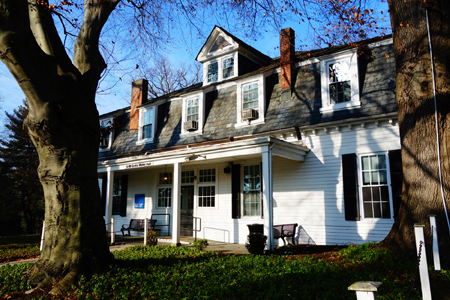
Maher Hall: home of the undergraduate and graduate English programs, English faculty offices, and the office of the Dean of the School of Liberal Arts; location of the graduate English symposium.
For our first panel three graduate students presented scholarly work. Gloria Buckley read her piece titled “Virginia Woolf’s Orlando: A Landscape Love Story Transcending All Borders,” in which she discussed the love and relationship of Virginia Woolf and Vita Sackville-West as bespoken by Orlando. Lynn Leibowitz-Whitehead presented “Hemingway, ‘The Greatest Writer of His Time’; With a Little Help from His Friends: An Examination of Fitzgerald’s Influence on Hemingway’s Writing Career.” Lynn’s study traced out some of the ways that Hemingway’s success was resultant from invaluable support of others, support which Hemingway tried to obscure and erase after gaining fame. Matthew Christoff then presented his study “Symbolism in the Sierra Morena Mountains” in which he unpacked the deep relevance of events taking place in those mountains to understanding the meanings within Cervantes’ Don Quixote.
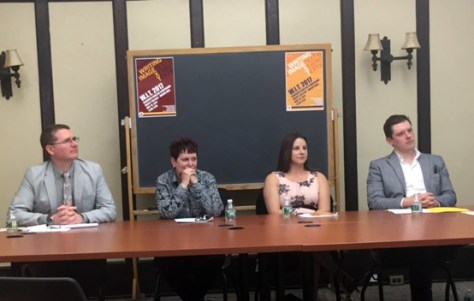
The first panel, left to right: Dr. Christopher Loots (moderator); Gloria Buckley, Lynn Leibowitz-Whitehead, Matthew Christoff.
For our second panel MA program alumna and current Mercy adjunct professor Carol Mitchell was joined by the Chair of the Dept. of Literature & Language, Dr. Celia Reissig-Vasile, and the Head of Undergrad English, Dr. Kristen Keckler, for a panel of creative non-fiction presentations. Carol read her work “On the Car Radio” in which she reflected movingly on her youth, family, father, and the passing of these things through the nodal points of songs heard on the car radio when young. Dr. Keckler then read her piece “Mixology, Metaphor, and Memory: What Bartending Taught Me about Writing,” in which she sounded out the (often hilarious) resonance between life behind the bar and life behind the the pen. Dr. Reissig-Vasile then concluded the panel by reading from her work “Where Oblivion Shall not Dwell,” as published in the collection Home: An Imagined Landscape. Dr. Reissig-Vasile’s piece involved stories of her experiences with movement, emigration, and all around change; with some of the many different referents for “home” that she’s known through her life.
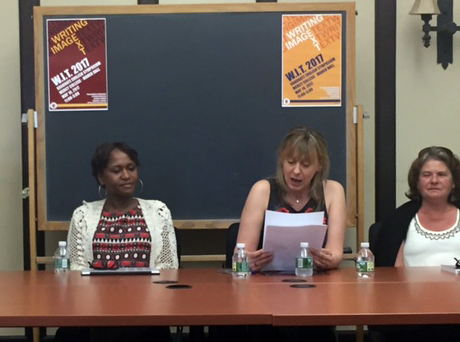
The second panel, left to right: Carol Mitchell, Dr. Kristen Keckler, Dr. Celia Reissig-Vasile.
The Dean of the School of Liberal Arts Dr. Tamara Jhashi attended, as did the Associate Dean Dr. Richard Medoff and several other faculty members both from within the program (Dr. Sean Dugan, Dr. Boria Sax) and from other programs (Dr. Saul Fisher). Graduate students Tara Farber and Lynne Fortunado attended as well, and some friends/family of the presenters were present too. Overall the event evidenced high-quality scholarship and writing, and the presentations engendered much thought and good collegial conversation. On the practical side our presenters earned a line-item to include on the scholarship section of their CV which is an essential pursuit for anyone seeking a PhD or other professional path in higher education beyond the MA program.
Thank you to everyone who attended. I look forward to seeing some/all of you again next year for the 2018 symposium, and encourage anyone who wasn’t there this year to consider attending in 2018 whether to present, or simply to gather with others from your scholarly community.
2017 Thesis of the Year Award
The winner of the 2017 Thesis of the Year award is Kate Oscarson for her paper “What’s so Super about Superman? Heroes and the Quest for Perfection.” All theses completed for ENGL 599 Master’s Thesis Tutorial courses during the summer and fall of 2016 and spring of 2017 were eligible for the Thesis of the Year title this year. The final paper is selected by program faculty who have no thesis students’ papers in the running, and who read over drafts of papers from which the authors’ names as well as mentor’s names have been removed. The award allows the student to list this honor on her or his curriculum vitae (CV). A thesis of the year award is something common to MA English programs and does hold weight on a CV, particularly if a person applies to PhD programs or to jobs within the field. So congratulations, Kate! We will begin a new cycle of consideration starting this summer.
2017 W.I.T. English Symposium Update
Hi all, just a reminder that in less than a month the MA Program will be hosting the 2017 Writing Image Text (W.I.T) English symposium here in Maher Hall on the Dobbs Ferry campus. Last year’s symposium was a good time all around. This year like last year we’ve got four grad students committed to presenting (Gloria Buckley, Matthew Christoff, Lynn Leibowitz-Whitehead, and Jenelle Luckey). We have a few more grad students who may or may not attend and present depending on other factors. Dr. Keckler plans to be there and to share some of her creative writing. Other professors might read or share something too. I’ll be moderating the event. I imagine a number of other faculty members and even perhaps the Dean might attend just for fun. Without further ado, here is the new very orange poster for the event:


