Category Archives: Annual Grad Student Symposium

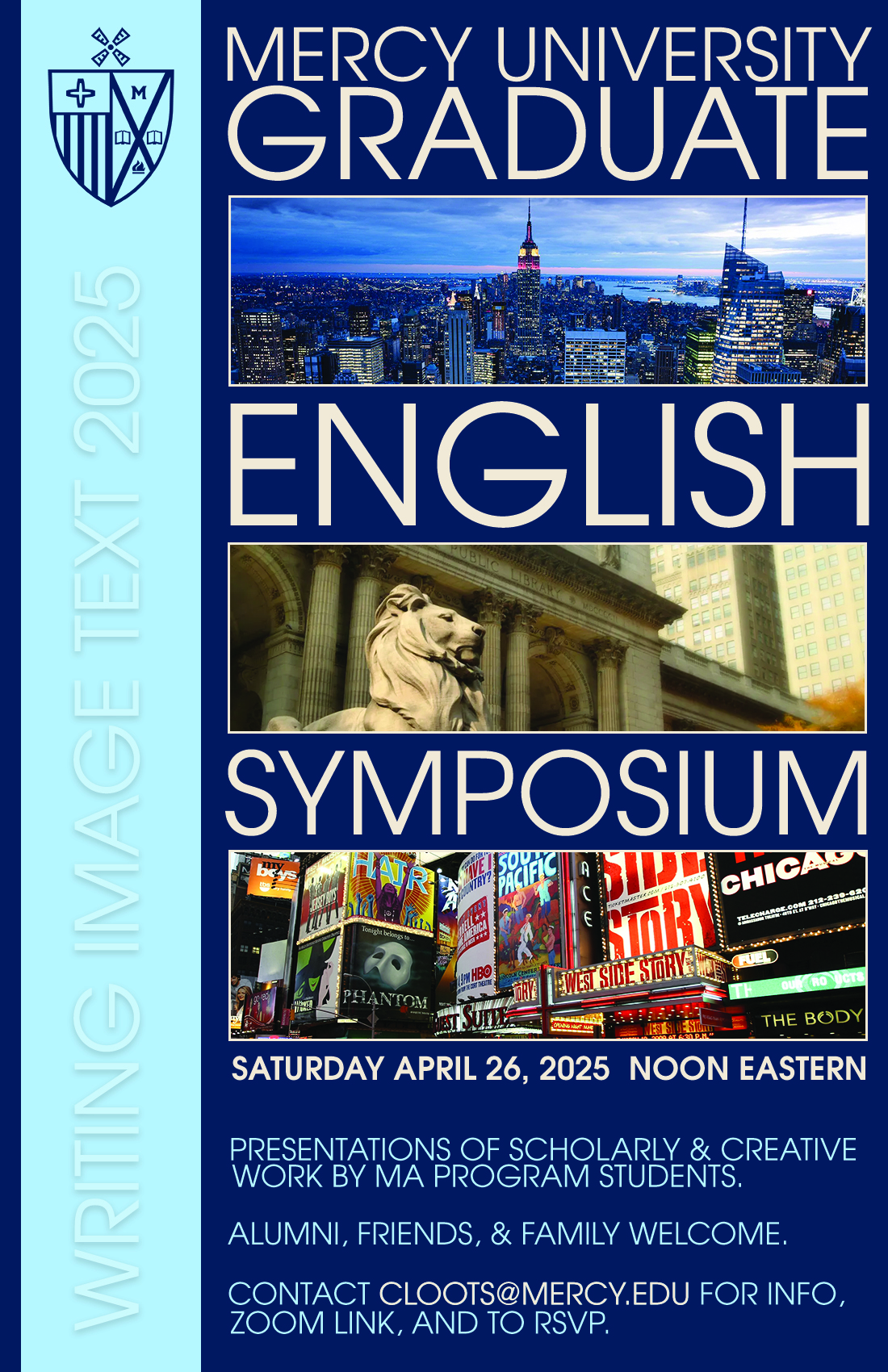
Presenters Needed! 2025 Grad English Symposium, Live Online Saturday April 26, Noon Eastern.

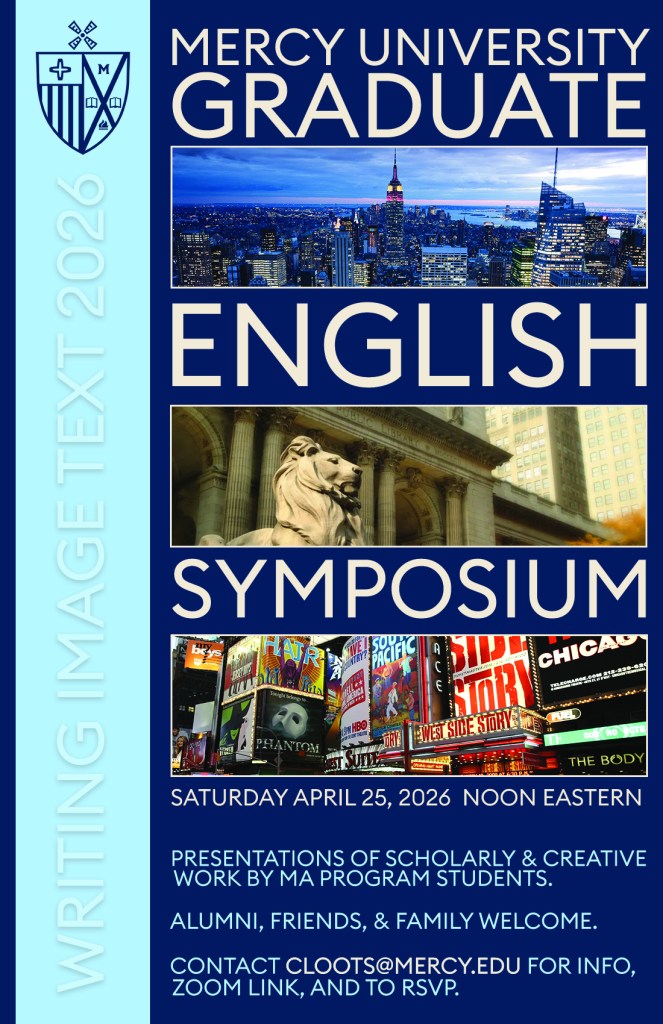
We’re still hoping for more grad students to step forward to present at this year’s “Writing / Image / Text” Graduate English Symposium, so please consider sharing something of your work (e.g. scholarly or creative writing) at the event on Zoom, at noon eastern, April 26. Also consider that the thematic title of the symposium, Writing / Image / Text, invites work that goes beyond just literary scholarship or creative writing. We’ve had students present visual-storytelling, have had students present analysis of video games, have had students present studies of visual and studio arts, and more. Anything in the world that can be analyzed and that involves, invites, or even requires interpretation to understand is a text, and so practically any sort of study of any sort of text is welcome and encouraged.

Presenting at events like this is an important step for anyone hoping to step into the profession of higher education in any way, including those who aspire to a PhD program. Beyond that, it’s also a community event, a collegial event, an event where people who appreciate ideas, literature, creativity, media, and the arts in general, can get together for a few hours and enjoy a thoughtful exchange of ideas. So, please consider stepping forward and presenting something of your work alongside your fellow grad-students.

Please write to cloots@mercy.edu asap if you will step forward to present something of your work, or if you have any questions. Those who want to attend but not present are certainly welcome and encouraged to do so too; and again, just write to cloots@mercy.edu to let me know if so. Thank you.

2025 Grad English Symposium; Live Online Saturday April 26, Noon Eastern

On Saturday April 26 the MA program will be hosting its annual “Writing Image Text” or “W.I.T.” Graduate English Symposium. The event will be held on Zoom. We will begin at noon, eastern time. The length of the event will depend on how many of our grad students will present, but usually it runs for a few hours.

This call for papers (CFP) is limited to current students in the program. Active students who want to attend but not present, as well as alumni, prospective students, faculty, family, guests, etc., are all very welcome and encouraged to attend as audience members. The deadline for responding to this CFP and declaring as a presenter is the end of Saturday, April 5.

The symposium is a casual mini-conference at which active MA English students present scholarly or creative work. A paper or project that you’ve created for any of your MA courses would do just fine. Full instructions and guidance for presenting will be shared with presenters after April 5. The symposium is also a community event at which you might see/meet fellow grad students, program professors, alumni, and others in the MA community.

Graduate students and professional scholars often attend and read at local, regional, national, and international conferences, so this symposium provides a friendly small-scale introduction to the conference experience. And for anyone who reads a paper, it becomes a line-item that you can list under the scholarship section on your CV (click here to read more about the CV).

Anyone planning to attend this year’s WIT symposium, as presenter or audience member, please indicate as much by sending an email to cloots@mercy.edu no later than the end of Saturday, April 5. And please use the subject line “WIT Symposium 2025” for your email. Zoom info will be sent out after April 5 to everyone who RSVPs.

You can read about some of our previous symposiums on the blog here, as well as here, here, here, and here. On behalf of the MA faculty: we hope to see you all there! Please contact cloots@mercy.edu if you have any questions about any of this.

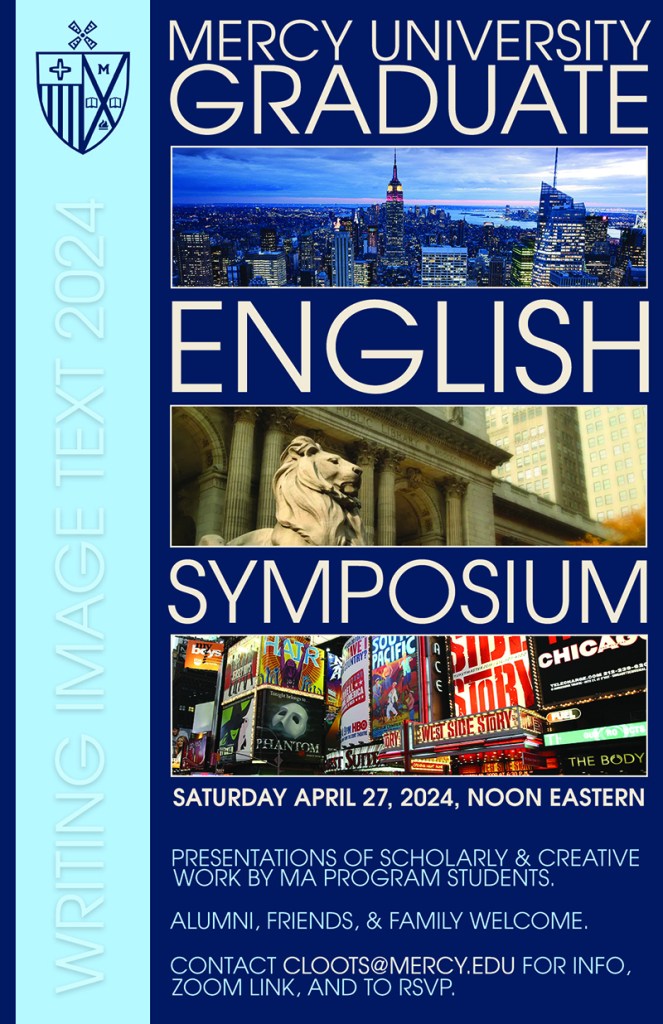
2024 Grad English Symposium; Live Online Saturday April 27, Noon Eastern

On Saturday April 27 the MA program will be hosting its annual “Writing Image Text” or “W.I.T.” Graduate English Symposium. The event will be held on Zoom. We will begin at noon, eastern time. The length of the event will depend on how many of our grad students will present, but usually it runs for a few hours.

This call for papers (CFP) is limited to current students in the program. Active students who want to attend but not present, as well as alumni, prospective students, faculty, family, guests, etc., are all very welcome and encouraged to attend as audience members. The deadline for responding to this CFP and declaring as a presenter is the end of Saturday, April 6.

The symposium is a casual mini-conference at which active MA English students can read aloud a scholarly or creative work. A paper that you’ve written for any of your MA courses would do just fine. Full instructions and guidance for presenting will be shared with presenters after April 6. The symposium is also a community event at which you might see/meet fellow grad students, program professors, alumni, and others in the MA community.

Graduate students and professional scholars often attend and read at local, regional, national, and international conferences, so this symposium provides a friendly small-scale introduction to the conference experience. And for anyone who reads a paper, it becomes a line-item that you can list under the scholarship section on your CV (click here to read more about the CV).

Anyone planning to attend this year’s WIT symposium, as presenter or audience member, please indicate as much by sending an email to cloots@mercy.edu no later than the end of Saturday, April 6. And please use the subject line “WIT Symposium 2024” for your email. Zoom info will be sent out after April 6 to everyone who RSVPs.

You can read about some of our previous symposiums on the blog here, and here, and here, and here, and here. On behalf of the MA faculty: we hope to see you all there! Please contact cloots@mercy.edu if you have any questions about any of this.

Fall (and Summer) 2024 Course Offerings; Also, Preliminary Grad Student Symposium Info

First please note that the annual Graduate English Symposium will again this year be held on Zoom, in order to accommodate our students at a distance. The date hasn’t been finalized yet but it will likely be near the end of April, and likely on a Saturday. A post with further information and details, including the call for presenters, will be coming soon, so stay tuned to this blog for more on that.

The fall (and summer) 2024 schedules will be appearing soon in Mercy Connect. Many of our students don’t take summer courses, whereas all of our students take fall and spring courses, which is why I’m privileging fall here in my phrasing. It’s also why we offer just a few summer courses. Fall and summer registration will open for veterans on Monday, March 11. General registration will open for all students on Monday, March 18. Registration normally opens at or around 9am, eastern (it begins when the Registrar’s Office opens and they activate the reg system).

Specific book info will be coming later, and some of these descriptions will change as professors refine their courses over the months ahead.

The five fall 2024 course offerings are:

  • ENGL 500 Theory and Practice of Lit Criticism1 (Dr. Kilpatrick)

An introduction to some of the major movements and figures of the theory of criticism. The question “what is literature?” is a primary concern of this course. Such an inquiry necessarily engages other, closely affiliated signifiers such as work/text, writing, reading, interpretation, and signification itself. After brief encounters with ancient antecedents and seminal moderns, influential contemporary approaches to the question concerning literature and its cultural significance are engaged. An assessment of the relative strengths and weaknesses of current trends in the practice of literary criticism, and their theoretical groundwork, is the ultimate objective of this course. Fulfills the requirement for ENGL 500.

  • ENGL 505 Transformations of the Epic (Dr. Sax)

This course is based on the conception of the epic as an encyclopedic narrative of substantial length featuring a central figure who reflects the values of a particular culture. It will proceed chronologically, studying the taxonomy and transformations of the epic, from its earliest Classical manifestations, through its emergence in Medieval and Renaissance texts, to its incorporation after the Renaissance into modern writing. Fulfills the Writing & Literary Forms requirement or an elective.

  • ENGL 525 Victorian Age in Literature (Dr. Dugan)

If one were asked to define the timeline of Victorian literature, one might be hard-pressed to do so. As literary genres are fluid, it is hard to determine when the Romantic Period ends and the Victorian Period begins; and when the Victorian Period ends and Modernism begins. Whatever the dates, a defining characteristic of Victorian England would be change, change matched with a belief in progress: societal, religious, economic, and artistic. While some benefited from these changes, others did not. The semester we will look closely, through Victorian literature, at issues that challenge the notions of change and progress, notably the role of women, industrialism, gender roles, and poverty as shown in fiction, poetry, and drama of the Victorian age. Fulfills a Literature Group 1 requirement or an elective.

  • ENGL 543 American Renaissance (Dr. Loots)

This course will study representative American writings from “The American Renaissance,” a period during the mid-nineteenth century (roughly 1832 to 1865) which saw the rise of the first truly non-Colonial, non-Revolutionary body of national literature; a literature which no longer concerned itself with European precedent, engagement, or approval. When F.O. Matthiessen coined the term “The American Renaissance” in 1941 he did so in light of five monumental American works by five different writers, all produced within five years (1850-55): Emerson (Representative Men), Thoreau (Walden), Melville (Moby Dick), Hawthorne (The Scarlet Letter), and Whitman (Leaves of Grass). Since Matthiessen’s time the notion of an American Renaissance has expanded to encompass a greater diversity of representative works, writers, and perspectives from this era. In this course we’ll study selections from across the American Renaissance, most likely engaging works by: Harriett Jacobs; Frederick Douglass; Harriet Beecher Stowe; Frances Harper; Sojourner Truth; Margaret Fuller; Sara Willis (Fanny Fern); as well as Emerson, Thoreau, Whitman and Melville.  Fulfills a Literature Group 2 requirement or works as an elective.

  • ENGL 560 Tilting at Windmills: Riding with Don Quixote and Sancho Panza though 16th century Spain2 (Dr. Reissig-Vasile) [Note: if you use the Mercy schedule-planning tool, the title for 560 will show as “Topics in American Literature.” Ignore that title, it’s just a generic place-holder title in the planning tool. The real title is the one in Mercy Connect, Tilting at Windows]

It is often said that the long and tangled history of the modern novel begins in Europe, and it begins with Cervantes.  Through a close reading and analysis of Cervantes’ literary masterpiece, Don Quixote de la Mancha (which many readers, including many authors, consider to be among the greatest works ever written), we will explore this issue and many others.  The course will focus on questions of literary, linguistic, cultural, and historical heterogeneity in Don Quixote. We will seek to understand why so many celebrate Cervantes for teaching us “to comprehend the world as a question.”  We will explore the polemics of 16th century Spain and how Cervantes used Don Quixote to raise ethical issues relevant to his time. Fulfills a Literature Group 2 requirement or works as an elective.

And for those nearing the end of the program, note that ENGL 599 Master’s Thesis is a one-on-one tutorial that needs to be taken during your final semester. You don’t enroll in 599 as you do a normal class. Check out this page on the blog for more about 599 and how you enroll in it.

The two summer 2024 course offerings are:

  • 509 Perspectives on the Essay (Dr. Keckler)

[Updated description 2/26] The course will study of the essay as a distinct literary genre; its characteristics, types, and structures; its history; and its role in reflecting authorial consciousness. This course will focus in particular on the personal essay and sub-genres such as nature writing, cultural criticism, travel writing, and academic-personal essay hybrid forms. Fulfills the Writing & Literary Forms requirement or an elective; can work in other ways, as needed, for the degree, by request.

  • 540 Monsters2 (Dr. Dugan)

In this course we will read classic and contemporary literary works to explore notions of monsters and monstrosities from the perspectives of the monster and the creator. Historical, societal, political, and cultural issues will be explored and addressed. Types of monsters and monstrosities will also be considered: e.g. human, beast, and scientific. Fulfills a Literature Group 1 field requirement or an elective by default; can work in other ways, as needed, for the degree, by request.


1 ENGL 500 runs once a year, in the fall, and because it’s a requirement for the MA degree seats are locked and reserved for students who are on track to graduate prior to fall 2025. Students who have not taken it already, and are on track to graduate prior to fall 2025, can get a seat by contacting the program director at cloots@mercy.edu. Students who are on track to graduate in fall 2025 or later can still contact the program director requesting a seat in the fall 2024 instance, but will be prioritized behind students who must have the course this fall to graduate on time.

2 ENGL 540 and 560 are numbers by which we run a variety of new or experimental coursework. Students can take multiple instances of ENGL 540 and 560, as long as they’re not taking the same course with the same title twice. So for example a student who took 540 Fairy Tales last summer can take 540 Monsters this summer because those are different courses, even though they both use the 540 number; likewise, students who took 560 African and Caribbean Lit last fall can take 560 Tilting at Windmills this fall.

Year-End Events and Honors: Symposium, Student Awards, and Commencement

We’ve reached the end of another academic year, which means it’s symposium season, awards season, and commencement season!

For our annual Graduate Student Symposium this past April, a good number of students, faculty, friends, family, and others in the graduate English community gathered on zoom to hear scholarly presentations from Abigail Collopy, Rayne Dolton, and Adrianne Gunter. Interpretations and insights were expressed; ideas were discussed; and much camaraderie and collegiality was had. Presenters earned a valuable line-item to list in the scholarship section of their curriculum vitae. The graduate faculty encourage all of our students to share some of your writing and ideas at next year’s symposium, which will likely be in late April 2024. Ask any of your professors or the Program Director about doing so, if you have any questions or need some guidance.

Three students were recognized recently for program year-end honors. The first of these honors is the Graduate English Christie Bowl, named for the late Joannes Christie who established and long chaired Mercy College’s English Program. The award, determined by the collective graduate faculty, recognizes one graduating student for their consistent academic excellence and classroom performance throughout their time in the graduate program, their other contributions to the program’s scholarly learning community, and their relevant accomplishments beyond the program’s coursework.

  • The winner of the 2023 Graduate English Christie Bowl is Tim Brosnan 

Next is the Howard Canaan Thesis Award for Innovation. This award honors the late Dr. Canaan, a long-time and highly-esteemed professor of English at Mercy College who (among many other things) taught Shakespeare and Science Fiction, and advocated that the latter could be as meaningful an area of study, could be as “literary” and as significant, as the former. This award recognizes a thesis that does one or some of the following: approaches literary analysis in a unique, unexpected, or unusual way; reconsiders and otherwise treats with dignity genre fiction; or involves interdisciplinary studies.

  • The winner of the 2023 Howard Canaan Thesis Award for Innovation is Casi Kapadia for her study “Fashion Statements: Fashion in Literature as a Social Mechanism in the Formation of Identity”

Finally, we have the Thesis of the Year Award. Selecting one study for this award, as much as for any of the other awards, is always extraordinarily difficult, as thesis students across the program regularly create excellent studies that are each worthy in their own right. The paper receiving this distinction stood out in all respects.

  • The winner of the 2023 Thesis of the Year Award is Selana Scott for her study “Ulysses’ Bloom; The Embodiment of the Mechanisms and Benefits of an Internal Locus Of Control Mindset”

It is always a strange thing to announce such distinctions as when doing so one can’t help but think of the marvelous students and studies that are not the ones named. Again, it is extraordinarily difficult for faculty judges to locate any single person to honor for any of these awards out of the many exceptional students graduating each year from our program and the college overall. So as we recognize these honorees let us please also recognize all members of the graduating MA class of 2022-23 for their hard work and dedication that has gotten them to this moment of completing their MA degree in English Literature.

One last program-relevant thing to mention here is that for Mercy College’s School of Liberal Arts commencement ceremony, held last week on the western athletic field of the Dobbs Ferry campus (the 100-yard event tent is pictured below), the college selected one of our own to deliver the graduate-student commencement address: Tim Brosnan. Tim gave a wonderful speech in which he expressed many of things that he cherished most about his time in the graduate program, as well as his appreciation for many of the individual faculty with whom he studied during his time in the program. It was a heartening and laudable finish to the year.

Cheers to everyone in the MA English Literature program, to our alumni, and to all of your family and friends. Congratulations to our graduating class of 2022-23. Onward we go!

Reminder: 2023 Symposium is live-online, April 29; RSVP and CFP deadline extended to Friday 4/14

In hopes of gathering more attendance for this year’s Graduate English Symposium, which will be online/on zoom on Saturday 4/29 starting at noon eastern, we’ve extended the deadline for declaring as a presenter or audience member to this coming Friday 4/14. If anyone has any questions, or would like to present, or attend, please write to cloots@mercy.edu by the end of Friday 4/29. Thank you.

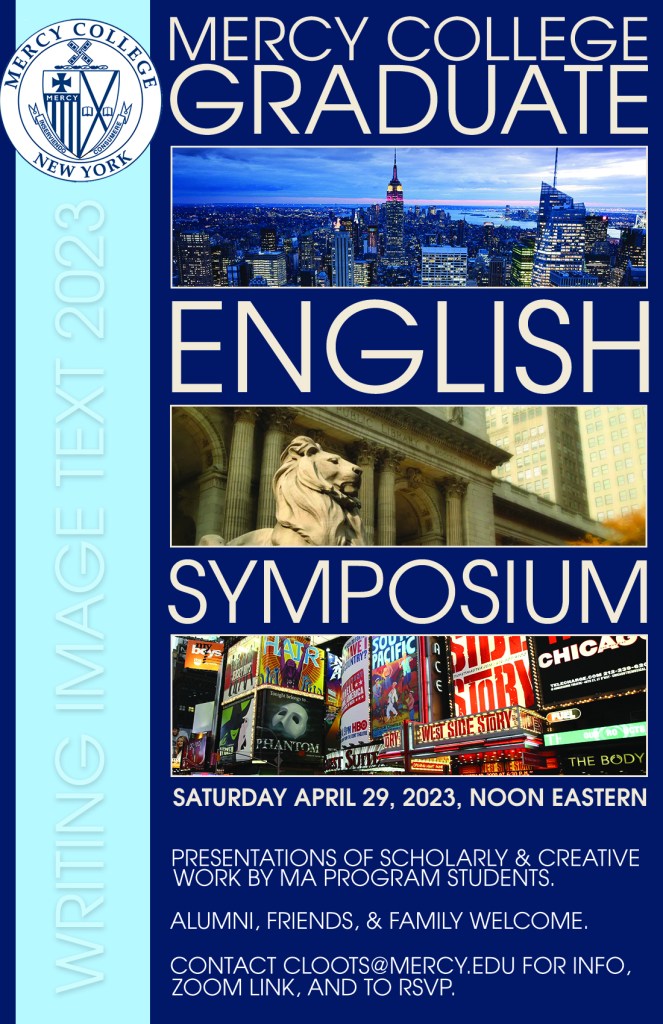
2023 GRADUATE ENGLISH SYMPOSIUM; LIVE ONLINE SATURDAY APRIL 29; CFP DEADLINE APRIL 8

On Saturday April 29 the MA program will be hosting its annual “Writing Image Text” or “W.I.T.” Graduate English Symposium. The event will be held live online through Zoom. We will begin at noon, eastern time. The event will likely run for three hours, or so, but the end-time will only come into focus once we know how many MA students will be presenting.

This call for papers (CFP) is limited to current students in the program. Active students who want to attend but not present, as well as alumni, prospective students, faculty, family, guests, etc., are all very welcome and encouraged to attend as audience members. The deadline for responding to this CFP and declaring as a presenter is the end of Saturday, April 8.

The symposium is a casual mini-conference at which active MA English students can read aloud a scholarly or creative work. A paper that you’ve written for any of your MA courses would do just fine. Full instructions and guidance for presenting will be shared with presenters after April 8. The symposium is also a community event at which you might see/meet fellow grad students, program professors, alumni, and others in the MA community.

Graduate students and professional scholars often attend and read at local, regional, national, and international conferences, so this symposium provides a friendly small-scale introduction to the conference experience. And for anyone who reads a paper, it becomes a line-item that you can list under the scholarship section on your CV (click here to read more about the CV).

Anyone planning to attend this year’s WIT symposium, as presenter or audience member, please let me know by sending an email no later than the end of Saturday, April 8, to cloots@mercy.edu. For all emails please use the subject line: WIT Symposium 2023. Presenters please also, in your email, let me know the title of the work you will present. I need this info in order to appropriately organize the event and create the program. I need non-presenters to RSVP as well so that I know everyone to whom I will need to send Zoom login info before 4/29.

You can read about some of our previous symposiums on the blog here, and here, and here, and here. On behalf of the MA faculty: we hope to see you all there! Please contact cloots@mercy.edu if you have any questions about any of this.

Year-End Events and Honors: Symposium, Student Awards, and Commencement

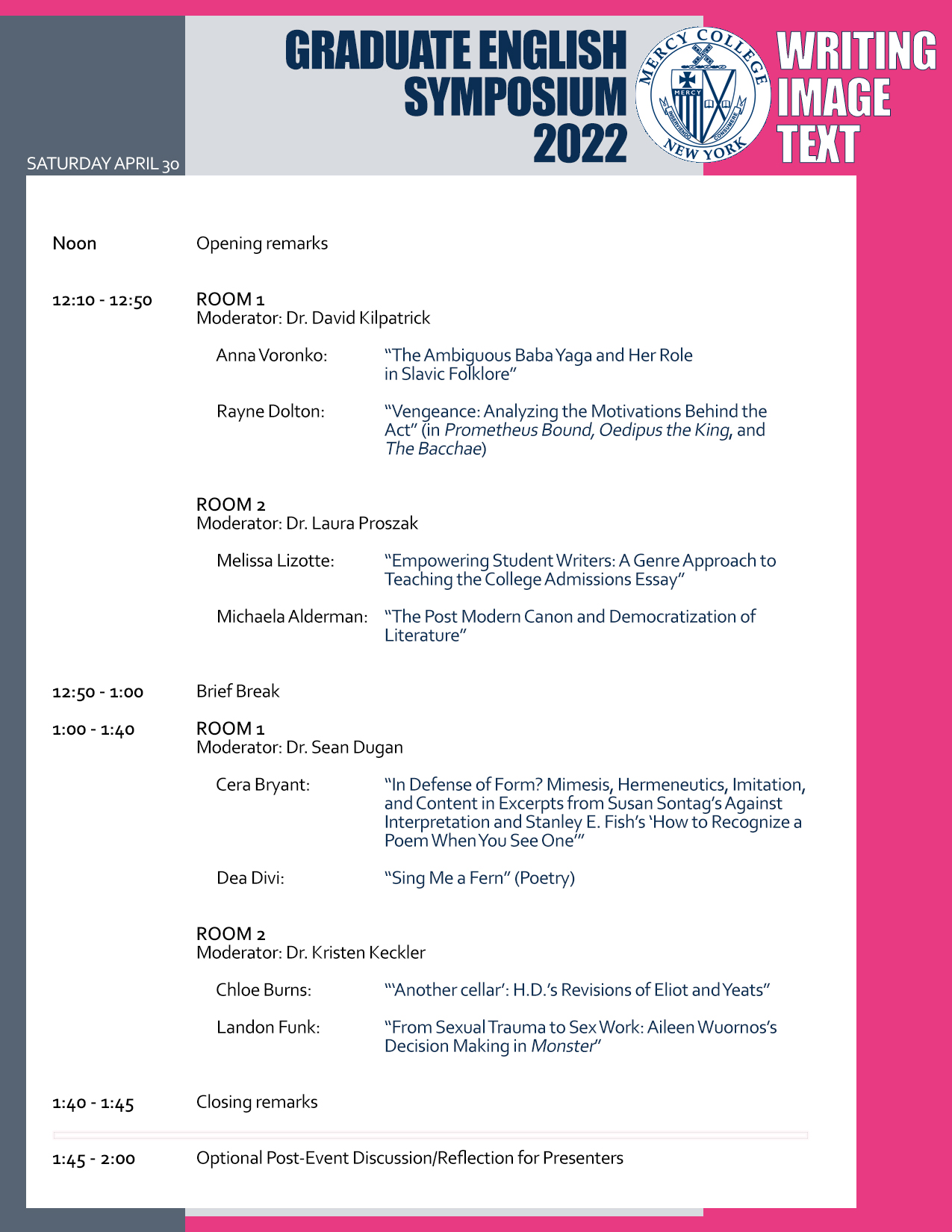
It’s the end of the academic year, which means it’s time to celebrate! One way we celebrate, as a graduate community, is with the annual graduate student symposium, which this year was held live-online at the end of April. Eight grad students presented a variety of scholarly and creative work. Four graduate faculty members moderated the different sessions. Other program faculty, and an Associate Provost of the college, were in attendance, as were a number of other active MA students and alumni. It was an interesting, idea-filled, and collegial event. Click the banner below to see the program for the event, and to get a look at the topics on which students presented:

Another way we celebrate the end of the academic year is by awarding four different program distinctions. The first of these is the Graduate English Christie Bowl, named for the late Joannes Christie who established and long chaired Mercy College’s English Program. The award, determined by the collective graduate faculty, recognizes one graduating student for their consistent academic excellence and classroom performance throughout their time in the graduate program, their other contributions to the program’s scholarly learning community, and their relevant accomplishments beyond the program.

  • The winner of the 2022 Graduate English Christie Bowl is Cera Bryant Fornataro 

Next is the Howard Canaan Thesis Award for Innovation. This award honors the late Dr. Canaan, a long-time and highly-esteemed professor of English at Mercy College who (among many other things) taught Shakespeare and Science Fiction, and advocated that the latter could be as meaningful an area of study, could be as “literary” and as significant, as the former. This award recognizes a thesis that does one or some of the following: approaches literary analysis in a unique, unexpected, or unusual way; reconsiders and otherwise treats with dignity genre fiction; or involves interdisciplinary studies.

  • The winner of the 2022 Howard Canaan Thesis Award for Innovation is John Alleman for his study “Revision and Women in a Selection of Alan Moore’s Comics”

Next we have the Thesis Award for English Studies. “English Studies” is an encompassing term that includes literary study and traditional literary pursuits but also enfolds wider practices in the field of English such as: theory, linguistics, writing, and rhetoric; inquiring into research practices, into English curriculum and canon, and into the teaching of English; exploring aspects of digital literacy; and more. This thesis award therefore recognizes an exceptional thesis that tends to the intra-disciplinary thresholds within the field of English.

  • The winner of the 2022 Thesis Award for English Studies is Melissa Lizotte for her study “Empowering Student Writers: A Genre Approach to Teaching the College Admissions Essay”

Lastly we have the overall Thesis of the Year Award. Selecting one study for this award, as much as for any of the thesis awards, is always extraordinarily difficult, as thesis students across the program regularly create excellent studies that are each worthy in their own right. The paper receiving this distinction stood out in all respects.

  • The winner of the 2022 Thesis of the Year Award is Cera Bryant Fornataro for her study “Intersectional Mysticism: Tarot, Hoodoo, Folk Magic, and the Working Conjure Woman in Select Works by Sandra Cisneros and Zora Neale Hurston.”

It is always a strange thing to announce such distinctions as when doing so one can’t help but think of the marvelous students and studies that are not the ones named. Again, it is extraordinarily difficult for faculty judges to locate any single person to honor for any of these awards out of the many exceptional students graduating each year from our program and the college overall. So as we recognize these honorees let us please also recognize all members of the graduating MA class of 2021-22 for their hard work and dedication that has gotten them to this moment of completing their MA degree in English Literature.

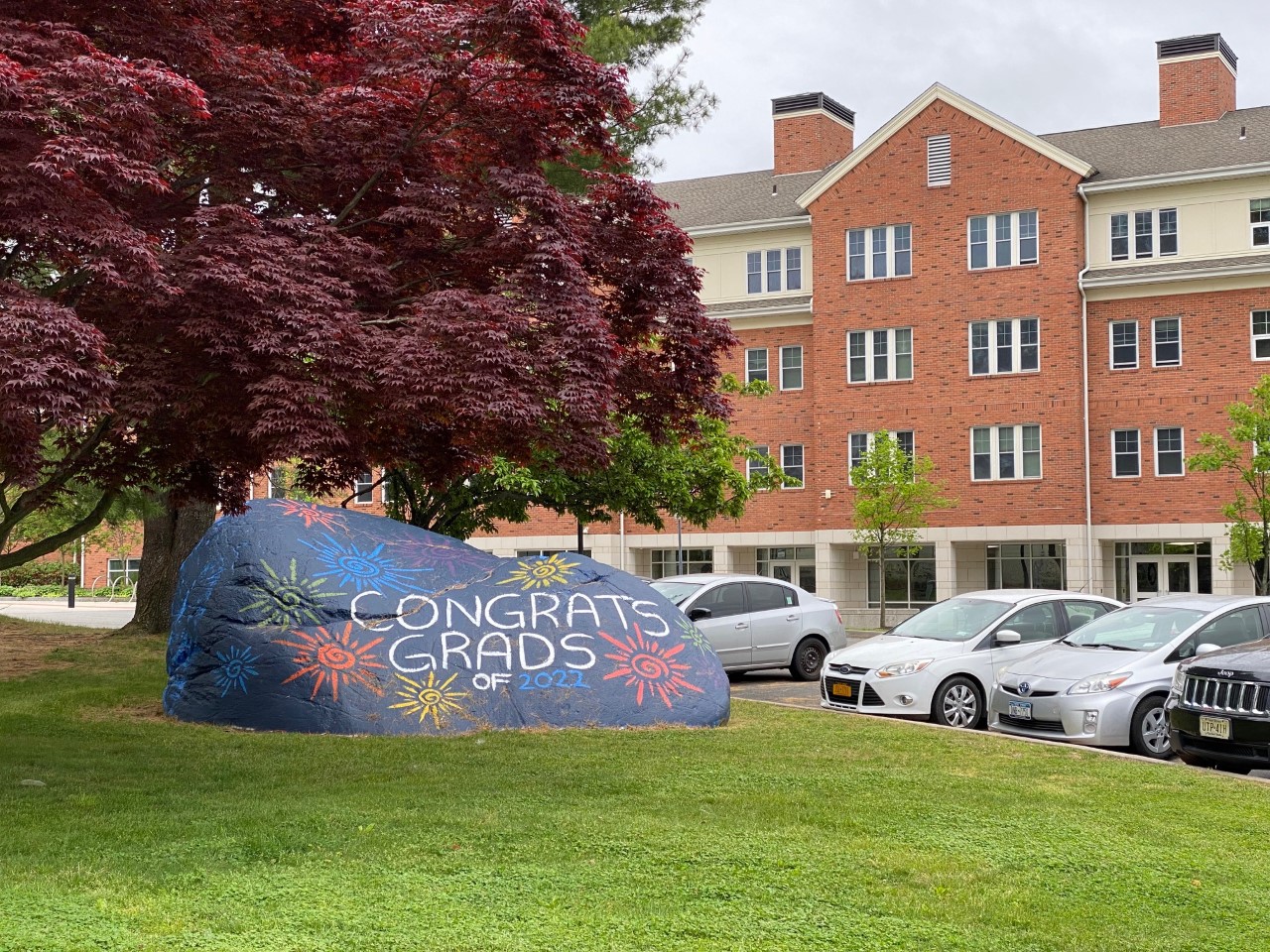
One final way we celebrate the end of the academic year is with commencement. Mercy College held five different commencements over the course of the past week, one for each of Mercy’s five schools (Liberal Arts, Health & Natural Sciences, Social & Behavioral Sciences, Education, and Business). The School of Liberal Arts, in which our MA program is housed, held commencement this past Wednesday. A good number of graduate English students were in attendance and walked in the procession. Below is a shot of the 100-yard tent on the western athletic field under which the event was held, this taken a few hours prior to the ceremony.

Cheers to everyone in the MA English Literature program, to our alumni, and to all of your family and friends. Congratulations to our graduating class of 2021-22. I hope that everyone will do something special, something nice for yourselves, to celebrate in your own way the end of the academic year, and the start of the summer. Onward!

2022 GRADUATE ENGLISH SYMPOSIUM; LIVE ONLINE SATURDAY APRIL 30; CFP DEADLINE APRIL 13

On Saturday April 30 the MA program will be hosting its annual “Writing Image Text” or “W.I.T.” Graduate English Symposium. The event will be held live online through Zoom. We will begin at noon, eastern time. The event will likely run for three or four hours (last year it ran from noon to 4pm) but the end-time will only come into focus once we know how many MA students will be presenting.

This call for papers (CFP) is limited to current students in the program. Active students who want to attend but not present, as well as Alumni, prospective students, faculty, family, guests, etc., are all welcome and encouraged to attend. The deadline for responding to this CFP and declaring as a presenter is the end of Wednesday, April 13.

The symposium is a casual mini-conference at which active MA English students can read aloud a scholarly or creative work. A paper that you’ve written for any of your MA courses will do just fine, though it might need to be edited down to a shorter length to fit into the 15 minute time-slot allotted to each presenter. Full instructions and guidance for presenting will be shared with presenters after April 13. The symposium is also a community event at which you might see/meet fellow grad students, program professors, alumni, and others in the MA community.

Graduate students and professional scholars often attend and read at local, regional, and national conferences, so this symposium provides a friendly small-scale introduction to the conference experience. And for anyone who reads a paper, it becomes a line-item you can list under the scholarship section on your CV (click here to read more about the CV). Earning line-items for the scholarship section of your CV is very important for anyone who aspires to apply to PhD programs.

Anyone planning to attend this year’s WIT symposium, presenter or not, please let me know by sending an email no later than the end of Wednesday, April 13, to cloots@mercy.edu. Presenters please also, in your email, let me know the title of the work you will present. I need this info in order to appropriately organize the event and create the program. I need non-presenters to RSVP as well so that I know everyone to whom I will need to send Zoom login info before 4/30.

I will host an optional Zoom practice session for presenters on Thursday April 21, at 2pm eastern time for anyone who wants to practice using the screenshare feature in Zoom. It’s not necessary to screenshare during a presentation; and traditionally an English conference presentation consists of a person simply reading aloud a written work while the audience listens and considers it. But screensharing visual elements (Powerpoint decks, media, images, etc.) has become more and more common in the past few years as more and more people have adapted to presenting virtually. So if you want to share your screen during your presentation, and you’re not familiar with how to do so, be sure to attend this optional practice session.

You can read about previous symposiums on the blog here, and here, and here, and here. On behalf of the MA faculty: we hope to see you there! Please contact cloots@mercy.edu if you have any questions about any of this.

YEAR-END NOTES: SYMPOSIUM IN REVIEW; PROGRAM AWARDS

The 2020-21 school year, now coming to a close, has been a strange one. Although our MA program experienced no pandemic-related curriculum disruptions due to us having long been delivering fully-online education, still each of us, student and faculty alike, had to find ways to focus on our work and studies while enduring and in many ways suffering through this global pandemic. It has been….a difficult year for everyone. Hopefully being a part of this graduate learning community, and working toward your MA degree in one another’s company, has enriched your lives and brought you some calm over this past year.

One of the ways we celebrate the end of the school year is with the Writing Image Text (W.I.T) Graduate English Symposium. This year’s symposium was held on Saturday, May 1, live online. Over twenty-five attendees made up of current graduate students, alumni, prospective students, faculty, and the Dean of the School of Liberal Arts gathered together to hear a variety of graduate student presentations. To see the event program listing the presenters and their presentation titles, click the banner below.

Good times were had. All feedback so far suggests that the presenters found the experience meaningful and invigorating. We already have presenters from this year declaring their intent to again present next year. Next year’s symposium will mix together campus-based panels with live-online panels, and this is how the format will be henceforth. The event will therefore always be accessible to all of our students and alumni, wherever you are in the world. If you can make it to the campus, though, you’ll get catered food!

Another way we celebrate the end of the school year is with the awarding of three MA English Literature program honors: the Thesis of the Year award, The Howard Canaan Thesis Award for Innovation, and the Graduate English Christie Bowl (program honoree) award.

All theses produced during an ENGL 599 thesis tutorial during the summer or fall 2020, and spring 2021, were considered for the Thesis of the Year Award. As always, selecting just one study from the group of over twenty qualified theses, each one excellent in its own unique way, was extraordinarily difficult. The final study was selected by a faculty panel with no students’ papers in the running.

  • The winner of the 2021 Thesis of the Year award is Lisa Irving for her paper: “Work It: The Black Feminist Body-Language of Missy Elliot, Janie Crawford, and the Shumalite Woman.”

The Howard Canaan Thesis Award for Innovation, now in its second year, is awarded to a thesis that does one or some of the following: approaches literary analysis in a unique, unexpected, or unusual way; reconsiders and otherwise treats with dignity genre fiction; or involves interdisciplinary studies. The award was created to honor the late Dr. Howard Canaan, who taught English literature at Mercy College for over thirty years, and who in addition to being a Shakespeare scholar was also a scholar of science fiction, and an advocate for the literary significance and value of genre fiction.

  • The winner of the 2021 Howard Canaan Thesis Award for Innovation is Kari O’Driscoll for her thesis “The Modern Witch in Contemporary Fiction: Why She Persists and Why She Matters.”

The third distinction that the MA program awards each year is the Graduate English Christie Bowl, named for the late Joannes Christie who established and long chaired Mercy College’s English Program. The award, determined by the collective graduate faculty, recognizes one graduating student for their consistent academic excellence and classroom performance throughout their time in the graduate program, their other work and contributions to the program’s scholarly learning community, and their relevant accomplishments beyond the program.

  • The winner of the 2021 Graduate English Christie Bowl is Kristen Vasquez.

It is always a strange thing to announce such distinctions as when doing so one can’t help but think of all of the marvelous students who are not the ones named. So as we recognize these honorees let us please also recognize all members of the graduating MA class of 2020-21 for their hard work and dedication. Congratulations, everyone.