Category Archives: Useful Program Info & Tips

Event of Interest, 10/28, On Zoom Or In Person: Dr. Boria Sax Speaks on “Top Secrets: Trauma, Boasting, Guilt, Fear, Anger, and the Residue of Truth”

On Friday October 28, at 2:30pm eastern, Dr. Sax will be giving a talk on “the challenges, satisfactions, and limitations of family history. ” Graduate English students and alumni are encouraged to attend whether on zoom or on campus. To attend on zoom go to https://tinyurl.com/mr4xh34a (pass is 319727, meeting ID is 986 7047 1930).

Student & Alumni Zoom Meeting, Friday 10/14, 12:45-1:30pm Eastern

All current students and alumni of the Mercy College MA in English Literature program are invited (and encouraged) to attend a Zoom meeting on Friday, 10/14, at 12:45pm eastern. The meeting will be with Dr. Jennifer Ryan-Bryant from SUNY Buffalo State. Dr. Ryan-Bryant is what’s called an “external reviewer” and she is reviewing the Mercy College MA English Lit program as a part of a greater five-year self-study process that all programs at accredited colleges/universities are required to undergo. For an external reviewer, meeting with students and alumni to hear your thoughts and feelings, whether positive or negative, about your experiences in the MA program is one of the most valuable and important parts of this process. To be clear: the external reviewer is not reviewing the students and alumni, she is reviewing the program’s faculty and curriculum, to determine if the the program is providing a substantive and effective graduate education to our students. No one can speak better to that than students and alumni.

No Mercy College faculty will be present for this, except at the very beginning when the Program Director will introduce Dr. Ryan-Bryant to the room, and then will exit the room. And although the external reviewer will include in her report some of the things she learns from this meeting, any such information will be anonymous.

To obtain the zoom link for this meeting, or if you have any questions, please contact the Program Director at cloots@mercy.edu.

We encourage all students and alumni to attend this meeting and to express yourself!

Red Hyacinth Journal: Editors Needed!

Red Hyacinth Journal is an annually published, perfect-bound literary magazine that showcases the writing and art of Mercy College students and alum. The journal’s first issue was produced in 2018 through the generosity of the family of the late Professor Valerie Lewis, a former instructor in the English program.  Over the past few issues, Red Hyacinth has featured the diverse creative work of over 200 Mercy College graduate and undergraduate students from across many majors and disciplines. Student editors from the Departments of Literature and Language and Communication and the Arts collaborate on the editorial decisions, design, and concept. The journal’s student editors receive hands-on experience in the editorial and production processes as they select the work (poetry, drama, nonfiction, fiction, and art) in a blind-review process, prepare the magazine for press, and communicate with the college community regarding its release. The journal’s website can be found at https://redhyacinthjournal.wordpress.com/

As we put together a 6th annual issue (2023) we are looking to assemble an all-volunteer staff of Editors. Many literary magazines are produced by not-for-profit entities such as colleges and art collectives, and as such, most rely on a volunteer staff. While the positions are not paid, the Editors’ names appear in the Masthead of the journal and editorial service can be listed on one’s resume and referenced in job interviews. Serving as an editor provides graduate and undergraduate students with invaluable, relevant, hands-on experience in editing, publishing, and arts administration, and allows you to make an important contribution to the Mercy Community, one that will endure for years to come. The journal is a “living” artifact, representing not only the students and editors who collaborate on an issue, but the challenges and aesthetics of the time in which the journal was produced.

We are looking for reliable, dedicated volunteers to fill the following positions for the 2022-23 academic year. The positions will start immediately and generally run until May 2023. In general, the first month or so of service is light as we wait for submissions to come in. All positions will currently operate remotely and applicants must have access to a computer, Zoom, reliable Internet, and the ability to meet at least twice a month during the day, Eastern Standard Time, to collaborate with other editors; some daytime availability (morning or afternoon) is required. Editors cannot publish their own work in the issue they are serving on.

If interested, please send your resume and/or a brief letter stating your interest and qualifications, as well as the general hours of your availability Eastern Standard Time, to Dr. Kristen Keckler, kkeckler1@mercy.edu no later than Oct 4, 2022.

Because the work is spread out over several months, the time commitment is manageable. Editors will be provided back issues of the journal so that they can see various versions of the finished product. Below you can find more information about the two different types of editorial positions we’re looking to fill:

Managing Editor (Priority position)

The Managing Editor position functions as the top editorial position on the staff and manages the day-to-day operations of the literary Journal for one cycle/issue, with the opportunity for renewal for another issue cycle if the candidate so desires. The Managing Editor will coordinate with the content and design editors to ensure that the team stays on task and that deadlines and benchmarks are met at key junctures in the production schedule. The position requires strong organizational skills and ability to create spreadsheets using Google.

Responsibilities include:

  • Manage the email and Google drive for the journal
  • Communicate with students/alum who submit to the journal
  • Create spreadsheets to track submissions and ensure a blind submission process
  • Create and monitor Google doc for Content Editors to mark as they review submissions
  • Lead editorial meetings
  • Communicate with faculty advisor about progress  
  • Ensure names of contributors are correctly reflected in journal and titles of pieces are accurate

Content Editors

Content Editors will review submissions in various written genres (fiction, nonfiction, poetry, drama, etc.) and determine the artistic merit/potential of each piece and its suitability for the issue of the journal. There are a limited number of Content Editor positions.

Content Editors’ responsibilities include:

  • Read submissions and mark notes on the spreadsheet
  • attending Zoom meetings to discuss the submissions and decide on which content is most suitable for the issue in terms of showcasing a variety of themes, styles, voices, and genres.
  • collaborating to decide on the order and “arc” of the journal’s creative work, deciding on, for example, which pieces have connections that can be highlighted through juxtaposition and ordering
  • assist in light copy editing and review of proofs for errors/omissions
  • assist with outreach to classes and potential contributors about the journal
  • other assistance as needed from faculty advisor and managing editor

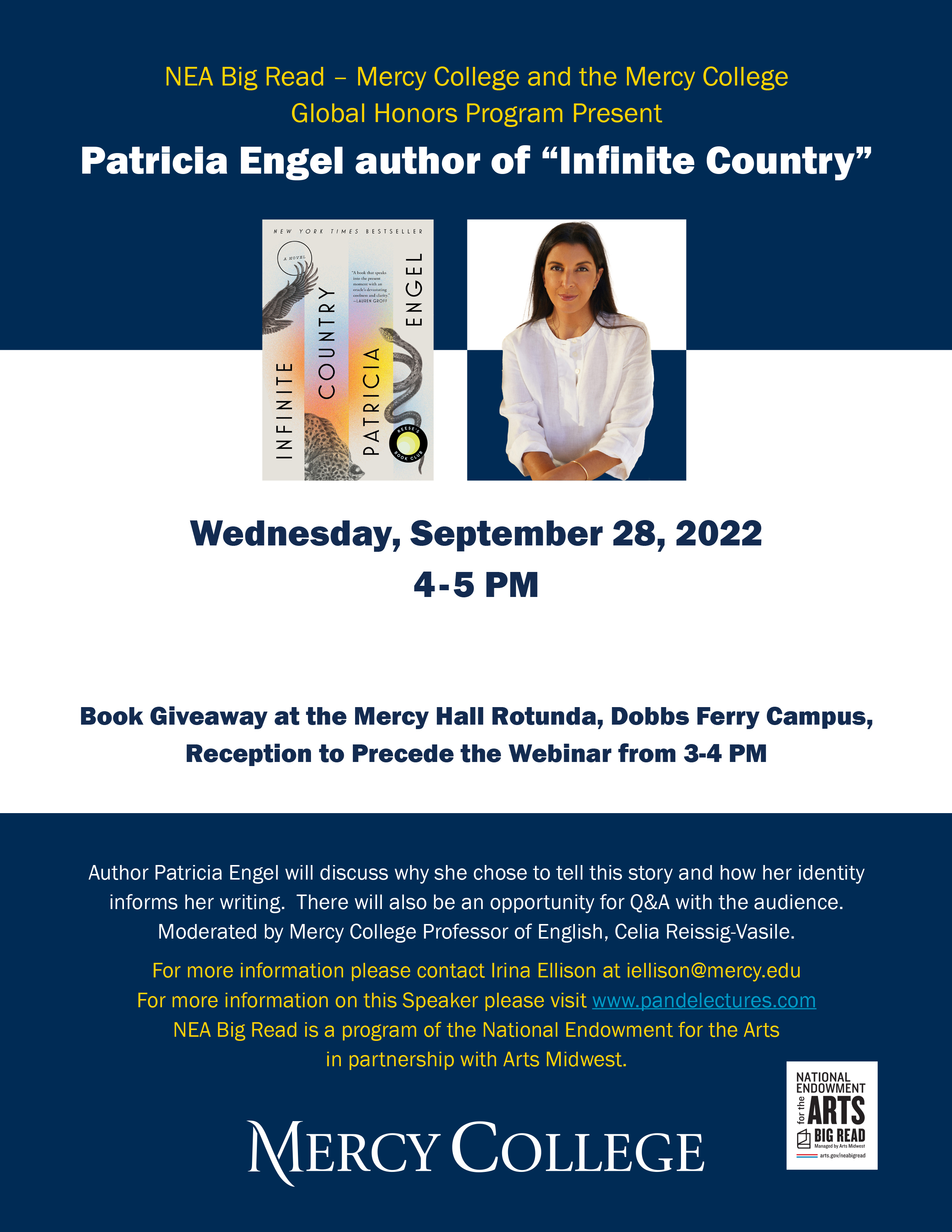
Author Event with Patricia Engel, Hosted by Dr. Celia Reissig-Vasile, Wed. 9/28

On Wednesday, September 28, Dr. Celia Reissig-Vasile of the Mercy College English Program will be hosting a discussion with author Patricia Engel, regarding her book Infinite Country. Mercy College MA students are strongly encouraged to attend this event; you can attend on zoom, or can join a larger viewing party in the Mercy Hall Rotunda on the Dobbs Ferry campus. Click here to register for the zoom webinar. Or click here if you plan to attend the viewing party in the Rotunda.

Attention students and alumni: please complete this program survey!

Every five years, as a part of Mercy College’s accreditation, the MA English Lit program is required to perform a “program self-study.” This involves the Program Director gathering together data and other info, including student & alumni feedback, and then reflecting with the MA faculty and college administrators on what these elements reveal. The goal is to identify where the program is succeeding, and where it needs improvement, based on what we learn from the “self study.”

Few things are as meaningful and as valuable for these purposes as student feedback, so please, if you’re an incoming student, active student, or alum, take some time and complete the survey linked here. Complete as much of it as makes sense (you don’t need to answer every question) and then click the submit button down at the bottom. Your voice is so important and so I hope that each of you will raise your voice and express yourself through the survey.

Survey responses are anonymous.

The direct link to the survey form, in case your browser is blocking the embedded link above is: https://forms.gle/poVC759f93VWpgef8

Any questions about the survey? Please write to cloots@mercy.edu.

MA English Lit program learning goals and learning outcomes, updated 2022

As a part of Mercy College’s accreditation, the MA English Literature program (like every program at Mercy College) is required to maintain and occasionally share among our graduate student community what our accreditors refer to as “program learning goals” and “student learning outcomes.” These things have very particular meanings in accrediting parlance, and those meanings don’t always translate to or encompass the spirit of humanities disciplines such as graduate English literature, a spirit which by its nature involves complexities, nuances, shadows, and wonderworkings which to some degree resist reductionist measurement and assessment (and since reductionist measurement and assessment form the basis of all 21st-century college accreditation, this puts English literary studies in a strange situation).

The MA program has necessarily, then, developed program learning goals and student learning outcomes which work to speak true to our curriculum and to the needs of our accreditation requirements, while also remaining flexible and generic enough so as to not betray the more nebulous spirit and explorations of graduate English literature study.

Below are the MA in English Literature program’s current program learning goals:

  • Students will develop their knowledge and comprehension of a variety of literary texts (Program Learning Goal 1)
  • Students will develop their knowledge and comprehension of critical approaches and literary concepts (Program Learning Goal 2)
  • Students will develop their critical and creative thinking, and their research and writing skills, toward the aim of developing a professional-level proficiency in these areas (Program Learning Goal 3)

Below are the program’s four student learning outcomes. Such outcomes require an even more particular phrasing: they must signal something that a student is expected to be able to do at the end of coursework, as a result of coursework, that they could not do, or could not do as well, at the start of coursework. So: By the end of the MA English Literature program, students are expected to be able to:

  • Analyze and interpret literary texts (Student Learning Outcome 1)
  • Apply critical approaches and concepts to the analysis and interpretation of literary texts (Student Learning Outcome 2)
  • Conduct research relevant to the field, and evaluate source quality (Student Learning Outcome 3)
  • Create original research topics and produce writings on those topics which demonstrate clear writing and accurate documentation style (Student Learning Outcome 4)

In one way or another those goals and outcomes undergird all of the curriculum in the MA English Literature program. If anyone has any questions about any of this, feel free to contact the Program Director at cloots@mercy.edu. Thank you.

Info about the SLA Graduation (Commencement) Ceremony on 5/18

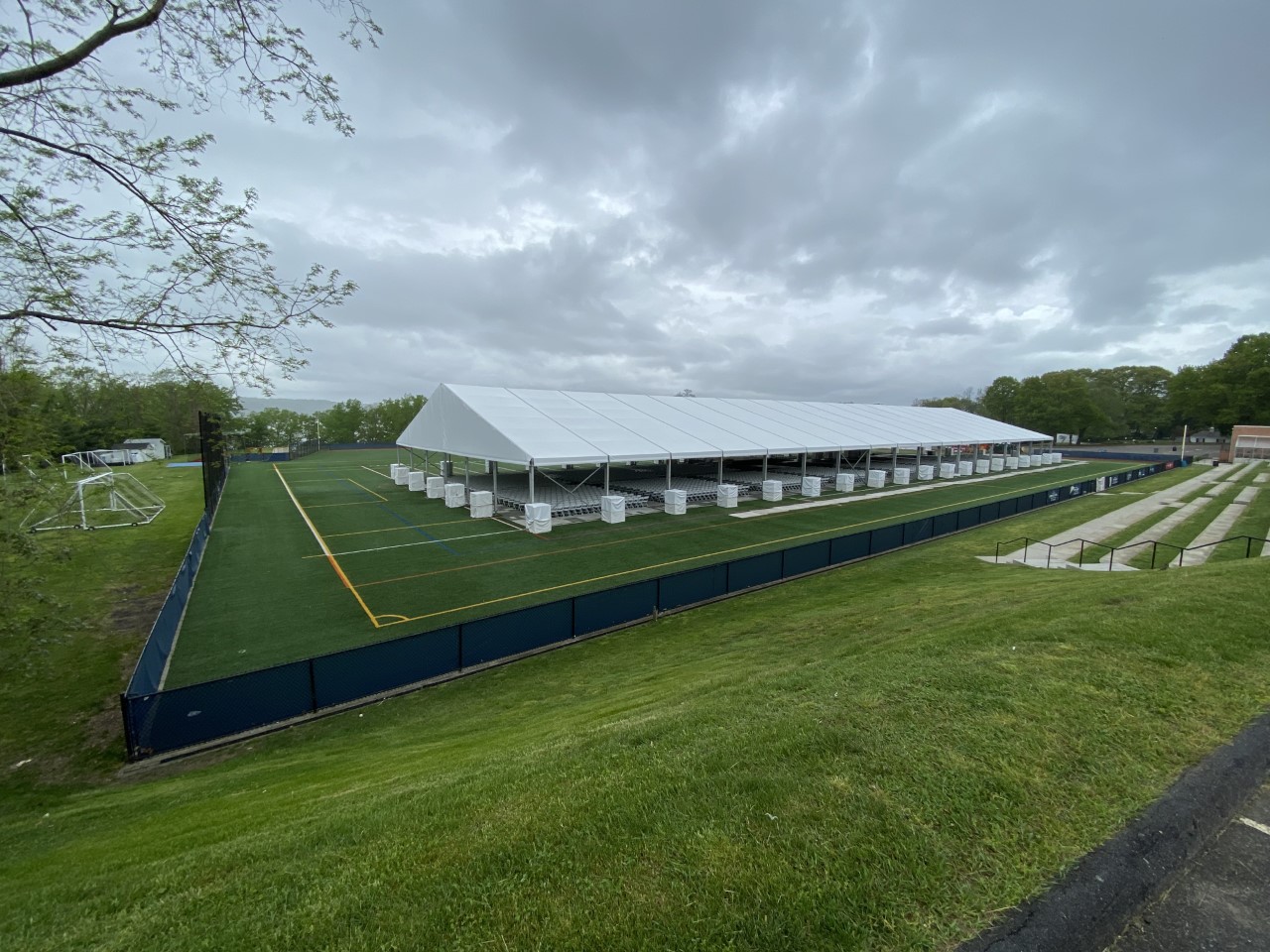
This Wednesday, 5/18, the School of Liberal Arts (SLA) will hold its graduation commencement ceremony on the Dobbs Ferry campus. Below you can see the tent being set up for the event on the western athletic field.

For any graduating students traveling to campus to attend here are a few things you should know:

First, the SLA event runs from 2pm to 4pm. Earlier that day, from 10am to noon, is the School of Business’s (SBUS) commencement ceremony. No one knows if the two hour window between the two events will be adequate for the SBUS attendees to exit the campus to clear the venue and parking spots for the SLA attendees arriving. This is the first time the college is holding commencement at the Dobbs Ferry campus so there are a lot of unknowns. The college’s other schools are holding their commencement ceremonies on other days this week.

Anyone who has registered for commencement should have received a temporary parking permit. You must have a parking permit to drive onto the campus. Security will turn you around at the campus entrance otherwise. If you have registered for the event but have not received a temp parking permit, contact cloots@mercy.edu immediately. FYI the Ardsley on Hudson Metro North station, on the MTA Hudson River Line, is just through those trees on the right side of the above image.

There will be coffee, water, snacks, bathrooms, and a place for our graduating MA English students (and other SLA students) and their families to sit prior to the event in the Gratia Maher Hall conference room. The room will be open from about 11:45am until about 1:30pm. Faculty will be moving in and out of the building that day in preparation for the ceremony, but you might see a few familiar faces in passing if you’re sitting in Maher Hall that afternoon.

Of course you don’t need to attend commencement to actually graduate. Commencement is a purely ceremonial event. Everyone who has met all of the requirements for the MA degree will be conferred their degree this month. Your physical diploma will be mailed out later, over the summer, but you will officially hold the MA degree once it has been conferred by the Registrar of the college. Any questions write to cloots@mercy.edu.

Planning to Graduate This Spring? Complete the Degree Conferral Form by 3/15

MA students for whom this spring is their final semester must complete the degree conferral form in order to be considered for degree conferral in May. The procedures and form are online here. The form is where you will indicate things like the mailing address to where your diploma should be mailed, contact info, degree info (Master of Arts in English Literature). Be sure to complete the form if you are on-track to complete your degree requirements this semester.

Summer Fellowship (Paid Internship) Opportunity in Professional Publishing

The Association of American Literary Agents (AALA), and their non-profit sister organization Literary Agents of Change (LAOC), are sponsoring fellowships for summer 2022. Mercy College English students, grad or undergrad, with an interest in the field of publishing are strongly encouraged to apply. Those selected will receive a grant of $6,000 each and be paired with one of AALA /LAOC’s 450+ members for a 10 week internship. This flyer provides more info, and this document/contract provides even more specific information (it sets forth expectations for the fellowship/internship program and ensures legal compliance with the Fair Labor Standards Act).

The application can be found here: 

https://aalitagents.org/internship-application/ 

The deadline to apply is March 15th.

AALA/LAOC has created this promotional video to give Mercy College English students a bit more information about this opportunity and the role of a literary agent.

If you have any questions please contact: fellowship@aalitagents.org   

How to Get a Student ID Card

If you are an active MA student and you want a student ID card, but live at a distance from the campus, here is what you do:

Using your @mercy.edu email account, send a photo of your face along with your full first name, last name, and college ID number (your eight-digit CWID number) to Amanda McKenzie at: amckenzie9@mercy.edu

Full photo guidelines are:

  • Submit a color photo of just your face taken in last 6 months
  • Have someone else take your photo – no selfies
  • Submit a high-resolution photo that is not blurry, grainy, or pixelated
  • Use a clear and unedited image of your face; do not use filters such as those commonly used on social media
  • Face the camera directly with full face in view
  • Have a neutral facial expression or a natural smile, with both eyes open
  • Use a plain white or off-white background

Let Amanda know in your email that you are a distance-learning graduate student in the MA English Lit program and that you would like a student ID card. She will explain the process further and get you the ID card.

Student ID cards can be useful for securing discounts at various places, and perhaps more importantly for your graduate studies will get you access to local university and college libraries in your area that would be otherwise inaccessible. Just check with those libraries before venturing to them to make sure they’ll admit graduate students from another college, with a current ID, for purposes of doing research.