Question Concerning the Summer 2025 MA Course Schedule

Currently we have one summer offering on the schedule, ENGL 517 Advanced Creative Writing. Despite that word “Advanced” this course is open to anyone, no matter if you’re just beginning your journey this summer as a creative writer, or if you’re well experienced in creative writing. In recent years we haven’t had too much demand for summer offerings. Last year we ran two summer courses and while one filled up, the second one only had a couple of students in it. So, the MA program is looking to hear from our students about whether or not a second summer course is wanted. Those who want or perhaps need two summer courses, please send feedback to cloots@mercy.edu to say so.

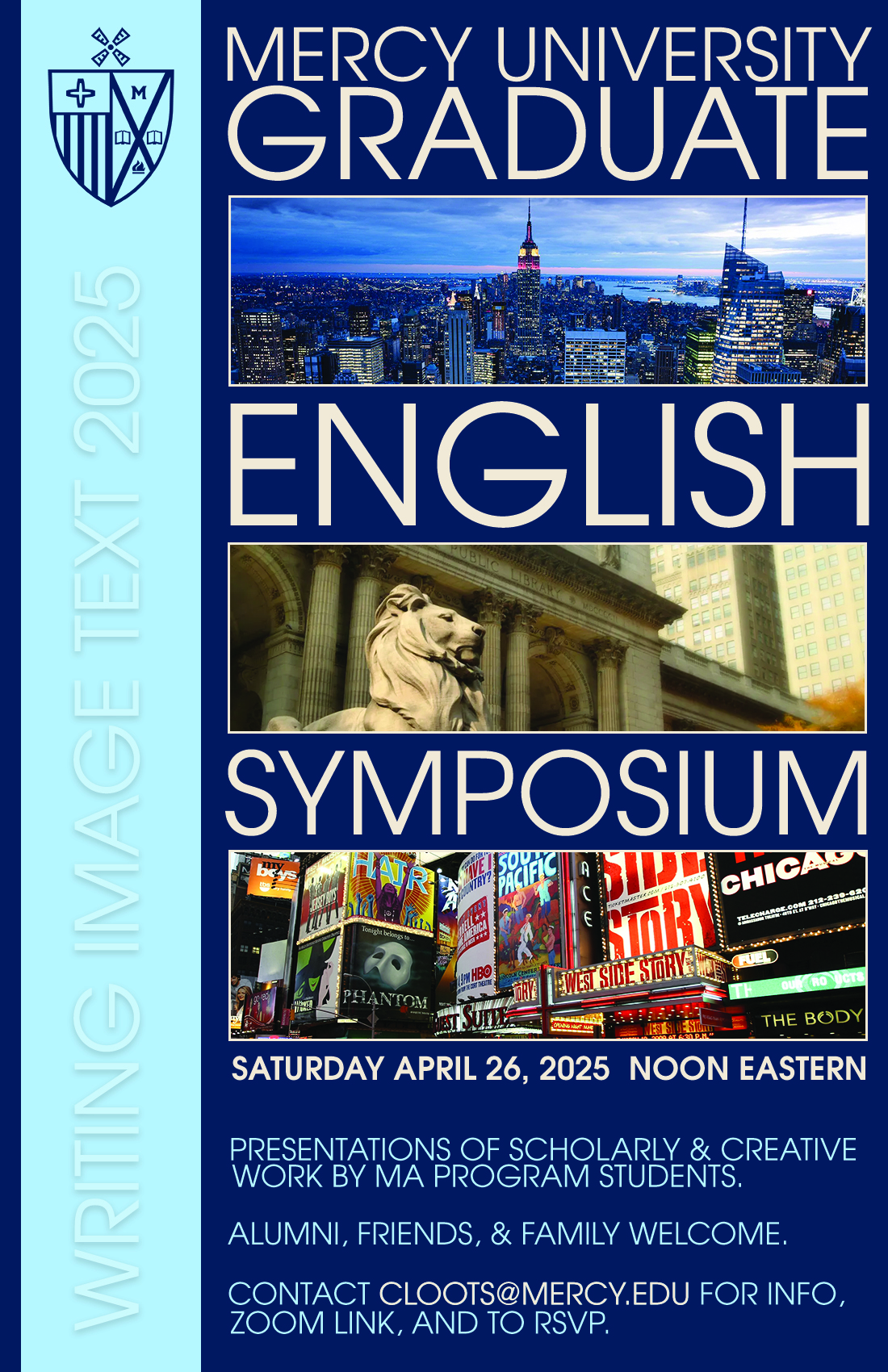
2025 Grad English Symposium; Live Online Saturday April 26, Noon Eastern

On Saturday April 26 the MA program will be hosting its annual “Writing Image Text” or “W.I.T.” Graduate English Symposium. The event will be held on Zoom. We will begin at noon, eastern time. The length of the event will depend on how many of our grad students will present, but usually it runs for a few hours.

This call for papers (CFP) is limited to current students in the program. Active students who want to attend but not present, as well as alumni, prospective students, faculty, family, guests, etc., are all very welcome and encouraged to attend as audience members. The deadline for responding to this CFP and declaring as a presenter is the end of Saturday, April 5.

The symposium is a casual mini-conference at which active MA English students present scholarly or creative work. A paper or project that you’ve created for any of your MA courses would do just fine. Full instructions and guidance for presenting will be shared with presenters after April 5. The symposium is also a community event at which you might see/meet fellow grad students, program professors, alumni, and others in the MA community.

Graduate students and professional scholars often attend and read at local, regional, national, and international conferences, so this symposium provides a friendly small-scale introduction to the conference experience. And for anyone who reads a paper, it becomes a line-item that you can list under the scholarship section on your CV (click here to read more about the CV).

Anyone planning to attend this year’s WIT symposium, as presenter or audience member, please indicate as much by sending an email to cloots@mercy.edu no later than the end of Saturday, April 5. And please use the subject line “WIT Symposium 2025” for your email. Zoom info will be sent out after April 5 to everyone who RSVPs.

You can read about some of our previous symposiums on the blog here, as well as here, here, here, and here. On behalf of the MA faculty: we hope to see you all there! Please contact cloots@mercy.edu if you have any questions about any of this.

Red Hyacinth, Mercy University’s Literary Magazine, Receives Highest National Recognition

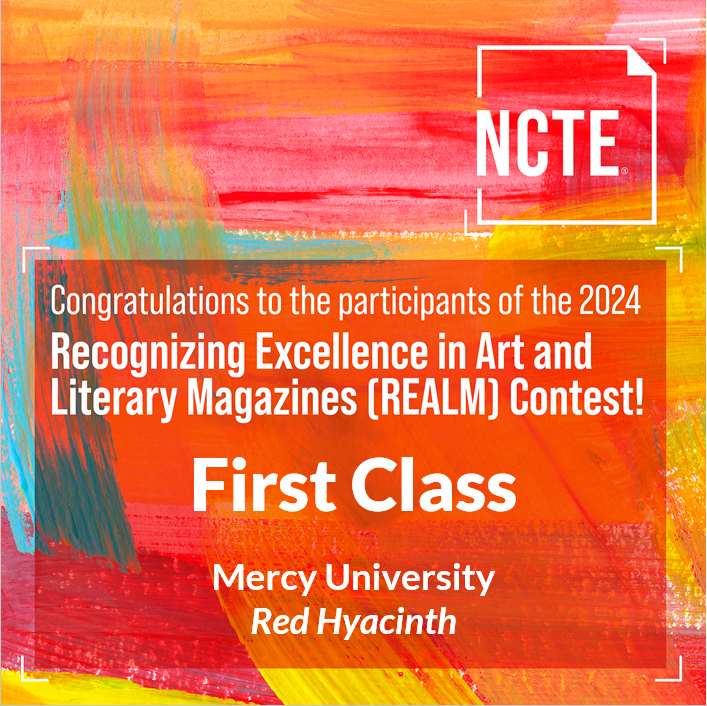
The Mercy University literary and arts magazine, Red Hyacinth, has just been awarded “First Class” status by the National Council of Teachers of English (NCTE). NCTE is the oldest professional organization for English educators across all levels of education in the USA, and is one of the most esteemed organizations in existence in the field of English studies and education. NCTE, through their “Recognizing Excellence in Art & Literary Magazine” (REALM) program, does an annual review of literary magazines produced throughout American education by students with the help of faculty, and recognizes a very small selection of those magazines with various levels of distinction. “First Class” is the highest level. This is a profound achievement and the MA English program would like to recognize the team of Editors who produced the award-winning edition (2024, vol. 7):

  • Editor-in-Chief, and Managing Editor: Nelson Orellana
  • Content Editors: Nyla Green, Bridget Gogliettino, Bilgilio Martinez, and Amy Romero
  • Layout and Design Editors: Sara Kastrati and Quinn Palafox
  • Faculty Advisor and Founder: Dr. Kristen Keckler
  • And every one of our graduate students who contributed creative work to Red Hyacinth over the years.

Click here to learn more about Red Hyacinth.

Happy New Year to our Graduate Community (And: Blackboard Ultra)

Cheers and happy new year to all of our MA English Lit program students, alumni, faculty, staff (and to all of your family and friends too). On behalf of all of the faculty and staff in the MA program here at MercyU let me say: we hope that all of our students and alumni had a pleasant holiday, and we wish you all the best for 2025.

One big thing going on behind the scenes this winter is that Mercy is switching from Blackboard (BB) to Blackboard Ultra (BBU). There are many similarities between the two Learning Management Systems (LMS), but visually at least they’re significantly different. So when you log into your spring courses, it’s all going to look strikingly different than what you’ve experienced in the past. Faculty have been training to use BBU but we’ve only now gained access to our spring sections in BBU to build them. And although the spring semester starts on January 22, the BBU sections become visible to students on January 8. So, there might be some “learning moments” during the spring as your professors adapt in real-time to the new LMS; and if you look at your course prior to January 22 it might look like a bit of a mess since your professors will still be working on them, and figuring out how to make them look right, in preparation for January 22.

Below are some of the book orders for the spring courses. The MercyU bookstore will list these too but the store tends to hide the particular edition/ISBN info in hopes of forcing you to purchase books from them; but you can surely find the books for cheaper elsewhere.

510 Theory/Practice of Writing:

  • No book orders/purchases required; everything will be provided as open-access texts within the BBU section.

515: Murder, Mystery, and Suspense:

  • Christie, Agatha. The Murder of Roger Ackroyd. William Morrow Paperbacks. ISBN: 978-0062073563.
  • Hammett, Dashell. The Maltese Falcon. Vintage Crime. ISBN: 978-0679722649.
  • Neeley, Barbara. Blanche on the Lam. Brash Books, LLC. ISBN: 978-1941298381.
  • Grafton, Sue. A is for Alibi. St. Martin’s, 2005. ISBN: 978-0312938994.
  • Highsmith, Patricia. The Talented Mr. Ripley. ‎ W. W. Norton & Company; Reprint edition (June 17, 2008). ISBN: 978-0393332148.

540: Shakespeare:

  • Greenblatt, Stephen, et al., eds. The Norton Shakespeare. 3rd ed. ISBN: 978-0393264029.

560: Hemingway/Modern Cryptography:

Note that there are many editions of Hemingway’s work out there, because many of his works are now entering the public domain meaning anyone in the world can list and sell them. Scribner’s is Hemingway’s original* publishing house and so I recommend you buy Scribner’s publications, which are listed below. Any edition will do, in the end, but I’ll be reading from and referring to the Scribner’s editions.

  • Hemingway, Ernest. A Farewell to Arms. Scribner’s. ISBN: 978-0684801469.
  • —. The Garden of Eden. Scribner’s. ISBN: 978-0684804521.
  • —. A Moveable Feast. Scribner’s. ISBN:  978-1439182710.
  • —. The Complete Short Stories of Ernest Hemingway: The Finca Vigia Edition. Scribner’s. ISBN:‎ 978-0684843322.
  • —. The Sun Also Rises. Scribner’s. ISBN: 0743297334. Knopf,

Recommended but Not Required:

  • Dearborn, Mary. Ernest Hemingway: A Biography. Vintage, 2018. ISBN: 978-0525563617.
  • Hemingway, Ernest. For Whom the Bell Tolls. Scribner’s, 1995 reprint. ISBN: 978-0684803357.
  • Lynn, Kenneth. Hemingway. Harvard UP, 1995. ISBN: 978-0674387324.

*Boni and Liveright is actually Hemingway’s original publishing house but he’s most famous for publishing through Scribner’s, and how he jumped from B&L to Scribner’s is a great story and one we’ll encounter this spring.

Spring 2025 Course Options

General registration for spring 2025 opens on October 30. It normally opens at or around 9am eastern. Priority registration, which includes veterans and active military, opens earlier. Students who know that they qualify for priority registration, or who would like to know if they do, should contact the graduate English PACT advisor Lydia Yearwood at lyearwood@mercy.edu for help arranging your priority registration. Any student in need of help with registration should contact Lydia. If anyone has any questions about any of the courses below, please contact the Program Director at cloots@mercy.edu. Note that the descriptions below might change a bit as professors work more on their courses during the fall, but these descriptions basically express the spirit of each course. Book orders will be shared later in a future blog post.

ENGL 510 Theory and Practice of Writing (Dr. Proszak)

  • In this course, students learn about how writing has been studied and theorized across writing studies and related disciplines. The course specifically focuses on cultural issues endemic to writing and how race, ethnicity, gender, and class enter into conversations on writing instruction and assessment. Students who take this course will understand how writing functions across contexts and communities, including within higher education. All course texts will be scanned or available online. Readings will likely include chapters from A Short History of Writing InstructionNaming What We Know: Threshold Concepts of Writing Studies and chapters from texts on the open-access WAC Clearinghouse, including Situating Writing ProcessesWriting Assessment, Social Justice, and the Advancement of OpportunityGenre in a Changing WorldFulfills the Writing & Literary Forms field requirement or an elective.

ENGL 515 Murder, Mystery, and Suspense (Dr. Dugan)

  • The genre of the murder-mystery novel is often viewed as “escapist “or “diversionary,” but in addition to it being entertaining for many, the genre rather offers insights into the social, cultural, and historical context from which the stories emerged. This course will trace the development of the murder-mystery genre from the 19th century to present-day, with a focus on, among many other things, the question of why stories of this genre have been and continue to be so interesting to so many people. 3 credits. Fulfills an elective by default but can instead fulfill a Literature Group 2 requirement upon request. Note that this last ran as ENGL 560; if a student took that instance or any earlier instance of this courses titled “Murder, Mystery, & Suspense,” they cannot take this course again.

ENGL 521 Themes & Genres of Medieval Lit (Dr. Fritz)

  • This course is designed to cultivate students’ awareness of the themes, genres, and issues related to medieval literature and to the study of medieval literature. Students will explore the major genres of medieval literature, including epics, lays and romances. Fulfills a Literature Group 1 requirement or an elective.

ENGL 540 Shakespeare (Dr. Kilpatrick)

  • Students in this course will critically study and discuss select Shakespeare works. During the course of this study students will gain familiarity with the syntax and lexicon of Shakespeare’s language, and develop a basic understanding of the cultural and intellectual background in which Shakespeare lived, and out of which his drama emerged. Fulfills a Literature Group 1 requirement or an elective.

ENGL 560 Hemingway / Modern Cryptography (Dr. Loots)

  • This course follows Ernest Hemingway, through his writings, from his early days in Paris to his final moments in Ketchum, Idaho. Readings will include many of his major novels and short stories, and some non-fiction. By exploring Hemingway’s travels and writings we will experience through his eyes the rise of modernity; the unprecedented way that the world changed forever in the early twentieth century; and the relationship of modern literature and art to modernity. We will as well consider the interrelated effects of Hemingway’s self-engineered celebrity status—as the rugged bearded “macho man” world traveler—which coincided precisely with the rise of modern media technology, exceeded his literary fame even within his lifetime, and belied the complexity, gentleness, and queerness of the man. We will as well consider how Hemingway’s groundbreaking style exemplifies a type of modernist code, a type of literary cryptography, requiring of us delicate work to interpret/intuit/decode what secrets and subtle meanings weave through the writings of this giant of 20th-century American literature, arguably the most influential American writer of all time. Fulfills a Literature Group 2 requirement or an elective. Note that this last ran as 514; if a student took that instance or any earlier instance of this course titled “Hemingway / Modern Cryptography” they cannot take this course again.

ENGL 599 Master’s Thesis

  • 599 doesn’t actually appears on the schedule in Connect. The way to enroll in a 599 Master’s Thesis tutorial is to follow the instructions here. Students need to take 599 as one of their courses during whatever is their final semester in the program (so if spring 2025 is not your final semester in the program, then you won’t be able to enroll in a 599 tutorial in the spring). Contact cloots@mercy.edu if you have any questions about this, and/or if you need assistance establishing a thesis mentor for your 599 in spring 2025.

Creative Writers & Artists Take Note! Submit your work to Red Hyacinth

The Mercy University literary/arts journal Red Hyacinth is now accepting submissions of creative writing, photography, and images of other original studio arts for it’s 2025 edition. For full submission guidelines and instructions, please click here. The deadline to submit is December 5, 2024. This is a great opportunity for graduate English students to get your creative work considered for publication, and potentially to see it in print in a perfect-bound hard-copy journal.

Welcome to the Fall Semester and the 2024-25 Academic Year

On behalf of all of the Mercy University MA in English Literature faculty: welcome, everyone in our graduate English community, to the 2024-25 academic year. Here in New York the summer is just starting to hint at the autumn ahead: the morning air cools; the deep and uniform forest green of the leaves begins to gesture to the yellow, red, and brown ahead; twilight comes a bit earlier, and each day earlier yet. In different regions, nature has different ways of signaling the changing season. Whatever region you’re in, and whatever are the tells of autumn, ever since we were young we know one thing that all of these signs mean: it’s time to get back to class, get back to our studies, get back to school. We few, we happy few, who still no matter how near or far we are from our younger days can return to our studies and explorations when the summer rolls into autumn–we get to begin again. And so today, Wednesday September 4th, the first day of our fall semester and of our new annual academic cycle, we begin again!

Before we all head off into our new adventures and explorations through the literatures, histories, and cultures from across all of human time and all around the globe, I want to share with our grad students information about resources and support which are available to you all.

THE UPDATED STUDENT HANDBOOK, AND NETIQUETTE GUIDE

Now and then we revise and update the Graduate Student Handbook. The latest version, updated summer 2024, is available by clicking here. Note that among the additions to the latest version is a netiquette guide (page 8). We ask all of our grad students to review the updated handbook, as it contains answers to and information about many of the questions and situations grad students face.

STUDENT ID

Grad students, whether on campus or online, can and should secure student ID cards. A student ID can get you discounts at various stores, and can usually get you access to any university library in your area. Students at the Dobbs Ferry campus can stop in and get your ID card in Person at the Admissions office in Main Hall. Students at a distance can secure an ID card through the mail by following these instructions:

Using your @mercy.edu email account, send a photo of your face along with your full first name, last name, and ID number (your eight-digit CWID number) to pact@mercy.edu.

 Full photo guidelines are:

  • Submit a color photo of just your face taken in last 6 months
  • Have someone else take your photo – no selfies
  • Submit a high-resolution photo that is not blurry, grainy, or pixilated
  • Use a clear and unedited image of your face; do not use filters such as those commonly used on social media
  • Face the camera directly with full face in view
  • Have a neutral facial expression or a natural smile, with both eyes open
  • Use a white or off-white background

Explain in your email that you are a distance-learning graduate student in the MA English Lit program at Mercy U, and that you would like a student ID card.

GENERAL STUDENT RESOURCES & SUPPORT

Each active graduate student has what’s called a PACT advisor, which is basically your staff advisor and the point-person for assisting you with issues that arise or general questions you might have. The primary PACT advisor for every graduate English student is currently Lydia Yearwood (lyearwood@mercy.edu). Also know that as the Program Director I am the faculty advisor to every graduate English student, so you can always contact me at cloots@mercy.edu with questions about the program or your classes.

Student Support Services is the general office/portal where you can find info about many of the things that students normally need info about. Note that practically all of Mercy University’s support services have some online variation, and so are available for our distance learning students.

The University’s Office of Accessibility is the place to contact if you need to discuss or register any accommodations.

We also have an office of Counseling Services for those in need.

The Center for Academic Excellence and Innovation (CAEI) provides tutoring (including online tutoring) and other such assistance for those who want some help with their writing and researching. Occasionally a professor might recommend or require that you seek additional help with your writing, and the CAEI is the place you can get it, whether on campus or online.

Mercy has extensive online library resources. JSTOR Language & Literature, MLA International Bibliography, and Academic Search Premier are the main databases in the field of literary research, though there are many other databases available online through the library. Additionally, Mercy has digitized versions of many scholarly books. To search the ebook selection use the advanced search option for the library catalog and under “format” select “EBook.” Then search away and check-out/download any useful books you find. For general research help and an overview of basic research methods, you might find useful this online guide that librarian Miranda Montez created specifically for the MA English program. And don’t hesitate to make use of interlibrary loan to secure any materials (such as academic journal articles, etc.) that you need but which Mercy might not have on hand. Librarians can secure materials using interlibrary loan and send scanned PDFs to students at a distance, within fair use and copyright allowance.

For those approaching their last semester, you must pay attention to your required comprehensive exam, to the instructions for how to enroll in the final 599 course, and to the instructions for how to apply for degree conferral. Also note that the format for the 599 thesis paper involves some in-house style requirements, which are explained here.

PROGRAM LEARNING OUTCOMES AND ENGL 599 MASTER’S THESIS ASSESSMENT RUBRIC

The program’s “student learning outcomes” are the big-picture things we hope you are developing throughout your time the program, and all of your courses in one way or another are geared around developing one, some, or all of those outcomes. We have a rubric keyed to those outcomes that we use when reviewing your final 599 thesis papers. You can see that rubric by clicking here. Even though we don’t apply the rubric systematically to papers written for courses prior to the 599 tutorial, it’s a good idea to look at it since more or less the things listed on the rubric are the things we’re considering when reviewing all of your papers for most courses in the program. The rubric and the outcomes, and our 599 assessment practices, as well as the sharing of this information with students, are all requirements of our university’s accreditation.

GRADUATE STUDENT SYMPOSIUM 2025

It’s not too early to be thinking about attending and/or, hopefully, presenting at the spring 2025 Graduate Student Symposium. More information about this will be shared in early spring here on the blog, but anyone interested or with questions should contact cloots@mercy.edu now for more information.

ONWARD INTO THE SEMESTER

Onward we go! If anyone has any questions about anything in this post, please let me know at cloots@mercy.edu. Once again, welcome, everyone, to the 2024-25 academic year here in the Mercy University MA in English Lit program. Here’s to the fall, here’s to your studies and explorations, and here’s to the academic year ahead. Thanks, all. -CL

YEAR-END EVENTS AND HONORS: 2024 SYMPOSIUM & STUDENT AWARDS

We’ve reached the end of another academic year, which means it’s symposium season, awards season, and commencement season!

This past April some of our grad students and faculty gathered on Zoom for the annual graduate student symposium. Raymond Fortunato read aloud a selection of his creative short fiction, while Nelson Orellana and Chad Teasley presented scholarship. As usual it was a collegial event at which ideas were expressed, discussions unfolded, and camaraderie was had. Presenters earned a valuable line-item to list on their curriculum vitae. The graduate faculty encourage all of our students to consider presenting creative or scholarly work at next year’s symposium, which will be held in April 2025.

Four of our grad students were recognized recently for year-end honors. The first such honor is the Graduate English Christie Bowl, named for the late Joannes Christie, who established and for many years chaired the Mercy English Program. The award is determined by the collective graduate faculty and recognizes one graduating student for consistent academic excellence and classroom performance throughout their entire time in the grad program, as well as for other contributions to Mercy and the university community, such as submissions to or editorial work on Red Hyacinth, work as a teaching assistant/learning assistant, and/or other related work and scholarship performed beyond Mercy’s perimeter.

  • The winner of the 2024 Graduate English Christie Bowl is Adrianne Gunter.

Next is the Howard Canaan Thesis Award for Innovation. This award honors the late Dr. Canaan, an esteemed Shakespeare scholar at Mercy who was also a lifelong advocate of the value and power of speculative fiction, science fiction, and other genre fiction more often looked down-upon by the academic establishment. This award recognizes a thesis that does one or some of the following: approaches literary analysis in a unique, unexpected, or unusual way; reconsiders and otherwise treats with dignity genre fiction; or involves interdisciplinary studies.

  • The winner of the 2024 Howard Canaan Thesis Award for Innovation is Nyasia Almestica for her thesis “Exploring the Intersections of Technology and Intimacy in Personal Relationships.”

Next is the overall Thesis of the Year award. Selecting one study to honor for this award is always extraordinarily difficult, as thesis students across the program, over the past twelve months, have produced numerous high-level and even publishable works, each of which is worthy and respectable in its own right. The one paper receiving this distinction excelled in all areas and was a standout study.

  • The winner of the 2024 Thesis of the Year Award is K. Chad Teasley for his thesis “‘Better…a Sober Cannibal Than a Drunken Christian’: Herman Melville’s Literary Advocacy for Socioeconomic and Cultural Equality.”

In most years those three awards would mark the whole of the year-end honors, however this year we have an additional honor to note. Each year Mercy University hosts what’s called the “The Mavie Awards” (Mercy’s mascot is a maverick, that’s where the term “mavie” comes from) which is an event involving forty-some different awards recognizing achievement of various sorts from across the past academic year. One of the Mavie awards is for “Outstanding Graduate Student” and recognizes one student, out of the thousands of Mercy grad students, for both their academic excellence as well as participation in and efforts for the Mercy community. This year one of our own was recognized for a Mavie:

  • The winner of the 2024 Mavie Award for Outstanding Graduate Student is Nelson Orellana.

It is always a strange thing to announce such distinctions as when doing so one can’t help but think of the many marvelous students and studies that are not the ones here named. It is extraordinarily difficult for faculty panels to locate any single person to honor for any of the program awards out of the many exceptional students and theses under consideration. So as we recognize these honorees let us please also recognize all members of the MA English Lit program, especially the graduating class of 2023-24, for your work and dedication.

One last program-relevant thing to mention here is that for the Mercy University School of Liberal Arts commencement ceremony, held on May 22nd, the university’s administrators selected one of our program’s own to deliver the graduate-student commencement address: Esteban Figueroa. Esteban gave a lively speech, and provided through his thoughtful and reflective words the perfect finish to the academic year. This is the second year in a row that the university has turned to the MA English Lit program for the grad-student commencement speaker. It seems the powers-that-be have figured out that MA program students have a way with words, and a skill for dramatic performance!

Here’s to each and every one one of you who completed the degree this past year. Here’s to everyone in the program still working toward your degree. Here’s to our alumni. Here’s to the faculty, and the people behind the scenes who make the university function. Here’s to your family, friends, and loved ones. Here’s to summer, and cheers to all!

2024 Grad English Symposium; Live Online Saturday April 27, Noon Eastern

On Saturday April 27 the MA program will be hosting its annual “Writing Image Text” or “W.I.T.” Graduate English Symposium. The event will be held on Zoom. We will begin at noon, eastern time. The length of the event will depend on how many of our grad students will present, but usually it runs for a few hours.

This call for papers (CFP) is limited to current students in the program. Active students who want to attend but not present, as well as alumni, prospective students, faculty, family, guests, etc., are all very welcome and encouraged to attend as audience members. The deadline for responding to this CFP and declaring as a presenter is the end of Saturday, April 6.

The symposium is a casual mini-conference at which active MA English students can read aloud a scholarly or creative work. A paper that you’ve written for any of your MA courses would do just fine. Full instructions and guidance for presenting will be shared with presenters after April 6. The symposium is also a community event at which you might see/meet fellow grad students, program professors, alumni, and others in the MA community.

Graduate students and professional scholars often attend and read at local, regional, national, and international conferences, so this symposium provides a friendly small-scale introduction to the conference experience. And for anyone who reads a paper, it becomes a line-item that you can list under the scholarship section on your CV (click here to read more about the CV).

Anyone planning to attend this year’s WIT symposium, as presenter or audience member, please indicate as much by sending an email to cloots@mercy.edu no later than the end of Saturday, April 6. And please use the subject line “WIT Symposium 2024” for your email. Zoom info will be sent out after April 6 to everyone who RSVPs.

You can read about some of our previous symposiums on the blog here, and here, and here, and here, and here. On behalf of the MA faculty: we hope to see you all there! Please contact cloots@mercy.edu if you have any questions about any of this.

Fall (and Summer) 2024 Course Offerings; Also, Preliminary Grad Student Symposium Info

First please note that the annual Graduate English Symposium will again this year be held on Zoom, in order to accommodate our students at a distance. The date hasn’t been finalized yet but it will likely be near the end of April, and likely on a Saturday. A post with further information and details, including the call for presenters, will be coming soon, so stay tuned to this blog for more on that.

The fall (and summer) 2024 schedules will be appearing soon in Mercy Connect. Many of our students don’t take summer courses, whereas all of our students take fall and spring courses, which is why I’m privileging fall here in my phrasing. It’s also why we offer just a few summer courses. Fall and summer registration will open for veterans on Monday, March 11. General registration will open for all students on Monday, March 18. Registration normally opens at or around 9am, eastern (it begins when the Registrar’s Office opens and they activate the reg system).

Specific book info will be coming later, and some of these descriptions will change as professors refine their courses over the months ahead.

The five fall 2024 course offerings are:

  • ENGL 500 Theory and Practice of Lit Criticism1 (Dr. Kilpatrick)

An introduction to some of the major movements and figures of the theory of criticism. The question “what is literature?” is a primary concern of this course. Such an inquiry necessarily engages other, closely affiliated signifiers such as work/text, writing, reading, interpretation, and signification itself. After brief encounters with ancient antecedents and seminal moderns, influential contemporary approaches to the question concerning literature and its cultural significance are engaged. An assessment of the relative strengths and weaknesses of current trends in the practice of literary criticism, and their theoretical groundwork, is the ultimate objective of this course. Fulfills the requirement for ENGL 500.

  • ENGL 505 Transformations of the Epic (Dr. Sax)

This course is based on the conception of the epic as an encyclopedic narrative of substantial length featuring a central figure who reflects the values of a particular culture. It will proceed chronologically, studying the taxonomy and transformations of the epic, from its earliest Classical manifestations, through its emergence in Medieval and Renaissance texts, to its incorporation after the Renaissance into modern writing. Fulfills the Writing & Literary Forms requirement or an elective.

  • ENGL 525 Victorian Age in Literature (Dr. Dugan)

If one were asked to define the timeline of Victorian literature, one might be hard-pressed to do so. As literary genres are fluid, it is hard to determine when the Romantic Period ends and the Victorian Period begins; and when the Victorian Period ends and Modernism begins. Whatever the dates, a defining characteristic of Victorian England would be change, change matched with a belief in progress: societal, religious, economic, and artistic. While some benefited from these changes, others did not. The semester we will look closely, through Victorian literature, at issues that challenge the notions of change and progress, notably the role of women, industrialism, gender roles, and poverty as shown in fiction, poetry, and drama of the Victorian age. Fulfills a Literature Group 1 requirement or an elective.

  • ENGL 543 American Renaissance (Dr. Loots)

This course will study representative American writings from “The American Renaissance,” a period during the mid-nineteenth century (roughly 1832 to 1865) which saw the rise of the first truly non-Colonial, non-Revolutionary body of national literature; a literature which no longer concerned itself with European precedent, engagement, or approval. When F.O. Matthiessen coined the term “The American Renaissance” in 1941 he did so in light of five monumental American works by five different writers, all produced within five years (1850-55): Emerson (Representative Men), Thoreau (Walden), Melville (Moby Dick), Hawthorne (The Scarlet Letter), and Whitman (Leaves of Grass). Since Matthiessen’s time the notion of an American Renaissance has expanded to encompass a greater diversity of representative works, writers, and perspectives from this era. In this course we’ll study selections from across the American Renaissance, most likely engaging works by: Harriett Jacobs; Frederick Douglass; Harriet Beecher Stowe; Frances Harper; Sojourner Truth; Margaret Fuller; Sara Willis (Fanny Fern); as well as Emerson, Thoreau, Whitman and Melville.  Fulfills a Literature Group 2 requirement or works as an elective.

  • ENGL 560 Tilting at Windmills: Riding with Don Quixote and Sancho Panza though 16th century Spain2 (Dr. Reissig-Vasile) [Note: if you use the Mercy schedule-planning tool, the title for 560 will show as “Topics in American Literature.” Ignore that title, it’s just a generic place-holder title in the planning tool. The real title is the one in Mercy Connect, Tilting at Windows]

It is often said that the long and tangled history of the modern novel begins in Europe, and it begins with Cervantes.  Through a close reading and analysis of Cervantes’ literary masterpiece, Don Quixote de la Mancha (which many readers, including many authors, consider to be among the greatest works ever written), we will explore this issue and many others.  The course will focus on questions of literary, linguistic, cultural, and historical heterogeneity in Don Quixote. We will seek to understand why so many celebrate Cervantes for teaching us “to comprehend the world as a question.”  We will explore the polemics of 16th century Spain and how Cervantes used Don Quixote to raise ethical issues relevant to his time. Fulfills a Literature Group 2 requirement or works as an elective.

And for those nearing the end of the program, note that ENGL 599 Master’s Thesis is a one-on-one tutorial that needs to be taken during your final semester. You don’t enroll in 599 as you do a normal class. Check out this page on the blog for more about 599 and how you enroll in it.

The two summer 2024 course offerings are:

  • 509 Perspectives on the Essay (Dr. Keckler)

[Updated description 2/26] The course will study of the essay as a distinct literary genre; its characteristics, types, and structures; its history; and its role in reflecting authorial consciousness. This course will focus in particular on the personal essay and sub-genres such as nature writing, cultural criticism, travel writing, and academic-personal essay hybrid forms. Fulfills the Writing & Literary Forms requirement or an elective; can work in other ways, as needed, for the degree, by request.

  • 540 Monsters2 (Dr. Dugan)

In this course we will read classic and contemporary literary works to explore notions of monsters and monstrosities from the perspectives of the monster and the creator. Historical, societal, political, and cultural issues will be explored and addressed. Types of monsters and monstrosities will also be considered: e.g. human, beast, and scientific. Fulfills a Literature Group 1 field requirement or an elective by default; can work in other ways, as needed, for the degree, by request.


1 ENGL 500 runs once a year, in the fall, and because it’s a requirement for the MA degree seats are locked and reserved for students who are on track to graduate prior to fall 2025. Students who have not taken it already, and are on track to graduate prior to fall 2025, can get a seat by contacting the program director at cloots@mercy.edu. Students who are on track to graduate in fall 2025 or later can still contact the program director requesting a seat in the fall 2024 instance, but will be prioritized behind students who must have the course this fall to graduate on time.

2 ENGL 540 and 560 are numbers by which we run a variety of new or experimental coursework. Students can take multiple instances of ENGL 540 and 560, as long as they’re not taking the same course with the same title twice. So for example a student who took 540 Fairy Tales last summer can take 540 Monsters this summer because those are different courses, even though they both use the 540 number; likewise, students who took 560 African and Caribbean Lit last fall can take 560 Tilting at Windmills this fall.

This is the director's blog for the Mercy University MA in English Literature Program. This is not the official University site.