Waiving Your Right to Access Recommendation Letters, & Other Advice for PhD Program Applications

Some of our MA students aspire to join a subsequent program upon completing their MA degree, such as a PhD or MFA program. If you’re one of those students interested in pursuing a PhD, this blog post is for you. This will be a long one so get a cup of coffee.

Securing admission to a PhD program has always been, and is still, a very difficult thing to do. The field is highly competitive. Most programs open just a few seats each year and have hundreds of applicants (the CUNY Graduate Center, for example, opens 15 to 20 English PhD seats each year and receives four hundred applications on average; UC Berkeley opens about 10 to 15 English PhD seats each year and receives upwards of five hundred applications annually). This information isn’t meant to discourage, is rather meant to contextualize the process so that your expectations will be informed by real data. Some of our MA graduates have achieved entry into PhD programs; others have tried and have not. There are steps you can take during your MA studies to make yourself a more viable candidate for PhD programs.

This includes developing a rapport with Mercy professors who teach and publish in your area of interest and from whom you will eventually want to request a recommendation. Building a rapport can be accomplished by taking courses with those professors and making sure you’re a positive and helpful presence in the classroom, aren’t just doing the bare minimum but are striving in discussions and in your papers to go beyond the minimum required. Building rapport can also be done by treating your professors with respect in exchanges of all sorts, whether in the classroom, in email, on the phone, or otherwise.

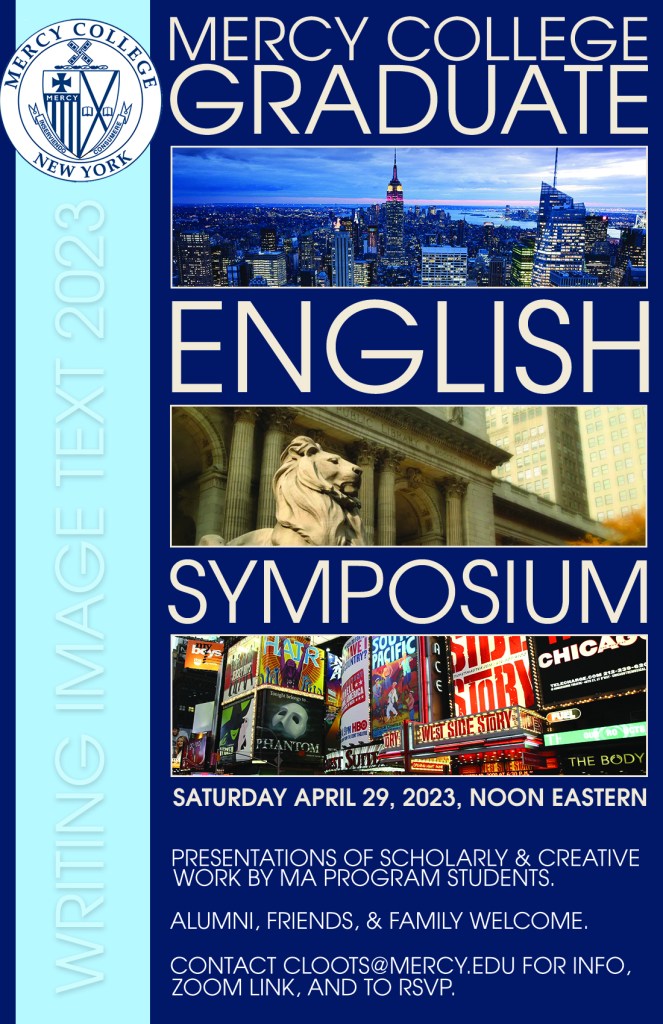
Another step is to go beyond the classroom and engage in the other types of professional development: such as presenting papers at conferences, conventions and symposiums. This might sound daunting but it can be done rather easily by reading something you’ve written for one of your MA classes at our annual Graduate Student Symposium; the next one of which will be held later this spring on zoom. Details about that will be shared on this blog in good time. Presenting in this way is classified as “scholarship” and having any sort of scholarship listed on your curriculum vitae is practically essential for applying to PhD programs these days.

The next-level of scholarship, the most valuable form of scholarship, is publication by peer-reviewed journals or presses. But it’s extremely rare for applicants applying for PhD programs to actually have publications of this sort. Most often it’s during PhD studies that a student begins to achieve scholarly publication of this sort. Again, presenting scholarship at conferences, conventions, and symposiums is the most reasonable focus for your scholarship as an MA student.

Performing other relevant work can boost your application chances too, such as volunteering for an editorial position for the college’s annual Red Hyacinth literary journal (advertised each year on the blog). Such volunteer editorial work doesn’t have to be done at Mercy College, so be on the lookout for similar opportunities in your area, or online.

Within your classes, be sure to read everything assigned; and read as much as is possible beyond the required readings. That can mean reading the recommended readings a professor might list, or even just doing your own research each week to secure sources, primary or secondary, relevant to the required reading. You all need to secure an assortment of secondary sources when completing your papers, but doing that sort of scholarly work throughout the semester, rather than just when the papers are coming due, will both develop your research chops and increase your overall knowledge of and experience with texts and scholarship in the field.

THE APPLICATION PROCESS

Typically PhD programs will accept applications during the spring, summer and early fall of the year prior to the intended year of entry, and will have a deadline late in the fall of that prior year (so for example, if applying for fall 2024 entry, the deadline for applications will normally be fall or early winter 2023). What this means is that MA students who aspire to apply to a PhD program for fall 2024, and who are on track to complete their MA degree prior to fall 2024, should be starting to survey the scene and get their application materials together now.

Surveying the scene can include selecting what programs to apply to, reviewing the applications from those places, gathering required application materials, establishing your recommenders, and actually submitting the application. Let’s talk about these steps.

When selecting institutions to apply to, the first consideration is whether or not you’re willing to relocate. If you’re not, then don’t waste time looking into any institution beyond whatever is your commute distance. It’s rare for someone to not have to relocate to attend a PhD program, so just keep that in mind. Even today it’s difficult to find a PhD program that’s fully online because one of the primary responsibilities of a PhD program is providing its students with old-fashioned in-room teaching experience. This is why you might find a few almost-fully-online options out there, but they’ll still usually require a semester or two of residency (because that’s when they’ll put you in the classroom to teach).

Research various programs. Learn about their faculty, and particularly about the faculty teaching in the area of your interest. Review their curriculum and see if it speaks to you. Find out what financial support the program offers (some offer “full rides” to every incoming student, others might have competitive scholarship or grant opportunities for some students, others offer support only through work-study and teaching fellowships, while others offer little or no support. Of course the programs that offer the most widespread and comprehensive support are also the most sought and competitive to enter, and so might not be the most reasonable target for your application).

Consider a range of institutions; and to increase your chance of success, apply to multiple institutions. A good start is to look into state universities (University of [X] and [X] State University). Avoid the allure of applying only (or at all) to the supposedly elite/prestige institutions. Ivy league institutions, for example, might open just a few new PhD seats in a year, and might favor their own undergrads or MA students, or applicants from what they consider to be their elite “peer” institutions. Moonshot applications to such places, including to ultra-elite public institutions such as UC Berkely, have an extremely low chance of success for most applicants nationwide, and especially those not already in the pipeline of these institutions. Of course you should do what you want and feel is right, but each application costs money. Consider, always, the cost of such things. As a point of reference, in recent years Mercy College MA students have entered PhD programs at: University of Wisconsin, University of Georgia, Texas Tech, Marquette University, St. Johns University, Bowling Green State University, Nova Southeastern University, among others.

Regarding recommendation letters: establish your faculty recommenders many months before any recommendation will actually be due. One of the rudest things you can do in this regard is to approach a faculty member for a recommendation that’s due next week. Many faculty will simply say no in that situation, as they will already have a huge queue of work to which they are tending. If you’re planning to apply to programs for a 2024 start, now is the right time to be asking around and securing your recommenders. Keep in mind that in instances where you and another candidate look essentially identical on paper, your recommendation letters will likely spell the difference. You want to be sure that whomever is writing your letter has plenty of time to do so, doesn’t feel rushed, and doesn’t feel disrespected (which is how it can feel when someone asks for a letter due next week). And with that in mind, let’s talk about the point included in the title to this blog post:

When submitting your application you will be asked whether or not you waive your right to access the recommendation submitted on your behalf. Of course the choice is yours to do whatever you want, but you should strongly consider waiving your right to access. You’re not going to find any Admissions Dept. that will ever say this in writing, but institutions will generally be skeptical of recommendations submitted for someone who did not waive their right to access the recommendation. The only reason this is even an option is due to a lawsuit a few decades ago which thereafter required this to be an option. Prior to that, recommendations were by default kept confidential between the recommender and the institution. When the recommendation is kept confidential, meaning is done without the applicant monitoring the exchange, institutions know that whatever the recommender is saying is the unfiltered truth. If the right to access the recommendation is not waived, though, institutions might presume that the recommendation is skewed toward the positive due to the recommender’s knowledge that the applicant is monitoring the recommendation. It’s human nature: people tend not to say anything critical about someone if that person is standing right there, and so the possibility of the student monitoring the situation threatens to invalidate anything positive being offered by the recommender.

Your recommenders know if you refused to waive your right to access the recommendation because we get an alert informing us of this when we go to submit our recommendation.

So from the institution’s perspective, not waiving the right to access could suggest that the applicant does not trust the recommender to provide a positive recommendation, or is even hoping to influence the recommender into providing a more positive recommendation than they might have otherwise. For the exact same reasons, from the recommender’s perspective, it can be insulting when you choose not to waive your right to access the recommendation.

The irony is that you should only be asking for letters of recommendation from faculty whom you know for sure will say only wonderful things about you (and the way you secure such faculty, and know as much, is by building rapport with faculty as described above). And so there should be no question that your recommenders will be saying only wonderful things on your behalf. And so by not waiving your right to access, you risk invalidating, in the eyes of your target institution, a glowing recommendation that would have been no less glowing otherwise. And you risk alienating your recommender.

If you’re curious to see what your recommenders are saying about you, all you have to do is ask them privately to share with you a copy of their letter. Most faculty are happy to do so, especially because there are plenty of situations in the world where it will help you to have a copy of the letter in-hand anyway.

Deciding whether or not to apply to a PhD program is a big decision. If you decide that you want to apply, that’s just the beginning of an application process that takes time, patience, research, and money; and that doesn’t always result in landing a seat in a PhD program. Hopefully the information and advice above will prove useful to those in our MA program who are interested in applying to PhD programs. As a last bit of advice: speak with your 599 thesis tutorial mentor for more personal suggestions and advice regarding this process.

Book Order Info for Spring 2023

Below you will find some info for books/materials required for your spring MA courses. This will be updated as professors finalize their courses and readings.

ENGL 505 Transformations of the Epic (Dr. Sax)

  • Boroff, Marie, trans. Sir Gawain and the Green Knight. New York: W. W. Norton, 2009. ISBN: 0393930254.
  • Alighieri, Dante. Inferno. Trans. Mark Musa. New York: Penguin, 2002. 0142437220.
  • Fagles, Robert, trans. The Iliad. New York: Penguin Classics, 1998. ISBN:  0140275363.
  • Harrison, Robert, trans. The Song of Roland. New York: Dover, 2002. ISBN: 0486422402.
  • Hatto, A. T., trans. The Nibelungenlied. New York: Penguin, 1965. ISBN: 0140441379.
  • Raffel, Burton, trans. Beowulf. New York: Signet, 2008. ISBN: 0451530969.
  • Sandars, N. K., trans. The Epic of Gilgamesh: An English Version with an Introduction. New York: Penguin Classics, 1960), ISBN: 014044100X.

ENGL 521 Themes & Genres of Medieval Lit (Dr. Fritz)

  • Black, Joseph, et al, eds. The Broadview Anthology of British Literature: Concise Volume A – Third Edition: The Medieval Period – The Renaissance and the Early Seventeenth Century – The Restoration and the Eighteenth Century. ISBN: 9781554813124

ENGL 525 Victorian Age in Literature (Dr. Dugan)

  • Braddon, Mary Elizabeth. Lady Audley’s Secret. Broadview Literary Texts, 2003.  978-1-55111-357-9.
  • Eliot, George. The Mill on the Floss. Dover Thrift Editions, 20003.  978-0-486-42680-8.
  • Dickens, Charles. Hard Times. Dover Thrift Editions, 2001.  978-0-486-41920-6
  • Stevenson, Robert Louis. The Strange Case of Dr. Jekyll and Mr. Hyde, 2019, 978-0-486-26688-6.

ENGL 540 Philosophy of Literature (Dr. Fisher)

  • Noël Carroll and John Gibson (eds.), The Routledge Companion to Philosophy of Literature, Routledge (2006). ISBN 9780367360399
  • Eileen John and Dominic McIver Lopes (eds.), Philosophy of Literature: Contemporary and Classic Readings, Wiley-Blackwell (2004). ISBN 9781405112086
  • Numerous other short readings will be provided as PDFs or links in Blackboard.

ENGL 544 Cyberpunk & Technoculture (Dr. Loots)

Required

  • Eggers, Dave. The Circle. ISBN 9780345807298.
  • Gibson, William. Neuromancer. ISBN 9780441007462.
  • Scott, Melissa. Trouble and Her Friends. ISBN 9780765328489. (But this is out of print [OOP] so a PDF will be provided in class. You can find used copies for cheap on Alibris.com, if you don’t like reading from PDFs. I use the hardcover 1994 edition but any edition will do.
  • Stephenson, Neal. Snow Crash. ISBN 9780553380958.
  • Numerous other shorter works will be provided as PDFs or links in Blackboard. Also note that students will be required to view a selection of relevant films and shows, and so should budget perhaps $25 for the cost of a few streaming rentals and a month of Netflix.

Recommended, not required:

  • Cadigan, Pat, ed. The Ultimate Cyberpunk. ISBN 9780743452397. (OOP, relevant selections from this will be provided in class as PDFs)
  • Dick, Philip K. Do Androids Dream of Electric Sheep? ISBN: 9780345404473.
  • Mill, Anna, and Luke Jones. Square Eyes. ISBN 9780224097222.
  • Sterling, Bruce, ed. Mirrorshades. ISBN: 9780877958680 (OOP and expensive, but you can sometimes find fairly priced copies on Alibris)
  • For anyone who games, I recommend you play through CD Projekt Red’s Cyberpunk 2077 which despite what you may have heard is a brilliant game; and the many issues/bugs present during its infamous 2020 release-debacle have been fixed through patches.

ENGL 560 Black Theatre, Art, and Power in the Digital Age (Dr. Morales)

  • London, Todd, and Ben Pesner. Outrageous Fortune. ISBN-13:‎ 978-0984310906
  • Nayeri, Farah. Takedown: Art and Power in the Digital Age. ISBN-10: ‎1662600550
  • Wilson, August. King Hedley II. ISBN-13:978-1559362603

Other materials will be provided as PDFs or links online.

Zoom Holiday Social Hour Wrap-up

Just want take a moment here to say thank you to the students, alumni, and faculty (and the dog) who were able to attend the holiday social hour hosted by Dr. Kilpatrick this afternoon on zoom. It was a nice time, full of conversation, stories, and humor. We will have future zoom social hours in 2023, in addition to our annual symposium. Information about those events will be posted here on the blog, as they come into view.

Cheers and Happy Holidays to everyone in the graduate English community!

Zoom Holiday Social Hour, Friday 12/16 at 3pm eastern

This coming Friday 12/16, at 3pm eastern, Dr. Kilpatrick will be hosting a live-online holiday social hour for the graduate English community. So make a cup of coffee, or pour yourself your favorite holiday drink, and get online this Friday afternoon for some casual conversation and holiday cheer. Use the link below to attend:

https://mercy.zoom.us/j/92960654436?pwd=bFlaTkZLUTVxMXNiNW83dkJtQ2xTdz09

Zoom Meeting ID: 929 6065 4436

Passcode: 314781

Reminder: Dr. Dana Horton’s Zoom Event Is Today 12/8 at 2pm

Just a reminder here for our graduate community that Dr. Horton will be discussing her current book project, “‘Don’t You Fuck With My Energy’: The Occult, Intersectional Spirituality, and Religious Appropriation in Hip Hop Culture,” today (12/8) on zoom starting at 2pm.

Students and alumni are strongly encouraged to attend. In order to do so please complete the rsvp form linked here. And then at 2pm today click here to open the zoom link. In case you’re new to Zoom, know that you don’t have to actually be on camera, so you can watch the event with your camera and mic off if you prefer. Any questions contact cloots@mercy.edu.

Book Publication by Faculty Member Dr. Dana Horton, and Upcoming Speaking Event on Zoom

Dr. Dana Horton’s book Gender, Genre, and Race in Post-Neo-Slave Narratives is now in print. As well, Dr. Horton will be hosting an online-zoom talk regarding her next book project on Thursday December 8, at 2pm, as a part of Mercy College’s Research Salon Series. More information about both the book and the event are as follows:

Gender, Genre, and Race in Post-Neo-Slave Narratives provides an innovative conceptual framework for describing representations of slavery in twenty-first century American cultural productions. Covering a broad range of narrative forms ranging from novels like The Known World to films like 12 Years a Slave and the music of Missy Elliott, Dr. Dana Renee Horton engages with post-neo-slave narratives, a genre she defines as literary and visual texts that mesh conventions of postmodernity with the neo-slave narrative. Focusing on the characterization of black women in these texts, Dr. Horton argues that they are portrayed as commodities who commodify enslaved people, a fluid and complex characterization that is a foundational aspect of postmodern identity and emphasizes how postmodern identity restructures the conception of slave-owners.

Students and alumni are strongly encouraged to check out the book, and to attend Dr. Horton’s upcoming research discussion based on her next book project, and titled: “‘Don’t You Fuck With My Energy’: The Occult, Intersectional Spirituality, and Religious Appropriation in Hip Hop Culture.” The project uses a Black Feminist theoretical framework to analyze how rappers, such as Princess Nokia, Gangsta Boo, and La Chat, assemble a diverse array of spiritual, religious, and occult symbols to construct their rap personas. Dr. Horton argues that rappers engage in sampling, a common Hip Hop practice, as a way to construct an inclusive identity that challenges patriarchal structures; ironically, by participating in religious appropriation, these artists reinforce the structures that they are attempting to thwart. In addition to lyrical/visual analysis and rap music, Dr. Horton’s presentation will discuss what Hip Hop culture teaches us about our individual and collective spiritual practices.

The zoom event will run from 2:00 – 4:00pm on 12/8. To attend, please complete the rsvp form linked here. And then, to join the zoom meeting, click here to open the zoom link at the appropriate day and time. Any questions contact cloots@mercy.edu.

Should the MA Program Add Live-Online (Zoom) Options to Future Course Schedules?

Attention all students in the MA English Lit program: Please click here to complete a survey regarding your thoughts on whether or not the MA program should add synchronous or hybrid (meaning, live online Zoom courses) to future schedules.

(Also: if anyone wants to express anything else on this topic to the Program Director personally, please do so by contacting me at cloots@mercy.edu.)

Spring Registration is Now Open. Be sure to access the English schedule in Connect, NOT the English Grad Ed schedule

Attention all MA English Lit students: spring 2023 registration is now active as of 11/2. When you go to register for courses, be careful to search for the English schedule, and not the English Grad Ed schedule. If you start typing “English” in Connect you’ll be prompted for one or the other, and you might naturally click on the one with “Grad” in the title, but this is not the schedule for us. That schedule is for students in the Master of Science in English Education which is a different program from ours, involving totally different faculty and actually run out of a different school at the college (it’s not in the School of Liberal Arts, as we are). You’ll know you’ve reached the proper schedule if you can see the level 500+ courses listed in the previous blog post.

Also, as some of you may have noticed, there’s a new tool available to students this fall, something called a “registration planner,” which unfortunately will not reveal the accurate titles for all of our courses. For example ENGL 540 up in Connect is titled Philosophy of Literature on the schedule, but in the registration planner it shows a title of Special Topics in British Lit. This will happen for courses numbered 514, 515, 540, and 560, because these are what are known (behind the scenes) as topics course numbers, meaning they are numbers that we can use to run all sorts of new or different courses. These four course numbers each have a generic title, in the system, that we use as placeholders until we actually plug something into the schedule using those numbers. So for another example, ENGL 560 has a generic title of Special Topics in American Literature, but in the spring scheduled its title is Black Theatre, Art, and Power in the Digital Age. What’s happening here is that students weren’t actually meant to see those generic titles, and you won’t see them in Connect; you will instead see the custom titles. Apparently the new planner tool is set up in a way where it’s drawing the generic titles out of the registrar’s system, without recognizing that they’ve been assigned custom titles in Connect. This is all a bit convoluted I know but, if you’re looking in the registration planner and are confused by what you’re seeing, this is why. Fortunately this should make no difference in terms of actually registering for courses in Connect.

If anyone has any questions about any of this, please contact me at cloots@mercy.edu. In the meantime, I encourage everyone to grab seats in preferred spring courses right away, before they fill up!

Spring 2023 Registration Opens Wednesday 11/2

Registration for spring 2023 courses will open on Wednesday 11/2. Usually it begins at 9:00am eastern, but in the past this wasn’t on a timer so it might not open at precisely 9:00am; it will open whenever the registrar starts working and toggles the system on that morning.

The seven courses for the spring are listed below, along with some info about each. 15 seats will be available for each course. Students who find a preferred course full by the time they go to register can attempt to make use of the waitlist feature and hope that a seat opens in a full course (which actually works some of the time); but in the meantime such students will need to select from whatever courses still have seats available.

ENGL 505 Transformations of the Epic (Dr. Sax)

  • This course is based on the conception of the epic as an encyclopedic narrative of substantial length featuring a central figure who reflects the values of a particular culture. It will proceed chronologically, studying the taxonomy and transformations of the epic, from its earliest Classical manifestations, through its emergence in Medieval and Renaissance texts, to its incorporation after the Renaissance into modern writing. Fulfills the Writing & Literary Forms requirement or an elective.

ENGL 515 Latino Literature (Dr. Reissig-Vasile) [Unfortunately we had to cancel this course]

  • This course focuses on the literature of Latino/a people living in the United States; a growing and important field of American literature. In this course we will examine texts that make salient the great diversity of literary themes, styles, and social concerns of literary texts written by these Latino/a writers. We will study issues such as gender, race, class, diaspora, bilingualism, violence, and community as raised by the various authors whose work we will be examining in this course. Our readings will focus on short stories, poetry, and novels written by writers from various Latino/a groups, including Chicanos, Puerto Ricans, Cuban Americans, and Dominican Americans. NOTE: This course last ran in spring 2021 as ENGL 560. Anyone who took that instance of the course may not take this ENGL 515 instance of the course. Fulfills an elective by default, but can fulfill a Literature Group 2 requirement if needed.

ENGL 521 Themes & Genres of Medieval Lit (Dr. Fritz)

  • This course is designed to cultivate students’ awareness of the themes, genres, and issues related to medieval literature and to the study of medieval literature. Students will explore the major genres of medieval literature, including epics, lays and romances. Fulfills either a Literature Group 1 requirement or an elective.

ENGL 525 Victorian Age in Literature (Dr. Dugan)

  • If one were asked to define the timeline of Victorian literature, one might be hard-pressed to do so. As literary genres are fluid, it is hard to determine when the Romantic Period ends and the Victorian Period begins, and when the Victorian Period ends and Modernism begins. Whatever the dates, a defining characteristic of Victorian England would be change, change matched with a belief in progress: societal, religious, economic, and artistic. While some benefited from these changes, others did not. The semester we will look closely at issues that challenge the notions of change and progress, notably the role of women, industrialism, gender roles, and poverty as shown in fiction, poetry, and drama of the Victorian age. Fulfills a Literature Group 1 requirement or an elective.

ENGL 540 Philosophy of Literature (Dr. Fisher)

  • This course explores literature through a philosophical lens. Questions we will consider include the nature of literature; as well as the relation between literature and the emotions, between literature and values, and between interpretation and truth. We will as well consider the relation between different forms of literature, for example between fiction and poetry and drama, in both Western and non-Western perspectives. We will consider whether (and how) such contemporary art forms as video games and comix may be thought of as literature. Our explorations will involve reading literature of various sorts alongside writings by contemporary and historical philosophers. No prior coursework or studies in philosophy are required. Fulfills a Literature Group 1 requirement or an elective

ENGL 544 Cyberpunk & Technoculture (Dr. Loots)

  • Each instance of ENGL 544 explores different “frontiers” depending on professor specialty. This instance of the course will focus on literature and media that tend to the frontiers of humanity and identity in the age of technoculture (also known as the Information Age, also know as the internet-era, also know as the age of cyberculture). Readings will include “cyberpunk” and other speculative fiction from the 1970s, ‘80s and ‘90s (e.g. writings of William Gibson, Pat Cadigan, Neal Stephenson, and Melissa Scott); and contemporary writings such as Jia Tolentino’s Trick Mirror and Dave Eggers’ The Circle. Visual media might include episodes of Black Mirror or Mr. Robot; TED talks; and films such as Blade Runner or Ex-Machina. Altogether we will consider, through exploring fiction and essay and film, the implications of humanity’s increasing interweave with cyberculture, technoculture, computer technology, social media, artificial intelligence, online/virtual realities, etc. — with the way that humanity is becoming posthuman or cyborg. Fulfills a Literature Group 2 requirement or an elective.

ENGL 560 Black Theatre, Art, and Power in the Digital Age (Dr. Morales)

  • This course explores the growing acceptance of black art, particularly Black theatre, as a force in defining contemporary American culture. In Farah Nayeri’s Takedown: Art and Power in the Digital Age, she writes that “this is not a flash in the pan,” and she wonders how after the success of “exhibitions in major museums of major African American . . . artists, how could we then go back?” Jesse Green, theatre critic for The New York Times, in his article on American theatre titled “The Reformation: The world is changing, and so is the theater,” affirms that because of movements like #MeToo and BLM, theatre is becoming introspective and is now talking “openly about its foundation and continuing inequities . . . . But more than ever, practitioners and critics are asking difficult questions about how we make actors, how we make plays, how we make seasons, how we make money — in short, how we make theater.” Consider the example of such evolution as evidenced by Antoinette Chinonye Nwandu’s play Pass Over. Her play premiered at the Steppenwolf Theatre in 2017 where it was also filmed by Spike Lee. Lee’s film screened at the Sundance Film Festival in 2018. In New York, Pass Over premiered at the Lincoln Center Theatre where it won the 2019 Lortel Award for Outstanding Off-Broadway play. In 2021 it played at the Kiln in London and finally moved to Broadway at the August Wilson Theatre in 2022. It was the first play to open on Broadway after the pandemic shut-down. Pass Over was inspired by the death of Trayvon Martin, the trial of George Zimmerman, and 2016 election of Donald Trump; but stylistically it is in the mold of Beckett’s Waiting for Godot as well as the Book of Exodus. Nwandu offers that: “At the end of the day, I’m writing for the people who want to go on the journey I’m making, and I’m not writing with one race in mind.” This example of Pass Over illustrates the changing dynamics of work/script, of the spaces such drama occupies, of the recognition such drama receives, and of the audiences for whom such drama is intended. The course will focus primarily on drama, but other art forms will be involved and studied. Fulfills a Literature Group 2 requirement or an elective.

This is the director's blog for the Mercy University MA in English Literature Program. This is not the official University site.