All posts by madirector

2018 Mercy College Graduate English Symposium: Call for Papers and Attendees.

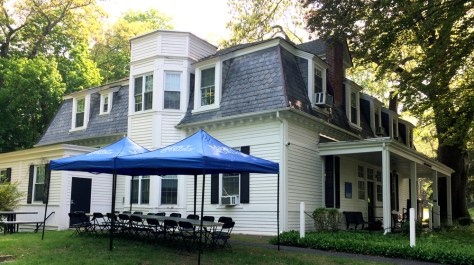
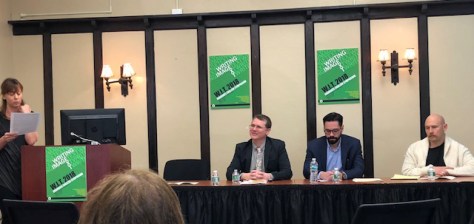
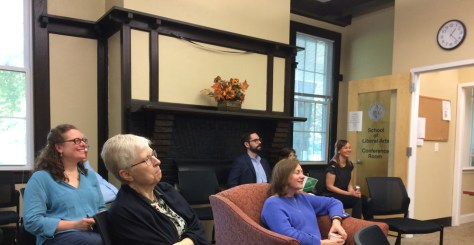
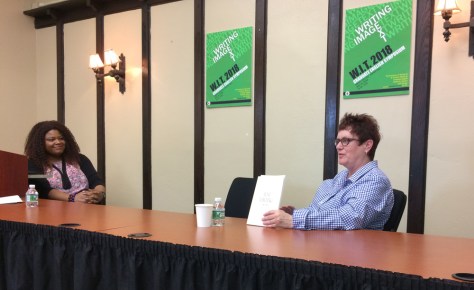
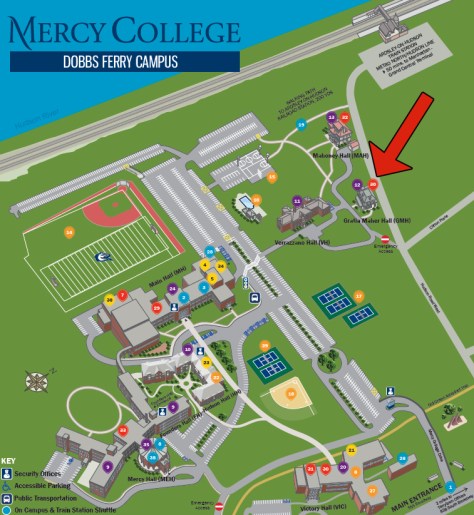
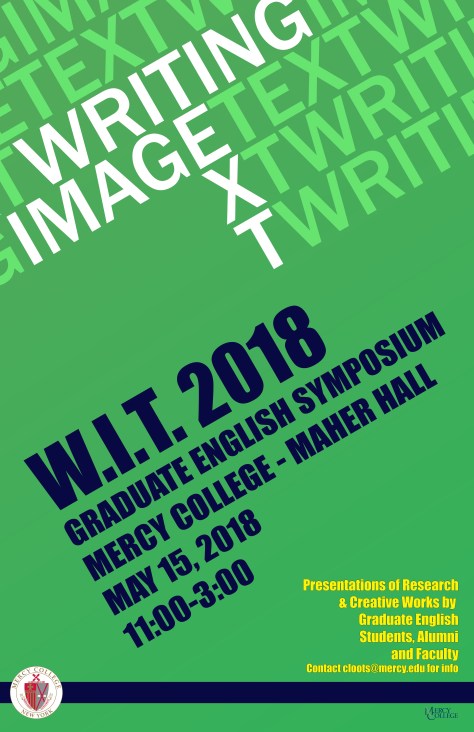
It’s that time again! This year’s Writing/Image/Text (W.I.T.) Graduate English Symposium will be held on Tuesday May 15 here on the Dobbs Ferry NY campus. May 15, in case it should matter to some of you, is the day before the School of Liberal Arts and the School of Education commencement ceremony. You can read about last year’s symposium here, if you’re interested.

The symposium is a casual mini-conference at which interested MA English students or alumni gather to read aloud a scholarly or creative paper (a paper that you’ve written for any of your MA courses will do just fine, though it must be edited to no longer than 10 pages), as well as to meet some fellow grad students and program professors. Family and friends are welcome to attend too. And MA students interested in attending but not reading aloud a paper are of course welcome to do so. Graduate students and professional scholars often attend and read at local, regional, and national conferences, so this symposium provides a friendly small-scale introduction to the conference experience. And for anyone who reads a paper, it becomes a line-item you can list under the scholarship section on your CV (click here to read more about the CV).

The symposium title “Writing/Image/Text” signals that you don’t have to just focus your presentation on literary analysis, as you traditionally would at an English conference, but might instead present work involving other media, other types of texts.

Anyone interested in attending, and in reading a paper, please let me know by sending a note as soon as possible to cloots@mercy.edu. I need to establish asap who all will attend, how many people will present, and how many overall to expect so that I can reserve the appropriate room space, order the right amount of catering (lunch provided courtesy of the MA program), and establish the necessary time-length for the entire event. Right now I have it as 11:00-3:00 but that could change depending on how many people respond. So please let me know soon, by mid-April at the latest, if you can attend, if you will read a paper, and how many people overall you will be bringing. Contact cloots@mercy.edu for answers to any questions you might have.

Recent Student and Faculty Achievements

I’d like to take a moment to recognize some recent achievements of current MA program students and alumni, as well as a recent faculty publication. In no particular order:

♦ Professor Emeritus Donald Morales recently published “An Afropolitan 2017 Update” in the Journal of the African American Literature Association. (https://doi.org/10.1080/21674736.2017.1375659)

♦ Active MA student Lynne Leibowitz-Whitehead has been awarded a Schiff Travel Grant to present a paper on John Updike’s Couples at the Fifth Biennial John Updike Society Conference at the University of Belgrade in Serbia this summer. Lynne has also been accepted to present a paper at the International Hemingway Conference in Paris this summer.

♦ Recent alum Gloria Buckley has been busy as well. She will be continuing her education in the Masters in Gaelic Literature program at University Cork College of Ireland. In the meantime she’s published two papers in the Journal of English Language and Literature: “Merlin the Political, Spiritual and Romantic Shape-Shifter in Robert de Boron’s Joseph of Arimathea, Merlin, Perceval and Edmund Spenser’s The Faerie Queene”; and “Edgar Allan Poe’s ‘The Fall of the House of Usher’: A Symbol of the Crumbling Borders of American and Psychic Consciousness and the Birth of Gothic Transcendence.” She also has a study of Virginia Woolf’s Orlando published here on the Virginia Woolf Blog.

♦ Alum Nicholas Cialini has been accepted into the PhD English program at Temple University. He will also be presenting at the International Hemingway Conference in Paris this summer.

♦ Alum Patricia Turner has been accepted into the Master of Fine Arts (MFA) program at the University of Denver.

♦ Alum Wayne Catan is aiming to present his scholarly paper “A Comparison of  Dreiser’s ‘Free’ and Hemingway’s ‘Mr. and Mrs. Elliot’” at the American Literature Association (ALA) and is working with faculty member Dr. Miriam Gogol on it.

Congratulations to everyone. If I have neglected to include news recently shared with me about our students’ or graduates’ activity please let me know at cloots@mercy.edu. And please, now or at any point in the future, keep me informed of any activity you’ve been up to, including conference presentations, publications, acceptances into doctoral or other subsequent programs, work activity, and the like. It’s important for us here in the MA program to maintain a view of how our students and graduates are faring beyond the program, and to celebrate your achievements.

On a semi-related note, in the next week or so I will be making the announcement here on the blog about the date for this year’s Graduate English Symposium. It will fall around the 5/16 commencement, most likely on the Saturday before or perhaps that Monday or Tuesday. I’m working out the scheduling details now but if anyone hopes to attend and has a preference for one of these days, please email me immediately at cloots@mercy.edu and let me know. I will make a more specific call for papers, to get a sense of who and how many people will be attending and presenting, along with the forthcoming symposium announcement. Stay tuned.

A Note About Courses Coded 514, 515, 540, and 560.

Registration has recently opened for summer and fall 2018 courses. For those who might not know, the program has four course numbers (514, 515, 540, and 560) which are not coded to specific courses, but instead work as shell numbers under which we cycle an assortment of different courses, sometimes our more experimental or newer courses. You are free to take as many instances of courses by these four numbers as you like to meet your field requirements or electives, including multiple instances of courses running by the same number: as long as the courses aren’t actually the same.

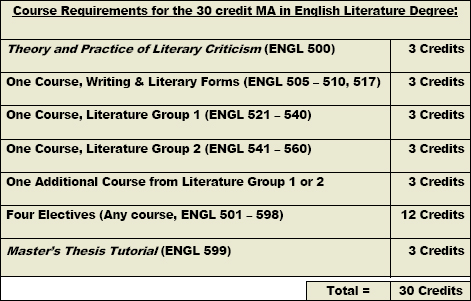
So in other words a student can take ENGL 540 Magic in Literature and ENGL 540 Mastering the Past, two different courses running at different semesters by the same 540 course code. Or, a student taking ENGL 560 African and Caribbean Lit. this spring semester can take ENGL 560 Hemingway: Modern Cryptography in the fall. As long as you’re keeping your ten-course/30-credit requirement in view, and are adhering to it, all will be fine. As a reminder, here’s that ten-course/30-credit degree requirement:

I should note that when you have multiple instances of the same course number on your transcript, it doesn’t immediately show up on your self-service degree audit in DegreeWorks (accessible in Mercy Connect, in case you didn’t know). We here go through the audits every year and manually flip a switch in the computer system that makes multiple instances of the same course number apply to the degree. That’s only to explain why if you do take multiple instances of courses running by one of these four numbers they might not immediately show up on your audit.

More info on Joining Sigma Tau Delta, the English Honors Society

Hi all, in response to my post from 2/12 a number of you have already been in contact with Dr. Horton about joining Sigma Tau Delta. Great! Here’s some more information about the organization, the membership process, and, for anyone who can attend, the induction ceremony:

Sigma Tau Delta was established in 1924 to confer distinction for high achievement in English language, literature, and writing. It now includes 825 chapters in the United States and abroad. Membership in this prestigious honor society is something you can list on your resume under “professional organizations” and membership will also provide you with resources and networking opportunities in our field of English. To be eligible graduate students must be actively enrolled in a graduate program, have completed six credits of graduate coursework, and have a minimum 3.3 GPA.

PAYMENT

Lifetime membership requires a one-time fee of $40. If you are eligible and would like to join, please submit a $40 check or money order made out to Mercy College. (Just to be clear, we send the entirety of this fee to Sigma Tau Delta, but the college collects all fees and then cuts one check to send on behalf of our college’s Alpha Alpha Phi chapter. Any check or money order that is not made out to Mercy College will be returned to you as we will not be able to deposit it).

When writing a check or money order include your name and Mercy ID# in the memo-line of the check. Mail (or hand deliver) the check or money order to:

Dr. Dana Horton
Mercy College
Maher Hall #208
555 Broadway
Dobbs Ferry NY 10522

Students may also pay in cash but you cannot send cash through the mail. You must hand-deliver cash to Dr. Horton or to the department administrator, Linda Dubiell, in Maher Hall on the Dobbs Ferry campus.

The deadline for receiving this payment of $40 is Tuesday, March 20, 2018.

INDUCTION CEREMONY

Inductees, along with family and friends, are cordially invited to Mercy College’s Honors Day Induction Ceremony taking place on Tuesday, May 8, 2018, beginning at 5:00pm in Lecture Hall on Dobbs Ferry campus with a dinner reception to follow in the Main Hall Cafe. There is no limit to the number of guests you may invite; we only ask you to let Dr. Horton know now how many will attend so that we can order adequate catering. Attendance at the May ceremony is not required for membership.

We of the English literature faculty at Mercy College hope that you will join the Alpha Alpha Phi chapter of Sigma Tau Delta, a tradition here at Mercy College since 1991. If you have questions, please reach out to Dr. Dana Horton at dhorton1@mercy.edu.

FINAL Registration Update: Fall and Summer 2018 Registration Opens 3/7.

The Registrar has now finalized the registration-opening date for fall and summer 2018. March 7, 2018, is the day. The only possible variation is for veterans, who can register early on 2/28. If you indicated on your college application that you are a veteran I am assuming that your account will be green-lit for registration on 2/28. If anyone is a veteran and is not able to register on 2/28 let me know.

Interested in Joining the English Honors Society, Sigma Tau Delta?

If you’re interested in joining Sigma Tau Delta, which is the International English Honors Society, registration is about to open. To be eligible graduate students must be actively enrolled in a graduate program, have completed six credits of graduate coursework, and have a minimum 3.3 GPA. Dr. Dana Horton (dhorton1@mercy.edu) is the Sigma Tau coordinator this year and is the one to contact about this, but please let me know as well if you intend to join (cloots@mercy.edu). There is a one-time membership fee, the payment of which you would coordinate with Dr. Horton. A Sigma Tau induction ceremony takes place at the end of each spring semester on the Dobbs Ferry campus. Inductees and any families/friends are invited and encouraged to attend though attendance is not required for membership.

Spring Semester Begins Today Wednesday 1/17

Just a reminder here that your spring semester courses begin today (“today” if you’re reading this on Wednesday, January 17th). Everyone should check into their courses asap and preferably before the end of the day in order to see what’s going on in your classes, what’s expected of you this first week and throughout the semester, and to get into the flow of the semester right from go. Have a great semester, everyone.

UPDATED 3/26: Summer and Fall 2018 Schedules & Related Info [change in summer offerings]

Registration will open in early February for both the summer 2018 session and fall 2018 semester. I will update here the specific registration-opening date/time when I learn it. Registering on the morning of the day registration opens is the only way to ensure you get into your preferred courses. This is especially important for students who need to take 500 this fall.

Below I will list the tentative but mostly settled course schedules for summer and fall 2018. Note that students do not have to take courses or maintain matriculation during the optional summer session, and because many students prefer to follow the traditional fall/spring schedule we run a shortened schedule during summers. (Courses most subject to change are listed in blue.)

Fall 2018
  • ENGL 500 Theory (Dr. Vasile)

This is the program’s core course, meaning the course that everyone must take and for which there are no alternative course options. This course runs once each fall semester, so if you’re aiming to graduate at the end of fall 2018, spring 2019, or summer 2019 and have not yet completed 500, you must enroll in this for fall 2018. The next instance of the course will be fall 2019. Here’s the catalog description for the course:

An introduction to major movements and figures of the theory of criticism, the question, “what is literature?” is the primary concern of this course. Such an inquiry necessarily engages other, closely affiliated signifiers such as work/text, writing, reading, interpretation, and signification itself. After brief encounters with ancient antecedents and seminal moderns, influential contemporary approaches to the question concerning literature and its cultural significance are engaged. An assessment of the relative strengths and weaknesses of current trends in the practice of literary criticism, and their theoretical groundwork, is the ultimate objective of this course. 3 credits.

  • ENGL 507 Narrative Strategies in the Novel (Dr. Fritz)

This course will study the novel and various narrative methods used in the novel over the centuries and across the British and American traditions. 3 credits. (Fulfills either the Writing & Literary Forms field requirement or an elective.)

  • ENGL 515 Graphic Novel (Dr. Medoff)

In this course we will explore the ways in which meanings emerge in several celebrated texts of the graphic novel genre, as well as some emerging classics. Our readings of these texts will be informed by a diversity of theoretical perspectives, including visual culture studies, postmodernism and intersectionality. We will interrogate the relationships between the concepts “graphic novel” or “comic book” and “popular culture,” with each of us bringing our lived experiences to our readings and discussions. Through in-depth studies of several primary texts, including Watchmen, Maus, Fun Home, and V for Vendetta, we will learn how graphic novelists use and manipulate historical and contemporary social issues as the building blocks for their art. 3 credits. (Fulfills an elective).

  • ENGL 524 Reason & Imagination (Dr. Sax)

This study of English literature between 1650 and 1850 examines Neoclassicism and Romanticism as two opposed aesthetic and philosophical stances. It traces the political, ideological, and literary roots of Neoclassicism in the English “Glorious Revolution” of 1688, the late seventeenth-century growth of rationalism and empirical science, followed by the flowering of Neoclassicism and then the shift in sensibility that led to the emergence of Romanticism. 3 credits. (Fulfills a Literature Group 1 field requirement or an elective).

  • ENGL 525 Victorian Age in Literature (Dr. Dugan)

This course will explore representative literature and the culture of the Victorian Age ( 1837-1901), a period of exploration, industrialization, empire, and imperialism. The poetry and novels of Tennyson, Carroll, the Brontes, Eliot, Wilde, and others will be approached from a variety of critical approaches. Particular attention will be given to the importance of gender, class, and societal expectations. (Fulfills a Literature Group 1 field requirement or an elective).

  • ENGL 560 Hemingway/Modern Cryptography (Dr. Loots)

This course follows Ernest Hemingway, through his writings, from his early days in Paris to his final moments in Ketchum, Idaho. Readings will include many of his major novels and short stories, and some non-fiction. By exploring Hemingway’s travels and writings we will experience through his eyes the rise of modernity; the unprecedented way that the world changed forever in the early twentieth century; and the relationship of modernism to modernity. We will consider the interrelated effects of Hemingway’s self-engineered celebrity status—as the rugged bearded “macho” world traveler—which coincided precisely with the rise of modern media technology, and exceeded his literary fame even within his lifetime. That is, we will examine how and why Hemingway was the first global celebrity. And we will consider what complex interior aspects Hemingway’s hyper-macho exterior perhaps worked to obscure.

The angle by which we will engage Hemingway’s writings and groundbreaking style is to consider them as written in modernist code. Throughout the semester we will work to decipher Hemingway’s modern crytography so to interpret/intuit what meanings lurk in the writings of this giant of 20th-century American literature, arguably the most influential American writer of all time. (Fulfills a Literature Group 2 field requirement or an elective).


Summer 2018
  • ENGL 510 Theory/Practice of Expository Writing (Dr. Dugan)

The course is especially encouraged for any student who is a teacher or who aspires to teach secondary school or college. The course will address the techniques of expository writing as reflected in academic discourse. Ideally, students will learn the general practices of critical writing, but focus their work in their individual fields of interest. These interests may include feminist approaches, deconstructive approaches, research in culture, education, etc. The course will specifically address techniques of analytic organization, and will consider the pedagogy and andragogy of writing. 3 credits. (Fulfills either the Writing & Literary Forms field requirement or an elective.)

  • ENGL 515 Magical Realism/Latin American Lit  (Dr. Filc)

We’re excited to offer this course run by scholar and writer Dr. Judith Filc. The course will involve a focus on “magical realism” but as Dr. Filc writes: “It won’t be strictly magical realism. We will work on three genres that have been very present in Latin American literature throughout the twentieth century and into the twenty-first – the grotesque, the fantastic, and the chronicle – in relation to magical realism and the so-called Latin American Boom.” (Will fulfill a Literature Group 1 requirement, or a Literature Group 2 requirement, or an elective: whichever each student needs most for their transcript at that point).
3/26: I’m sorry to report that this 515 class will not run due to unforeseen circumstances. Contact cloots@mercy.edu with any questions.

  • ENGL 540 Mastering the Past, Literature and National Myths (Dr. Sax)

Every country likes to see itself as heir of to a glorious past, filled with heroic and ultimately successful struggles against oppression. But the construction of such a narrative always leads to the repression or trivialization of uncomfortable aspects of the past. Important authors of Antiquity such as Homer and Virgil have created national myths, while others such as Sophocles and Euripides have challenged them. If the myths themselves can often serve to rationalize complaisance, injustice and chauvinism, correcting them involves hazards as well. It can reopen old resentments, leave people disoriented, and open the way for other, similarly dangerous illusions. This course will look at the contrasting ways in which modern and contemporary writers have tried to come to terms with the collective past, and will likely include readings by Faulkner (USA), Sebald (Germany), Solzhenitsyn (Russia), Lampedusa (Italy) and Ishiguro (Britain and Japan). Students will endeavor to evaluate their intellectual strategies, especially in the light of current controversies such as whether we should continue to display statues that commemorate dubious legacies. Questions to be addressed will include: Can we ever truly come to terms with the past? Can the brutalities of history ever be redeemed or compensated for? What lessons, if any, can we legitimately learn from history? Are some aspects of history better left forgotten?


And for those who really want to look ahead, here’s a HIGHLY TENTATIVE list of current ideas for the spring 2019 schedule:

  • ENGL 514 Animals in Literature
  • ENGL 507 History of Drama
  • ENGL 522 Humanism in Renaissance Text
  • ENGL 540 James Joyce’s Ulysses
  • ENGL 542 Classics of African American Lit
  • ENGL 546 Working Women’s Literature


Some Book Orders & Related Info for Spring 2018 Courses [Updated 1/2]

Below is some information about the book orders for the spring 2018 MA courses. I will update this with relevant information as professors share it with me leading up to the spring semester, and will add missing ISBNs below as I learn them. This mostly just duplicates the book orders listed for each class at the Mercy College online bookstore, but might also contain additional information that isn’t made clear by the bookstore list (for example, that for ENGL 543 you don’t need to purchase those specific books, and can rather use any source for the various readings throughout the semester if you prefer).

Note that you do not have to purchase your books through the Mercy Bookstore, but make sure that you get the right edition of a book if you purchase it elsewhere (assume that the edition matters unless your professor states otherwise). If you’re new to accessing books through the online bookstore you go to the site linked above, click to enter the textbook section, then go through a series of pull-down menus as follows: for term select SP Sem 2018; for department select ENGL; for course select whatever is the relevant course number, 509, 514, 521, 540, 543, or 560.

Below are the book orders (so far) for your spring courses.

ENGL 509 – Perspectives on the Essay

  • Jamison, Leslie. Best American Essays 2017. ISBN: 9780544817333

ENGL 514 – James & Lawrence

  • James, Henry. The Ambassadors. ISBN: 8780199538546
  • James, Henry. Daisy Miller. ISBN: 0141441348
  • James. Henry. Portrait of a Lady. ISBN: 9780141441269
  • Lawrence, D.H. Rainbow. ISBN: 0141441380
  • Lawrence, D.H. Sons and Lovers. ISBN: 048642121X
  • Lawrence, D.H. Women in Love. ISBN: 0486424588

ENGL 521 – Medieval Literature

  • Norton Anthology of English Literature, Volume A, 9th Edition. ISBN: 9780393912494

ENGL 540 – Magic in Literature

  • Hesiod. Theogony & Works and Days. ISBN: 9780192817884.
  • Hoffmann, E. T. A. The Golden Pot and Other Tales. ISBN: 0199552479.
  • Roob, Alexander. Alchemy: Mysticism. ISBN: 9783822850381.
  • Rowling, J. K. Harry Potter and the Sorcerer’s Stone. ISBN: 0439708184.
  • Sax, Boria. Imaginary Animals: The Monstrous, the Wondrous and the Human. ISBN: 9781780231730.
  • Shakespeare, William. Twelfth Night. ISBN: 9780140714890.
  • Yates, Frances, The Occult Philosophy in the Elizabethan Age. ISBN: 0415254094.

ENGL 543 – American Renaissance

You are not required to use these specific books and can use any source for the readings throughout the semester. The main disadvantage of using other sources is not being on the same page should I refer to specific pages during lectures or discussions, but that’s just a minor inconvenience and won’t often be an issue. When Blackboard sections becomes visible for previewing on January 3rd I will share there some specific readings for those who might want to start reading ahead.

  • The Norton Anthology of American Literature, Volume B, 9th Edition. ISBN: 9780393264470
  • Melville, Herman. Moby Dick. Norton Critical Edition. 2nd Edition (though 1st edition works fine). ISBN: 9780393972832

ENGL 560 – African & Caribbean Literature

  • Adebayo, Ayobami. Stay With Me. ISBN: 9780451494603
  • Danticat, Edwidge. The Dew Breaker. ISBN: 9781400034291
  • Phillips, Caryl. Color Me English. ISBN: 9781595588357
  • Williams, Ray. Sing Yer Hearts Out for the Lads. ISBN: 9780713682823
  • Walcott, Derek. Omeros. ISBN: 9780374523503.

The Incomplete “I” Revisited

As we approach the end of the fall 2017 semester let me remind (or inform) everyone about the situation surrounding the “incomplete” or “I” mark a student might request/receive in place of an actual grade. This post repeats information from earlier blog posts on this same subject, but this is critical information for program students to know so please make sure you’re all aware of this.

First off the incomplete might be granted by a professor to students who have completed most of the required work for a course and who have met attendance requirements. The incomplete is not for students who get buried under work and other responsibilities and need a little more time. It is intended for emergency situations, for students who experience an unexpected crisis (such as a debilitating illness) at a specific point during the term which unexpectedly interrupts their ability to complete all required work for a course. Each professor has the right to not grant an incomplete and instead grant some other grade, including an F, based on whatever work the student completed during the regular term.

Students who find themselves in a situation which might warrant an incomplete must request it of the professor. Even if the professor agrees, she or he might still require you to complete a form to initiate the incomplete.

Sometimes an incomplete can be a life-saver for students who experience sudden crisis, but in just about all cases students should avoid incurring an incomplete. Many students who take an incomplete never resolve it: because life goes on, new responsibilities and coursework come along, and it just becomes very difficult to find time to go back and do work on past requirements. It is also difficult for your professors to deal with incompletes because their work, responsibilities, and lives move forward but they now have to figure out how to accommodate, tend to, assess, and sometimes even just remember what this work is that a student left untended in the past. It is a big deal for everyone when a student takes an incomplete, which is one reason why a professor simply might not grant it.

If a student is granted an incomplete, the student should work to complete the missed work and so remedy the incomplete as soon as possible–and prior to the start of the next semester. At the maximum, students have one year in which to remedy the incomplete: after that year the potential credits for the course and tuition for the course are lost, and the incomplete cannot be changed into any real grade.

So for example students who have an incomplete from fall 2016 have only until the end of this current fall 2017 semester to remedy the incomplete. Once this semester ends, all fall 2016 incompletes are locked in and cannot be fixed. And note: sending your professors paperwork at 11pm on the 365th day of the year’s window is not acceptable. So, anyone still seeking to correct fall 2016 incomplete should be in the very final stages of resolving them. If anyone has any questions about this please, as always, contact the program director at cloots@mercy.edu.