All posts by madirector

The 2016 Graduate English Symposium

On Saturday, May 14th, a few MA students, alumni, family members, program faculty, and the Dean of the School of Liberal Arts gathered together at Mercy College for the 2016 Graduate English “Writing Image Text” symposium. The symposium took place in Maher Hall, the headquarters for the School of Liberal Arts on the college’s Dobbs Ferry campus. Below are a few photos from and information about the event.

001

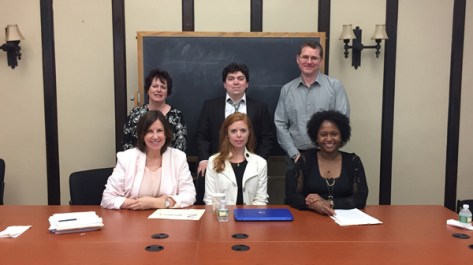
The two panels of presenters: seated, l-r, Dr. Miriam Gogol, Kit Gower, and Carol Mitchell; standing, l-r, Gloria Buckley, Nicholas Cialini, and Dr. Christopher Loots.

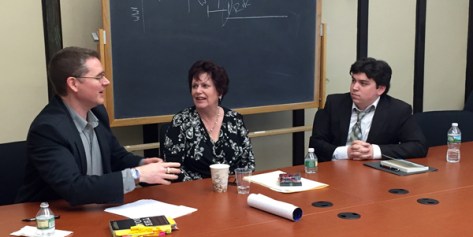
The MA program director, Dr. Loots, opened the symposium with welcomes and remarks, and then led the first panel sharing his research on “Entropy/Negentropy in Cormac McCarthy’s Fiction.” Gloria Buckley followed with her paper on “Whitman’s Free Verse: A Lyrical Embrace Shaped by Oration, Opera, Nature or War?” Nicholas Cialini, a recent alumnus and also now adjunct faculty in English at Mercy College, concluded the first panel with his study of “Eliot, The Eagles, Dylan, The Beatles: Modernism and Rock n’ Roll.”

003

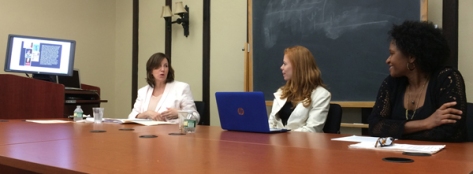
Following a lunch break, Dr. Gogol led the second panel with a discussion of her forthcoming book project, a collection of essays on Dreiser and his representations of women workers, for which she is the editor and a contributor (Dr. Gogol is the founder of the International Theodore Dreiser Society and a leading scholar in the field). Kit Gower followed with her study of “The Philosopher’s Dog: How Animal Characters in Children’s Literature Act as Guides for Transformation.” Carol Mitchell concluded the day’s research presentations with her paper on “Henry James’ What Maisie Knew and D.H. Lawrence’s ‘The Rocking-Horse Winner’:The Financial Morality Behind a (Literary) Childhood.”

002

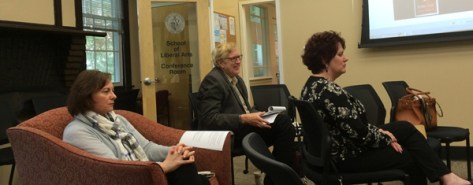
Below, Dean Jhashi (left) watches the second panel of presenters along with Dr. Dugan and Gloria.

004

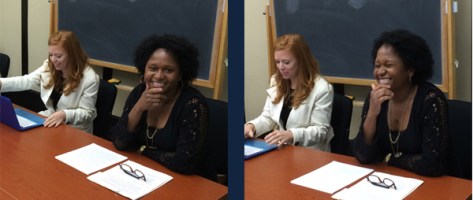
Below, Kit and Carol prepare for their panel to begin. Presenting CAN be fun!

005

All in all, it was an afternoon filled with collegiality, ideas, good conversation and laughter. All of us here in the MA program and the greater School of Liberal Arts would like to thank all of our panelists and their guests for traveling to come together for this event. We look forward to seeing some and hopefully all of you again, as well as seeing some new faces, at next year’s 2017 symposium.

Writing/Image/Text Graduate English Symposium: Saturday 5/14

Writing Image Text 2016 Poster copy

Based on the responses that I received from students regarding availability and interest, on Saturday 5/14 the MA in English Literature program will be hosting a graduate English student symposium at Maher Hall on Mercy College’s Dobbs Ferry campus. A few students indicated that they could have made other dates/times, but 5/14 was the one that worked out for the majority of respondents. We have two current students and one alumnus scheduled to present a scholarly paper, and will have a few faculty sharing their scholarship as well. This will be a small, informal and friendly gathering to which all current and former students, as well as their friends and family, are invited. A catered lunch will be served compliments of the MA program. So if you’re anywhere within traveling distance that weekend and would like to come by and meet a few of the students and faculty from the program, please do (and please rsvp to cloots@mercy.edu if you plan to, so that I can get the size of the catering order correct).

Recent Publications of Mercy MA Faculty

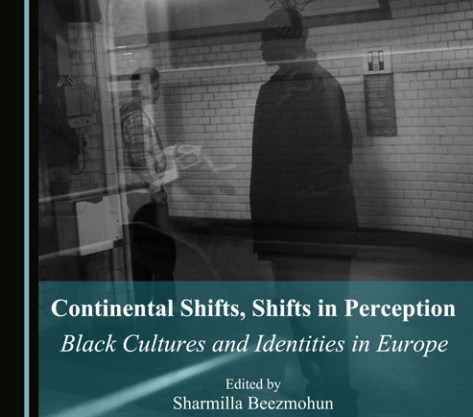
Dr. Donald Morales is Professor Emeritus at Mercy College, where as a full professor he has taught courses in Caribbean, African, and African American literature. He was awarded the 2009 “Mercy College Online Teacher of the year” (awarded annually to one professor out of the hundreds who teach online at the college; the MA program has three such award-winners actively teaching in it). This month sees the publication of his latest work, “American ‘Migritude’: The Flight of Black British Artists to the United States,” which appears as a chapter in a book to be released in just a few days: Continental Shifts, Shifts in Perception: Black Cultures and Identities in Europe.

Final Cover Image to Share.jpg-1

Dr. Morales is widely published and highly-regard in his field. Some of his other many publications include: “Do Black Theater Institutions Translate into Great Drama?” in African American Review (31:4, 1997). “Post-Apartheid Theater,” in African Visions (2000). “The Pervasive Force of Music in African, Caribbean and African American Drama,” in Research in African Literature. (34:2, 2003). “Garcia Marquez in Film: His Image of Women,” in Hispanic Connection: Spanish and Spanish-American Literature in the Arts of the World (2004). “Current South African Theater: New Dilemmas” in African Diasporas: Ancestors, Migrations and Boundaries (2008). “August Wilson & Derek Walcott, a Conversation Moderated by Paul Carter Harrison,” in Black Renaissance Noire (9:2/3, 2009/2010). And “Contemporary African-American Drama: Trends in Diaspora Performance,” in Diaspora Representation and the Interweaving of Cultures (2013). Dr. Morales is currently a member of the New York Jazz Workshop and plays soprano saxophone.

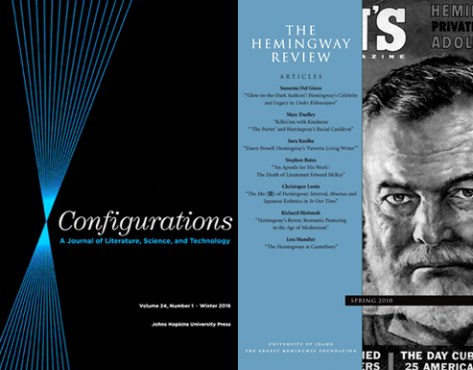
Dr. Christopher Loots is currently the head of the MA program in which he teaches American literature, modernism, and modern expatriate literature. His article “‘That Inscrutable Thing’: Holography, Nonlocality, and Identity in American Romanticism” has just been published in the latest edition of Configurations: A Journal of Literature, Science and Technology (24:1, 2016).

lootscovers

Other publications include “The MA of Hemingway: Interval, Absence, and Japanese Esthetics in In Our Time,” in The Hemingway Review (29:2, 2010), and “Wrinkles in Time: Tracing Joseph’s Trauma in Saul Bellow’s Dangling Man,” in Saul Bellow Journal (22:1, 2006). Research interests include interdisciplinary studies of American literature and science, and intercultural studies of American literature and Japanese religio-aesthetics. Currently he is completing a chapter for a collaborative book-project on Hemingway and Japanese aesthetics, to be published later in 2016, and is working on a study concerning entropy and negentropy in Cormac McCarthy’s fiction. Like Dr. Morales, Dr. Loots is also a winner of the “Mercy College Online Teacher of the Year Award.”

Second 500 Section Open: Those Waitlisted on First Section Must Manually Register to Be in Newly Opened Section

We have just opened a second section of ENGL 500 for the fall. There were over ten people on the waitlist for the original section. Those waitlisted people now need to go and actively register for the newly opened 500 section in order to be in it. There is no mechanism by which students on the waitlist are automatically enrolled in the new section. As two courses per-semester is the full-time load, every full-time student planning to take 500 this fall should consider taking that and one other course, so as to not be overwhelmed with reading and requirements for three courses. This may require you to drop a course in which you’re currently enrolled. Feel free to contact me for advising on this situation if you have any questions (cloots@mercy.edu).

Update regarding fall 500 and 599 courses.

After spring break, so starting in the first week of April, a second 500 section will open. Those on the waitlist will be able to enroll in this, and a few more seats will be available for others who need to take it this fall. Students seeking to enter a 599 thesis tutorial section and who have completed the procedures to get a 599 section opened (explained here, as well as in the program handbook downloadable in the left-hand menu of this blog) will start seeing this appear on their schedules early in April as well. Note that your mentor is the one who must notify me when you are ready to have your 599 section opened. There’s plenty of time to secure a 599 section for the fall so don’t panic if you don’t see it appearing on your schedule right away in April, or if you’re just discovering now the procedures for enrolling in the course. As always contact me at cloots@mercy.edu with any questions (though I will be away from email over spring break).

If You’re Needing 500 this Fall, Get on the Waitlist

Currently the fall ENGL 500 theory course is full with six additional people on the waitlist. If you were needing to take 500 this fall be sure to get on the waitlist too. Once the waitlist number reaches a certain point, we can work to open a second section of 500 to make sure that everyone gets a seat as needed. But we need the evidence of the people on the waitlist to justify to the administration opening the second section.

Seeking Feedback About Spring Symposium / Gathering

In years past the graduate English program has put together a symposium, sort of a mini-conference right here in Maher Hall, for interested MA English students at which to gather and read aloud a scholarly paper, as well as to simply meet some fellow students and professors. Graduate students and professional scholars often attend and read at local, regional, and national conferences, so this symposium can provide a friendly small-scale introduction to the conference experience. And for anyone who reads a paper, it becomes a line-item you can list under the scholarship section on your CV (click here to read more about the CV). The issue in recent years has been that, because our student-body has shifted in the past decade from being traditional/on-campus to being entirely distance-learning, we don’t necessarily have enough students within convenient driving/traveling distance of the campus who are interested in participating in the symposium.

Well, maybe this year will be different, and that’s what I’m seeking feedback about. If you would be interested in attending a program-hosted symposium, please send me a note at cloots@mercy.edu letting me know. If we get enough student interest we’ll schedule an afternoon, perhaps near to commencement in May so that anyone traveling to walk in the commencement ceremony can attend, during which we’ll have a catered reception and have a few panels sharing a bit of our scholarship/writing aloud to one another. Any topic, really any type of writing would be appropriate to share, including creative. Again, if you’re interested, just write me a note letting me know, please. I’ll update everyone here on this blog later this semester based on the feedback I receive.


Fall and Summer Registration Opens On Wed. March 2.

Fall and summer registration open at the same time this year, Wednesday March 2, usually at 9am eastern (when the Registrar comes to work and activates the system that morning). We’re running six courses in the fall and three in the summer. We don’t run as many summer courses because overall many of our students don’t take summer classes. The course offerings are as follows:

Fall 2016:

ENGL 500, Theory/Practice of Literary Criticism

Dr. Yunus Tuncel

An introduction to major movements and figures of the theory of criticism. The question “what is literature?” is the primary concern of this course. Such an inquiry necessarily engages other, closely affiliated signifiers such as work/text, writing, reading, interpretation, and signification itself. After brief encounters with ancient antecedents and seminal moderns, influential contemporary approaches to the question concerning literature and its cultural significance are engaged. An assessment of the relative strengths and weaknesses of current trends in the practice of literary criticism, and their theoretical groundwork, is the ultimate objective of this course. 3 credits. (Core course: required of all students for the MA degree).

ENGL 510, Theory/Practice of Expository Writing

Dr. Sean Dugan

The course is especially encouraged for any student who is a teacher or who aspires to teach secondary school or college. The course will address the techniques of expository writing as reflected in academic discourse. Ideally, students will learn the general practices of critical writing, but focus their work in their individual fields of interest. These interests may include feminist approaches, deconstructive approaches, research in culture, education, etc. The course will specifically address techniques of analytic organization, and will consider the pedagogy and andragogy of writing. 3 credits. (Completes either the Writing & Literary Forms field requirement or an elective).

ENGL 521, Themes & Genres of Medieval Lit.

Dr. David Fritz

This course is designed to cultivate students’ awareness of the themes, genres, and issues related to the study of medieval literature. Students will study the major genres of medieval literature, including epics, lays and romances. 3 credits. (Completes either a Literature Group 1 field requirement or an elective).

ENGL 524, From Reason to Imagination

Dr. Boria Sax

This study of English literature between 1650 and 1850 examines Neoclassicism and Romanticism as two opposed aesthetic and philosophical stances. It traces the political, ideological, and literary roots of Neoclassicism in the English “Glorious Revolution” of 1688, the late seventeenth-century growth of rationalism and empirical science, followed by the flowering of Neoclassicism and then the shift in sensibility that led to the emergence of Romanticism. 3 credits. (Completes either a Literature Group 1 field requirement or an elective).

ENGL 541, Search for Identity in American Lit.

Dr. Christopher Loots

This course will study the search for identity, individually and collectively, as it manifests in American literature from Colonial times through the turn of the twentieth century. Attention will be paid to the changing historical/cultural contexts from which such literature emerged, as well as to different literary movements (Romanticism, Realism, etc). Readings this fall will likely include works by Anne Bradstreet, Edward Taylor, Olaudah Equiano, Jonathan Edwards, Thomas Paine, Alexander Hamilton, James Madison, Phillis Wheatley, Philip Freneau, Poe, Emerson, Margaret Fuller, Whitman, Frederick Douglass, Henry James, Charlotte Perkins Gilman, Charles Chestnutt, W.E.B. Du Bois, and Paul Lawrence Dunbar. 3 credits. (Completes either a Literature Group 2 field requirement or an elective).

ENGL 542, Classics of African American Lit.

Dr. Donald Morales

Toni Morrison states in an interview with Paul Gilroy [Small Acts, 1993] that “My parallel is always the music because all of the strategies of the art are there.” It is no accident that her reference to music is echoed by other African American artists, for the music is the trope that best illuminates contemporary African American writing. Richard Powell in The Blues Aesthetic: Black Culture and Modernism specifies the blues as providing “much contemporary literature, theater, dance, and visual arts with the necessary element for defining these various art forms as intrinsically African-American.” It is from this perspective that this course analyzes various African American authors and texts, emphasizing those of the twentieth century. 3 credits. (Completes either a Literature Group 2 field requirement or an elective).

ENGL 599, Master’s Thesis Tutorial

Enrolling in 599 requires a different process which is explained in detail here.

Summer 2016:

ENGL 509 Perspectives on The Essay

Dr. David Kilpatrick

The course will study the essay as a distinct literary genre; its characteristics and types; its history; and its role in reflecting authorial consciousness. This course will examine the taxonomy of the essay in terms of its medium (verse or prose), its tone and level of formality, its organizational strategies, and its relationship to its audience and to particular modes of literary production (speech, manuscript, pamphlet, book, magazine, newspaper). It will trace the development of the essay from its origins to the modern era. 3 credits. (Completes either the Writing & Literary Forms field requirement or an elective).

ENGL 515, Lit. of the Spanish Golden Age

Dr. Celia Reissig-Vasile

This course will focus on two of the best known 16th and 17th century writers of the Spanish Golden Age, Miguel de Cervantes and Sor Juana Ines de la Cruz, and their most important literary works.  Miguel de Cervantes (1547-1616) is best known for his novel Don Quixote de la Mancha, regarded as the first modern novel and one of the world’s literary masterpieces. Through a close reading and analysis of this novel, we will focus on questions of literary, linguistic, cultural, and historical heterogeneity.  We will come to understand why so many celebrate Cervantes for teaching us “to comprehend the world as a question.”  It is both a parody of classical morality and chivalry and critique of Spain’s rigid social structures.  Sor Juana Inés de la Cruz (1651-1695) was a poet, playwright, essayist and scholar.  She is considered one of the most important literary figures of the American Hemisphere and Spain.  Although she lived in a colonial era when Mexico was part of the Spanish Empire, she is considered today both a Mexican writer and a contributor to the Spanish Golden Age. Sor Juana Inés de la Cruz was an exceptional seventeenth-century nun who set precedents for feminism long before the term or concept existed and is considered the first feminist writer of the Americas. Two of her most important works will be examined in this course:  A Philosophical Satire and  Reply to Sor Filotea. 3 credits. (Completes an elective).

ENGL 517 Advanced Creative Writing

Dr. Kristen Keckler

This course is intended for writers with some background or preparation, whether personal or formal, in creative writing. The course continues to develop each student’s creative writing ability through a close study of various writing styles and techniques, matched with assignments and workshops which encourage the students to further develop their own creative writing informed by such literary study. The emphasis of the course will shift depending on the expertise of the professor running it, and could involve poetry, narrative, or other forms. 3 credits. (Completes either the Writing & Literary Forms field requirement or an elective).

Special Event: Harper Lee Book Discussion / Gathering at Dobbs Ferry Public Library, 2/25, 5:00pm.

For anyone who might be in the Hudson Valley/New York City  area on Thursday, February 25, the College’s Honors Program is hosting a book discussion and pizza dinner in Dobbs Ferry, the village in which Mercy College’s main campus is located. The book under discussion is Harper Lee’s Go Set a Watchman. Lee passed away today, 2/19, and so this will also surely involve people sharing other reflections on their experiences with Lee’s work. The Dobbs Ferry Public Library and Mercy College have long collaborated in a “Town & Gown” series bringing together college faculty, students, and community residents. Everyone is welcome, and in particular English literature students of both graduate and undergraduate level are encouraged to attend. Click here to RSVP for this event.

Go Set a Watchman_Page_1