Some Book Orders & Related Info for Spring 2018 Courses [Updated 1/2]

Below is some information about the book orders for the spring 2018 MA courses. I will update this with relevant information as professors share it with me leading up to the spring semester, and will add missing ISBNs below as I learn them. This mostly just duplicates the book orders listed for each class at the Mercy College online bookstore, but might also contain additional information that isn’t made clear by the bookstore list (for example, that for ENGL 543 you don’t need to purchase those specific books, and can rather use any source for the various readings throughout the semester if you prefer).

Note that you do not have to purchase your books through the Mercy Bookstore, but make sure that you get the right edition of a book if you purchase it elsewhere (assume that the edition matters unless your professor states otherwise). If you’re new to accessing books through the online bookstore you go to the site linked above, click to enter the textbook section, then go through a series of pull-down menus as follows: for term select SP Sem 2018; for department select ENGL; for course select whatever is the relevant course number, 509, 514, 521, 540, 543, or 560.

Below are the book orders (so far) for your spring courses.

ENGL 509 – Perspectives on the Essay

  • Jamison, Leslie. Best American Essays 2017. ISBN: 9780544817333

ENGL 514 – James & Lawrence

  • James, Henry. The Ambassadors. ISBN: 8780199538546
  • James, Henry. Daisy Miller. ISBN: 0141441348
  • James. Henry. Portrait of a Lady. ISBN: 9780141441269
  • Lawrence, D.H. Rainbow. ISBN: 0141441380
  • Lawrence, D.H. Sons and Lovers. ISBN: 048642121X
  • Lawrence, D.H. Women in Love. ISBN: 0486424588

ENGL 521 – Medieval Literature

  • Norton Anthology of English Literature, Volume A, 9th Edition. ISBN: 9780393912494

ENGL 540 – Magic in Literature

  • Hesiod. Theogony & Works and Days. ISBN: 9780192817884.
  • Hoffmann, E. T. A. The Golden Pot and Other Tales. ISBN: 0199552479.
  • Roob, Alexander. Alchemy: Mysticism. ISBN: 9783822850381.
  • Rowling, J. K. Harry Potter and the Sorcerer’s Stone. ISBN: 0439708184.
  • Sax, Boria. Imaginary Animals: The Monstrous, the Wondrous and the Human. ISBN: 9781780231730.
  • Shakespeare, William. Twelfth Night. ISBN: 9780140714890.
  • Yates, Frances, The Occult Philosophy in the Elizabethan Age. ISBN: 0415254094.

ENGL 543 – American Renaissance

You are not required to use these specific books and can use any source for the readings throughout the semester. The main disadvantage of using other sources is not being on the same page should I refer to specific pages during lectures or discussions, but that’s just a minor inconvenience and won’t often be an issue. When Blackboard sections becomes visible for previewing on January 3rd I will share there some specific readings for those who might want to start reading ahead.

  • The Norton Anthology of American Literature, Volume B, 9th Edition. ISBN: 9780393264470
  • Melville, Herman. Moby Dick. Norton Critical Edition. 2nd Edition (though 1st edition works fine). ISBN: 9780393972832

ENGL 560 – African & Caribbean Literature

  • Adebayo, Ayobami. Stay With Me. ISBN: 9780451494603
  • Danticat, Edwidge. The Dew Breaker. ISBN: 9781400034291
  • Phillips, Caryl. Color Me English. ISBN: 9781595588357
  • Williams, Ray. Sing Yer Hearts Out for the Lads. ISBN: 9780713682823
  • Walcott, Derek. Omeros. ISBN: 9780374523503.

The Incomplete “I” Revisited

As we approach the end of the fall 2017 semester let me remind (or inform) everyone about the situation surrounding the “incomplete” or “I” mark a student might request/receive in place of an actual grade. This post repeats information from earlier blog posts on this same subject, but this is critical information for program students to know so please make sure you’re all aware of this.

First off the incomplete might be granted by a professor to students who have completed most of the required work for a course and who have met attendance requirements. The incomplete is not for students who get buried under work and other responsibilities and need a little more time. It is intended for emergency situations, for students who experience an unexpected crisis (such as a debilitating illness) at a specific point during the term which unexpectedly interrupts their ability to complete all required work for a course. Each professor has the right to not grant an incomplete and instead grant some other grade, including an F, based on whatever work the student completed during the regular term.

Students who find themselves in a situation which might warrant an incomplete must request it of the professor. Even if the professor agrees, she or he might still require you to complete a form to initiate the incomplete.

Sometimes an incomplete can be a life-saver for students who experience sudden crisis, but in just about all cases students should avoid incurring an incomplete. Many students who take an incomplete never resolve it: because life goes on, new responsibilities and coursework come along, and it just becomes very difficult to find time to go back and do work on past requirements. It is also difficult for your professors to deal with incompletes because their work, responsibilities, and lives move forward but they now have to figure out how to accommodate, tend to, assess, and sometimes even just remember what this work is that a student left untended in the past. It is a big deal for everyone when a student takes an incomplete, which is one reason why a professor simply might not grant it.

If a student is granted an incomplete, the student should work to complete the missed work and so remedy the incomplete as soon as possible–and prior to the start of the next semester. At the maximum, students have one year in which to remedy the incomplete: after that year the potential credits for the course and tuition for the course are lost, and the incomplete cannot be changed into any real grade.

So for example students who have an incomplete from fall 2016 have only until the end of this current fall 2017 semester to remedy the incomplete. Once this semester ends, all fall 2016 incompletes are locked in and cannot be fixed. And note: sending your professors paperwork at 11pm on the 365th day of the year’s window is not acceptable. So, anyone still seeking to correct fall 2016 incomplete should be in the very final stages of resolving them. If anyone has any questions about this please, as always, contact the program director at cloots@mercy.edu.

Call for Submissions (Creative Writing) for the Mercy College English Journal

All creative writers in the MA program take note: we’re currently accepting submissions for potential publication in a new Mercy College English journal, Red Hyacinth, which our own Dr. Keckler has been designing along with other faculty and in coordination with our college’s Arts & Design faculty. The deadline for the current round of submissions is November 15. Click here to download the submission guidelines and instructions. You can also click here to download a higher-quality PDF of the poster pictured above.

To find out more about the journal click here to visit the journal’s website.

Spring 2018 Schedule – [Update] Registration Opens November 1

Spring semester registration will open on November 1, usually in the morning when the Registrar comes to work and flips the switch so figure around 9am eastern. We are running the following six courses in the spring:

  • 509 Perspectives on the Essay (Dr. Keckler)

The course will study the essay as a distinct literary genre; some of its characteristics and types; some of its history; and some of its role in reflecting authorial consciousness. Further, this course will examine the taxonomy of the essay in terms of its medium (verse or prose), its tone and level of formality, its organizational strategies, and its relationship to its audience and to particular modes of literary production (speech, manuscript, pamphlet, book, magazine, newspaper, etc.). 3 credits. Fulfills either the Writing & Literary Forms field requirement or an elective.

  • 514 Henry James & D.H. Lawrence (Dr. Dugan)

I have long been interested and intrigued by the question of how one attains personal and social freedom in a society that seems to reward conformity. Is it possible? Or, does one pay a price, social, professional, emotional, for such attempts? Two writers from two different worlds–the American Henry James, the son of a wealthy philosopher, and the English D.H. Lawrence, the son of a coal miner and a factory worker–differ in writing style and subject yet explore the complexities of an industrialized society and personal relationships. We will read novels and short stories by each, including Lawrence’s The Rainbow and Women in Love, James’s The Ambassadors and Portrait of a Lady, as well as selected short stories. We will explore stylistics, characterizations, and themes in order to answer the question of how one resolves, if at all, conflicting demands of society’s expectations and the an individual’s quest for an understanding of self and of happiness. 3 credits. Fulfills an elective but can also meet a Lit Group 1 or 2 field requirement if a student requests it.

  • 521 Medieval Lit. (Dr. Fritz)

This course is designed to cultivate students’ awareness of the themes, genres, and issues related to the study of medieval literature. Students will study the major genres of medieval literature, including epics, lays and romances. 3 credits. Fulfills either a Literature Group 1 field requirement or an elective.

  • 540 Magic in Literature (Dr. Sax)

This course examines alchemy, together with related activities that now impress us as “magical,” as a virtually all-inclusive discipline which laid much of the foundation for later literature, art, and science. It looks at the beginnings of alchemy in the ancient world, and how these developed, along with the revival of Classical learning, in the Renaissance. Finally, it looks at the continuing influence of magic in Romantic, Modern, and Post-Modern literature and culture. Readings include works by Hesiod, Ben Johnson, Shakespeare, E. T. A. Hoffmann, J. R. Rowling and others. Textbooks include The Occult Philosophy in the Elizabethan Age by Frances Yates. 3 credits. Fulfills either a Literature Group 1 field requirement or an elective.

  • 543 The American Renaissance (Dr. Loots)

This course will study representative American writings from “The American Renaissance,” a period during the mid-nineteenth century (roughly 1832 to 1865) which saw the rise of the first truly non-Colonial, non-Revolutionary body of national literature; a literature which no longer concerned itself with European precedent, engagement, or approval. When F.O. Matthiessen coined the term “The American Renaissance” in 1941 he did so in light of five monumental American works by five different writers, all produced within five years (1850-55): Emerson (Representative Men), Thoreau (Walden), Melville (Moby Dick), Hawthorne (The Scarlet Letter), and Whitman (Leaves of Grass). Since Matthiessen’s time the notion of an American Renaissance has rightfully come to encompass a greater diversity of works, writers, and perspectives from this era. In this course we’ll read selections from across this American Renaissance, most likely engaging works by: Harriett Jacobs; Frederick Douglass; Harriet Beecher Stowe; Frances Harper; Sojourner Truth; Margaret Fuller; Sara Willis (Fanny Fern); as well as Emerson, Thoreau, Whitman and Melville. 3 credits. Fulfills either a Literature Group 2 field requirement or an elective.

  • 560 African & Caribbean Lit. (Dr. Morales)

This survey course of cross-generational writers from Africa and the Caribbean will take as its focal point the theme of the 2016 African Literature Conference in Atlanta: “Justice and Human Dignity in Africa and the African Diaspora.” The course looks at writers whose works address the idea of justice and human dignity in the domestic, political, religious and moral arenas. Some possibilities include Nobel Laureates Naguib Mafouz [Egypt], Wole Soyinka [Nigeria], V.S. Naipaul [Trinidad], J.M. Coetzee [South Africa], Nadine Gordimer [South Africa] and Derek Walcott [St Lucia]. Other options are Chimamanda Adichie [Nigeria], Jamaica Kincaid [Antigua], Edwidge Danticat [Haiti], Mariama Ba [Senegal], Tsitsi Dangaremba [Zimbabwe] and Athol Fugard [South Africa]. As a group these writers look critically at their societies, with, at times, grave consequences but nonetheless seek a just life for themselves and their fellow citizens. 3 credits. Fulfills either a Literature Group 2 field requirement or an elective.

Welcome to the 2017-18 School Year

Welcome, all you MA students both new and returning, to the 2017-18 school year of Mercy College’s Master of Arts in English Literature program. At the end of this letter I’m going to share some helpful program information/links. Before that though I want to encourage each of you, even challenge each of you to consider and pursue as best as you can the following four points over the course of this new school year.

I. Find Your Thing

Consider: what is your primary literary interest? What is the author, or type of literature, or era, or genre, or theoretical focus, or any other thing that you love to read, study and explore more than any other? Of course you each likely have many literary interests and loves, many different authors and works that come to mind. And naturally you might have a different answer depending on the day or semester. That’s all healthy, and the MA program encourages you to get prepared in and excited about a diverse range of writings, from traditional to eclectic. You should get a solid footing across as wide a range of writings as possible during your time in the MA program. But if you had to focus in on one area or author, on one thing that is your thing above all else, what would it be? Even if you’re just starting out the program and graduate studies you might still consider this in terms of: what was the literature that inspired you to pursue MA studies? Or: if you could design and teach one course on any topic, what would that topic be?

Why might you want to reflect on this now? Here are two of many reasons:

When you get to the final course in the program, ENGL 599, you’ll basically be asked to do this very thing—to select your favorite topic of focus and then to design a thesis and customized reading list around it. In many respects the 599 course is a custom course that you design and execute with the help of your mentor. If you start thinking now about what your thing is you should have an easy and fun time later when it comes to deciding upon a focus for your final 599 course.

Also: by becoming more conscious of your deeper interests and literary affections throughout your progress in the MA program, you can start personalizing your coursework—all of your coursework—in ways that can make any course more relevant to your personal interests. So for example you might find yourself taking Medieval Lit. in order to fulfill one of your Literature Group 1 requirements, and might (hopefully) find meaningful the study of the medieval texts and ideas. But maybe your thing is psychological approaches to literature, or British modernism, or gender studies, or Toni Morrison, etc. If so you can integrate any such pursuit into your medieval studies by (a) designing a paper topic that blends your particular interest with any course’s content, and (b) privately augmenting your required readings with other readings that cross between the course’s focus and your interests.  (More on that in a second).

You don’t have to take my advice here—perhaps you prefer to remain a bit more nebulous in your approach to education, and to absorb the curriculum as it comes to you rather than actively engage it and turn it as you like. That’s entirely up to you. I would understand that approach, as different approaches have different qualities. But I encourage you to at least reflect on this point here at the start of the new year: What is your thing?

II. Read Beyond the Syllabus

Your reading loads will vary, sometimes significantly, from class to class and from unit to unit. That’s just part of graduate literary study and is something each of you must balance and navigate in your own way, in your own time. But no matter your reading load you should consider your courses’ syllabuses as starting points. You don’t have to go deeper into and research further everything you encounter. Some semesters you might not read anything other than the specific syllabus texts and whatever sources you find for your term papers. Some semesters you’ll be so swamped with responsibilities that reading beyond the syllabus would be absurd (we only have so much time in the day, the week). That’s fair and understandable.

But when you do discover a reading or author that turns on the lights, well go off the syllabus and go research related primary and secondary sources. Don’t wait for your professors to tell you to go exploring off-syllabus. We hope that something we’re doing in class is sending off sparks which might ignite your further interests throughout the semester.

Remember that one thing the MA program seeks to do is develop you into a professional-level literary researcher and scholar. Going off-syllabus and exploring further the things that interest you is one sign that you are developing as we hope you will.

III. Upload an Avatar

Okay basic technical thing here but this is important. An avatar is an image that will appear alongside each post you make in every Blackboard class you’re taking. An avatar allows you to provide some small but meaningful visual representation of yourself which complements your written words, and it provides all of your fellow students with a recurring visual icon by which to get to know you better throughout the semester. Avatars are an essential part of any online community or learning environment and you should all have one. Click here for instructions for how to upload an avatar into Blackboard. There should be no avatar-less accounts in any online classroom.

IV. Make Friends

Distance learning, for all its strengths and advantages, has the potential (ironic) disadvantage of leaving some students feeling disconnected. Not every student feels this, and not every student cares. Some students actually prefer that they can orbit in and out of the virtual setting, meet their minimum commitments and do their work, and then get back to whatever is the rest of their life. That’s fine. Other students though value, yearn for, even need the connectivity and development that can happen, week in and week out, in the discussions. For those students here are a few suggestions for making sure you get the level of engagement you want  in discussions.

First, make the first move by responding to someone else’s post. That is, reply to other conversations rather than waiting for others to join in on a conversation you may have started. And don’t hesitate to join in on any conversation that seem to be “in progress” no matter how many others have already posted there. Those are the best conversations to join in as those are the closest the virtual room comes to matching the dynamic banter of a physical seminar session. I’m still waiting eagerly to see the single discussion thread in which every student participates. The bottom line here is to be proactive about talking to other people rather than waiting for someone to talk to you.

Also, get into the unit discussions early and come back at least a few times throughout the unit to develop and carry on discussions. If you’re looking to develop connections well don’t wait until the last few hours of a unit to sign in and make your posts. For one thing posts that appear at the very end of a unit will probably not get many or any responses due to the timing. For another thing, students look to see who shows up and when they do in order to figure out who’s looking to talk and converse and who’s just doing the basic requirements. Again, there is nothing wrong with just doing the basic requirements. For many students that is the great advantage of distance learning, that it gives you much more power and control over the timing of your weekly course responsibilities. But if you’re looking to talk, to discuss—to make a few colleagues or even friends—well signal this by jumping in earlier in the units and increasing your presence in the discussions.

Finally, and this gets at the situation from the other side: be friendly. Keep an eye out for those in the room who aren’t getting much feedback or response. Reply to them! Even if whatever they’re talking about isn’t something you’re interested in talking about, find something to say about their post which might carry the conversation forward a little. It can make a world of difference if someone gets even a little acknowledgement, just a little response, that lets them know that they’re not invisible. You all probably know how deflating it can be if you make a post and no one responds. Because you know that feeling, be on the lookout so that no one else has to experience it.

Okay that’s it for the four main points for this letter.

Before signing off let me link you to resources of which every MA student should be aware. This information repeats information found elsewhere on this blog. Okay this blog post here contains a rundown of resources and contact-info that Mercy College provides for its students, whether on-campus or online. On this post here you’ll find critical information about the incomplete “I” grade which some of you might occasionally receive. For those approaching their last semester, you must pay attention to your required comprehensive exam, to the instructions for how to enroll in the final 599 course, and to the application you must complete in order to graduate. For those hoping to enter the college teaching job market check out this post here where I introduce a variety of resources and information on that topic. If you’re going to be applying to anything in any academic field you’ll need to have your curriculum vitae (CV) polished up and also need to know the difference between a CV and a resume. I talk about that here.

Finally, remember that although you can get advising from Student Services, I serve as faculty advisor to every student in the MA program. I am here to help and to answer any questions at cloots@mercy.edu. Okay that’s it! Have a great school year and fall semester, everyone. The spring schedule and registration date/time will be posted here on the blog before the end of this month so as always, check back here periodically to stay up on the latest.

Best, -CL.

9/5/2017

Reminder: Fall Classes Begin Next Week – Wed. 9/6!

This is it, the final weekend before we start up our fall semester of graduate literary studies and a new school year overall. I hope that everyone has a great Labor Day weekend and that everyone is ready to get back into the groove of exploring literature (and your insights into literature and life) together. Even though the semester doesn’t begin until 9/6 your Blackboard courses are actually visible at this point. Your professors might have their Blackboard section sorted, primed and looking fine or it might still look like a construction zone. Different profs put together their courses in different ways, and on different schedules. But on 9/6 everything starts for real. I’ll be putting up a longer semester-welcome post here after the semester gets going but for now, enjoy the weekend and get ready to get into it all starting next Wednesday.

Withdrawing from courses / getting tuition refunded.

Sometimes when nearing a semester you find out that you need to drop a course in which you’re registered, and for which you’ve paid or had aid allocated. It’s important to note that in order to get some or all of your tuition refunded you must officially withdraw from the course. Even if you don’t attend/log into a course after it begins, that isn’t the same as withdrawing and technically you’re still in the course until you officially withdraw. The next thing to note is that the amount that you’ll be refunded depends on when you withdraw. Below is the policy as written in the Graduate Catalog:

  • Refunds

When a student officially withdraws from any course or courses by filing a formal withdrawal notice (Drop/Add Form) with the Office of Enrollment Services, refund of tuition will be made according to the below outlined schedule. See the course bulletin for specific refund dates. The date of withdrawal is the date upon which the formal withdrawal notice is received. Withdrawal may be processed at the Office of Enrollment Services or via the Web at Mercy Connect. Fees are non-refundable once courses begin.

Date of Withdrawal / Tuition Refund

Prior to second week of scheduled course meetings /100%

Prior to third week of scheduled course meetings / 80%

Prior to fourth week of scheduled course meetings / 50%

During or after the fourth week of scheduled course meetings / No Refund

Notice that as per those instructions the specific dates for each semester’s refund schedule will be listed in that semester’s bulletin. You can always find full digital versions of the catalog and bulletins here on the Mercy.edu site.

Fall Semester Begins Wed. 9/6. Students taking 599 this fall take note of Comprehensive Exam.

The fall 2017 semester begins on Wednesday 9/6. Even though our online courses run on a weekly unit schedule all students should sign in on the first or second day of the semester to read over the syllabus, get clear on the course policies and schedules, and see what activities your professors require of you that first week. Each professor will run her or his class a bit differently and have different requirements to which you’ll need to adhere.

For your reference you can always find the academic calendars for upcoming semesters published HERE on the Mercy website. MA courses are always “Term A” so refer to the Term A section of the academic calendars.

All students needing to take ENGL 599 this fall should be enrolled in their 599 section at this point. It will appear on your schedule like any other class if you are in fact enrolled in a 599 section. If you plan to take 599 this fall and are not already in a 599 section, contact me right now at cloots@mercy.edu and refer to this post for the procedures for getting into your 599 course. We will get you setup in time for the fall but this needs to get sorted now. Related: all students need to take and pass the program’s Comprehensive Exam before entering 599 and beginning their final semester. So for those taking 599 in the fall, if you have not yet taken and passed the Comp Exam contact me at cloots@mercy.edu now and we’ll get that taken care of.

I will be putting up my annual “welcome to the semester” post here on the blog in several weeks so check back at the start of the semester for that, and for other informational posts that might pop up this and next month.

Recent Faculty Activity (Publications, Presentations, Etc.)

For those curious, here are some of the things that some of your MA faculty have been up to/will be up to soon, professionally speaking:

Dr. Miriam Gogol, Professor of Literature, will be participating in the MS Screen Arts and Culture Forum at the Modern Language Association’s (MLA) 2018 Annual Convention in New York City. This session will examine Lois Weber’s newly restored silent film Shoes (1916) in relation to American naturalism, early-twentieth-century consumer culture, the working girl, and sexual mores. Dr. Gogol, editor of and contributor to Working Women: New Essays in American Realisms (forthcoming 2017) will compare the film to depictions of prostitutes and kept women in the American naturalistic fiction of that day (Stephen Crane’s Maggie: A Girl of the Streets [1893]; Theodore Dreiser’s Jennie Gerhardt [1911]; David Graham Phillips’s Susan Lenox: Her Fall and Rise [1917]; and Rachel Crothers’s Ourselves [1913], the only prostitute play by a woman performed in that era).

Anyone looking for a reason to see New York City and to gain some experience at professional conferences (see the post just below this one for more on why you might want to do that) should look into visiting the MLA conference here during the first week of January 2018 and attending Dr. Gogol’s presentation.

Dr. Celia Reissig-Vasile, Chair of the Dept. of Literature and Language in which the MA program is housed, received sabbatical leave last year to conduct research on historical memory and cultural production in the post-dictatorial period in Argentina and is now in the process of preparing her manuscript for publication. Her book will focus on Argentine film and literature as cultural manifestations of historical memory.

Her most recent publication is a chapter in the book Home: An Imagined Landscape (Solis Press 2016) edited by renowned writer and scholar Dr. Marjorie Agosin. Dr. Reissig-Vasile has also been invited to read her creative work at various events and venues in the past year: e.g. Po’Jazz at the Hudson Valley Writers Center in Sleepy Hollow, NY (May 2016); Art Speak at Blue Door Art Gallery in Yonkers, NY (June 2016); Writing to the Wall at the Hudson Valley Center for Contemporary Art in Peekskill, NY (July 2016); Mercy College Writers Corner at Mercy College (March 2017); and as part of Grupo Quetzal at the Stamford CT Library’s International Women’s Day (March 2017).

Cover art for Home (2016) and The Oxford Handbook of Animal Studies (2017).

Dr. Boria Sax, who teaches a range of courses in the MA program including his self-designed Animals in Literature and Magic in Literature courses, has had a typically busy and prolific year. Recent articles include “Animals in Folklore” which appears in the prestigious Oxford Handbook of Animal Studies (Oxford University Press, 2017). Also: “Animal Models and Utopias: ‘A Bird of Paris’ by J.J. Grandville, George Sand, and P.J. Stahl” which appears in Anglistik – International Journal of English Studies (27.2, 2017). And: “Zootropia, Kinship, and Alterity in the Work of Roberto Marchesini” which appears in Angelaki (21.1, 2016).

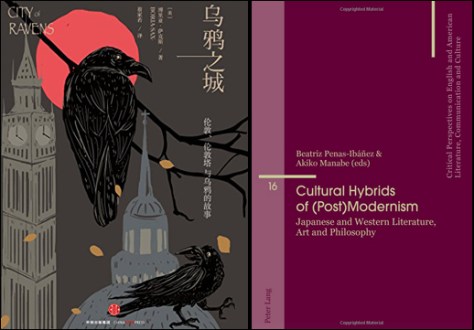
Furthermore, his 2012 book City of Ravens was recently published in Chinese translation (鸦之城:伦敦,伦敦塔与乌鸦的故事 , trans. Weng Jiaruo, Beijing: CITIC Press Corporation, 2016). The Chinese Mythological Society at Normal University in Beijing is just finishing up a translation of his 2013 book The Mythical Zoo. That edition is slated for publication in late 2017 and will be Dr. Sax’s third book translated into Chinese. And his 2003 book Crow has just been reissued by Reaktion Books of London. His next book is Lizard forthcoming from Reaktion Books in October 2017.

Cover Art for the Chinese translation of City of Ravens (2017) and for Cultural Hybrids of (Post)Modernism (2017).

Dr. Christopher Loots’ article “Nada and Sunyata in ‘A Clean, Well-Lighted Place'” was published as a chapter in Cultural Hybrids of (Post)Modernism: Japanese and Western Literature, Art and Philosophy (2017), as part of the Critical Perspectives on English and American Literature, Communication and Culture series. The book is edited by Beatriz Penas-Ibáñez and Akiko Manabe.

Dr. Sean Dugan, who has long had an interest in so-called “mid-brow” literature and media and popular culture, recently presented his research on Edna Ferber, Calder Willingham, and the Earle Stanley Gardener character Perry Mason as represented in the TV series at the South Atlantic MLA (SAMLA) conference as well as the College English Association conference. He is currently working on a paper for SAMLA 2017 on TV Noir and The Twilight Zone episode “Perchance to Dream” by Charles Beaumont. He continues to do research into his other field of interest, linguistics, and in particular accent perception, English grammar, and syntax (some of which he will apply in the 2017-18 year as a Faculty Fellow working with Dr. Miriam Ford of the Mercy College Nursing Dept. on reading comprehension and fluency in first year college students). Dr. Dugan regularly teaches MA courses on Irish Literature, Henry James and D.H. Lawrence, Composition, and Narrative Strategy.

Recent MA Student Achievements and Activity

I’d like to take a moment here as July turns into August, as our summer semester comes to an end and we begin looking to the fall semester and the new school year, to congratulate some of our program’s alumni and current students on various achievements and related scholarly activities.

First we’ve had a number of MA students and alumni gain acceptance into doctoral and MFA programs over the past year:

  • Amy Lou Ahava (MA 2015) was accepted into the PhD program at Marquette University.
  • Angie Still (MA 2014) was accepted into multiple PhD programs and of them plans to attend the PhD program at Texas Woman’s University.
  • Krystal Johnson (MA 2015) was accepted into the doctoral program at St. John’s Fisher College.
  • Gloria Buckley (active student, MA 2018) was accepted into the Savannah College of Art and Design (SCAD) MFA creative writing program and also into the Faulkner University doctoral program.

Again, congratulations! I’m always hoping to hear from all of our alumni and active students about any such news or accomplishments, and hope that anyone with anything to share will contact me at cloots@mercy.edu. We want our grad students and alumni to stay in touch and keep us updated on your doings, and hope that you all always will.

Of course moving on from the MA to a subsequent degree isn’t everyone’s goal. Many of our grad students are here for the MA as the end-goal in and of itself. I talk about some of the reasons the MA is a good degree in and of itself, and of the doors that the MA alone might open for you in last year’s annual welcome letter. Many of you, particularly our active secondary-school teachers, know that the MA degree on its own can be critically important for aspects of your job.

But for those who do see the MA degree as one step in a path toward a future doctoral or MFA program, I hope that you will find inspiring this news of the success of some of our students.

Now then! For grad students who aspire to doctoral study and particularly for those who hope to eventually secure some sort of college professorship, you may want to start thinking now about the scholarship section of your CV and start engaging, as much as you like and want, in the professional flow of the academic field. You don’t have to at this point: PhD programs are where you really would start getting serious about this stuff, not MA programs. But again, you may want to start at l east thinking about this while you’re here in the MA program. The “stuff” I’m talking about is attending and ultimately reading papers at conventions, conferences or symposiums. If that sounds like fun, well read on. If it sounds like something you’d rather not bother with or think about at this point in your studies, no worries.

One easy and very low-stakes way to get involved in such professional practice is to participate in our MA program symposium at the end of each school year (in May). But academic events are taking place all year round, some almost certainly within reasonable travel distance of wherever you’re living and reading this right now. The main place where English students and faculty find out about such upcoming events, and try to get involved in ones that look interesting, is UPenn’s “Call for Papers” (CFP) bulletin board linked here.

In recent exchanges with current MA student Lynn Whitehead I learned about a flurry of such activity that she’s been involved with this summer: from attending F. Scott Fitzgerald scholar Anne Margaret Daniel’s book reading in Woodstock NY, to listening to various presentations at the American Lit. Association (ALA) annual conference in Boston, to attending the annual F. Scott Fitzgerald Society Conference in Minnesota. Lynn took the time at each event to seek out and discuss ideas with various presenters, and as a result has made a number of helpful contacts. Several scholars she spoke with encouraged her to take the next step up from attending conferences and to present at conferences, and she’s already putting together proposals to do just that.

I share with you Lynn’s activities this spring and summer as an example of how any student in the program can (and if you aspire toward a doctoral program and/or professorship should) get involved in the professional current of our English field. You can do this no matter where you live in the world: start by seeking out conferences within a reasonable drive and just go and attend them. Make a day or weekend trip out of it. See how it goes, listen to panels, get a sense of what it’s like to be at a conference. Don’t be afraid to chat with people around you. Then check out the Upenn CFP page linked above and, look for CFPs that are in the area of your interests, and send out some paper proposals. Eventually something will work out and you’ll find yourself a part of a presentation panel at a conference.

So once again congrats Amy, Angie, Krystal, Gloria, Lynn, and everyone else in the program who’s been up to something similar but just hasn’t told me about it (in which case TELL me about it so I can share it in a future blog post!).


This is the director's blog for the Mercy University MA in English Literature Program. This is not the official University site.