
The W.I.T Conference is being postponed until the fall so that we can coordinate a bigger turnout. We’re thinking of collaborating with the undergraduate English program to have student panels and MA grad student panels. It would be good for our undergraduates to hear some of the more developed studies that our grad students or alumni are generating. Anyway that will take some more coordination and so we’re going to postpone the April event and try to get it up and running in the next school year. Thank you to those who volunteered to participate; I hope you’ll be up to participate again when the symposium comes to fruition. Best, all, -CL
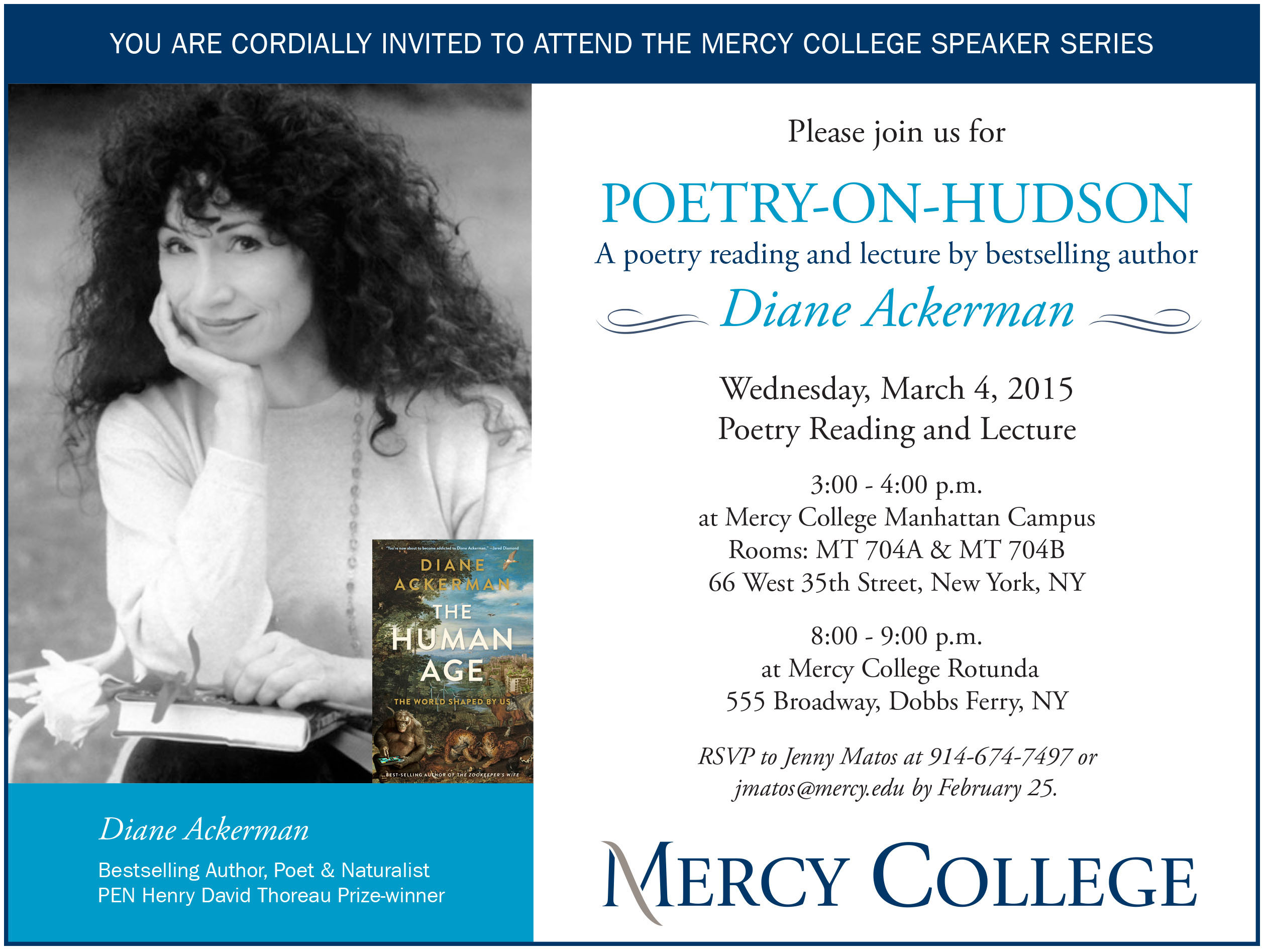
Diane Ackerman speaks at Mercy College Wednesday 3/4/2015.
If you’re in the New York Metro area this Wednesday and are interested in hearing a world-class writer (and NYTimes bestselling poet and essayist) give a reading and talk, come by the Manhattan or Dobbs Ferry campus of Mercy College. The event will be held on the Manhattan campus on Wednesday March 4th in rooms: 704A and 704B at 3:00 p.m-4:00 p.m and later that evening in the Rotunda on the Dobbs Ferry campus at 8:00 p.m. – 9:00 p.m. Call 914-674-7497 for more information.
Interested in Joining the English Honors Society, Sigma Tau Delta?
If you’re interested in joining Sigma Tau Delta which is the English Honors Society click here to open up a letter from the Chapter Sponsor/Coordinator here at Mercy College, Dr. Kristen Keckler, detailing how you can join. Dr. Keckler will also be teaching the graduate creative writing course over the summer, fyi. So read that letter if you’re curious and follow the instructions for how to join. Contact Dr. Keckler at kkeckler1@mercy.edu if you have any questions about this. Best, -CL
Curious about what this semester’s 599 Thesis Students are working on?
Well then click on the program poster icon in the left-hand panel (the third one down) to open a large poster-sized image that shows what our students in their final semester are working on for their thesis papers.
Fall 2015 Course Schedule; Registration Opens March 4th 9am Eastern.
It appears that registration for both summer and fall 2015 semesters is going to open at the same day and time this year. That’s really odd but that’s what they’re telling me. So, that means that fall registration opens on March 4th, just like summer. As I wrote in the summer-schedule post, it usually opens at 9am Eastern. Those of you who know that you MUST enroll in this fall’s running of 500 because you’re nearing the end of your time in the program should be online at 9am on the 4th in order to secure a seat in that course, a course which all students must take (consult the Graduate Student Handbook which you can download in the left-hand menu or refer to the post on the degree audit to see what courses you need for the MA degree). We’re running six courses in the fall, and here they are:
- ENGL 500 Theory and Practice of Literary Criticism.
Dr. David Kilpatrick
This course offers an introduction to major movements and figures of the theory of criticism. The question “what is literature?” is the primary concern of this course. Such an inquiry necessarily engages other, closely affiliated signifiers such as work/text, writing, reading, interpretation, and signification itself. After brief encounters with ancient antecedents and seminal moderns, influential contemporary approaches to the question concerning literature and its cultural significance are engaged. An assessment of the relative strengths and weaknesses of current trends in the practice of literary criticism, and their theoretical groundwork, is the ultimate objective of this course. This course is a core course and so is required of all students in the program. 3 credits.
- ENGL 506 History of Poetic Forms
Dr. Alison Matika
This course investigates the relationship between meaning and form. We are concerned with developing the depth of understanding afforded by close reading, precise writing, and shared discussion, and we will develop a coherent overall context that problematizes the consideration of poetic forms through both creative and critical engagements using full class and small group reading and workshop. This course fulfills the Writing & Literary Forms group requirement, or can count as an elective. 3 credits.
- ENGL 515 Working Women’s Literature in the US: 1865 to Present
Dr. Miriam Gogol
This online course will examine writings about working women from the post-Civil War era to the present. We will review key changes in the American work force, and social, economic, and racial factors since 1865, with attention to movements leading up to changes in the second half of the 19th century. We will use literature to help us deconstruct the definitions of “women,” “working,” and “The United States” up to the present writings about the millennials. We will inquire into the shifting definitions of the term “gender.” We will start with gender as a concept, a social construction reflecting differentials of power and opportunity. A goal of this course will be to deconstruct and reconstruct these and other pivotal terms. Breaking what the feminist writer Tillie Olsen calls the “habits of a lifetime” is not a trivial pursuit. One of the course’s goals is to accept contradictions and tensions, to be prepared for them, and know the history and benchmarks of major events in the lives of women. This course defaults to an elective but can be used to fulfill a Literature Group 2 requirement, upon request. 3 credits.
- ENGL 522 Humanism in Renaissance Texts
Dr. David Fritz
This course will focus on humanism and the concepts arising from it in relation to the production and appreciation of literature during the Renaissance. The revival of interest in the arts and ideas of Greco-Roman antiquity and the dependence of Renaissance thought on classical themes will be among the issues discussed. This course fulfills a Literature Group 1 requirement or an elective. 3 credits.
- ENGL 524 From Reason to Imagination
Dr. Boria Sax
This course looks at the tension between reason and imagination in representative literature from cultural movements such as neo-Classicism, Enlightenment and Romanticism. This course fulfills a Literature Group 1 requirement or an elective. 3 credits.
- ENGL 560 Modern Cryptography: Hemingway
Dr. Christopher Loots
This course follows Ernest Hemingway, through his writings, from his early days in Paris to his final moments in Ketchum, Idaho. Readings will include many of his major novels and short stories, and some non-fiction. The course will consider the interrelated effects of Hemingway’s self-engineered celebrity status—as the rugged bearded world traveler—which coincided precisely with the rise of modern media technology, and exceeded his literary fame even within his lifetime. The concept by which we’ll angle into our semester of study is that Hemingway’s writing, written in a then-groundbreaking style of seeming simplicity, might be considered a modernist code. Like any code, his method seeks to communicate hidden meanings which are not readily apparent upon casual read. Students will work to critically decipher Hemingway’s modern crytography so to interpret/intuit what meanings lurk in the writings of this giant of 20th-century American literature, arguably the most influential American writer of all time. This course fulfills a Literature Group 2 requirement or an elective. 3 credits.
As a final note, students who took the 514 Hemingway course a few years ago are not eligible to take this 560 Hemingway course.
Summer MA Courses and Registration Date/Time
This summer we have four graduate literature courses on the schedule. Three are summer standards and the fourth, Magical Realism, is a new offering being run by a professor who is an expert in Latino literature and Magical Realism. Registration for summer courses opens on March 4. The administration hasn’t sent out the specific time registration opens on this date but in the past it has been 9:00am Eastern. The four summer courses are:
- ENGL 509 Perspectives on the Essay
The course will study the essay as a distinct literary genre; its characteristics and types; its history; and its role in reflecting authorial consciousness. This course will examine the taxonomy of the essay in terms of its medium (verse or prose), its tone and level of formality, its organizational strategies, and its relationship to its audience and to particular modes of literary production (speech, manuscript, pamphlet, book, magazine, newspaper). It will trace the development of the essay from its origins to the modern era. 3 credits.
- ENGL 510 Theory & Practice of Expository Writing
The course is encouraged for any student who is a teacher or who aspires to teach secondary school or community college English, or to adjunct at senior colleges. But the course is also encouraged for anyone who simply wants to focus in on exploring and developing his or her own critical, expository writing. The course will address the techniques of expository writing as reflected in academic discourse. Ideally, students will learn the general practices of critical writing, but focus their work in their individual fields of interest. These interests may include aesthetic approaches, feminist approaches, deconstructive approaches, research in culture, education, etc. The course will specifically address techniques of analytic organization, and will consider the pedagogy and andragogy of writing. 3 credits.
- ENGL 517 Advanced Creative Writing
This course is intended for writers with some background or preparation in creative writing. “Some background” could simply be that you’ve worked in private on poems, essays, or stories; or that you’ve attended courses or workshops; or that you’ve been published. The idea is that each of you in the room will be continuing to develop whatever is your personal stage of creative writing prowess, rather than starting out from absolute zero. The course continues to develop each student’s creative writing ability through a close study of various writing styles and techniques, matched with assignments and workshops which encourage the students to further develop their own creative writing informed by such literary study. The emphasis of the course will shift depending on the expertise of the professor running it, and could emphasize or involve poetry, narrative, creative non-fiction, or other forms. 3 credits.
- ENGL 560 Magical Realism
A fuller description of this course will be forthcoming. In brief, though, it will explore Latino literature and in particular literature of Magical Realism, and will be taught by Dr. Celia Reissig-Vasile, an expert in this field.
The 10-Course Audit for your MA Degree
A “degree audit” is a template that I and your advisors look at when trying to determine what courses you still need to take to earn your MA degree, as well as to see how courses you’ve already completed work toward your degree. This audit is the new one, implemented just this past semester. We’re in a transitional phase where some of you are working under the previous audit, and some of you are working under this new audit. The audits are very similar and I and your advisors are making sure that all of your completed coursework counts toward your degree. Still, this audit uses new catalog numbers (for example, the 501 Medieval course which many of you have taken is henceforth 521 in the new order) so for students who have been in the program a while this audit might seem a little confusing. You still can and should contact me and/or your advisor for help with course selection, but I wanted to share this 10-course degree audit with you so that you have a clear view into the course requirements for the MA degree. Other than the final 599 course, which is always taken during the final semester, there is no required sequence in which to complete this coursework.
- ENGL 500 Theory of Criticism (required of all students)
- One course from 505-510, or 517
- One course from 521-540
- One course from 541-560
- One additional course from 521-560
- Elective – Any course from 501-598
- Elective – Any course from 501-598
- Elective – Any course from 501-598
- Elective – Any course from 501-598
- ENGL 599 Master’s Thesis Tutorial
Student News:
I’d like to take a moment here to note a few recent achievements of MA students, and to simultaneously ask all of you to keep me updated on any scholarly, creative, professional, or other related accomplishments or activities. Let’s celebrate you, and use your accomplishments and activities to inspire one another. In this post I’d like to call out Bernard Sell and Catherine Becker:
- Bernard Sell was awarded a National Endowment for the Humanities (NEH) grant to attend summer coursework on existentialism, teaching, and teaching existentialism.
- Catherine Becker has been accepted into the Idaho State University PhD program.
On behalf of all of the faculty in the program, congratulations and bravo, both! These are brilliant accomplishments.
Spring 15 Schedule is accurate in Connect, and ready for 11/5 9:00am Registration
The spring schedule is fully up and corrected in the online system. You will be able to enroll in any courses you wish starting at 9:00am eastern on 11/5. You will see some new catalog numbers and of course might have questions about what courses you should take. Please direct all such inquiries to me over the next weeks and months. I am here to advise all of you. Your academic advisors will help as best as they can, but this new structure will be new for them too. I am at cloots@mercy.edu.
Call for Papers: Sport Literature Association Conference, 2015
Students who plan to take the Sport Literature course in the spring (and anyone else interested) should consider submitting a paper proposal to the 32nd Annual Conference of the Sport Literature Association. It runs from June 24 through June 27, 2015, at East Tennessee State University in Johnson City, Tennessee. Dr. Kilpatrick plans to be there, and is hoping to see as many of you there as is possible. In case the above hyperlink to the call for papers is broken, the url is:
 Program Director's Blog for the Mercy University MA in English Literature Program