All posts by madirector

Book Lists for Some Spring 2017 Courses

Hi all, here are some of the book orders for spring 2017 MA courses. These might not be comprehensive lists for your course as some professors are still considering various readings for the spring semester. You should be able to buy any of these through Mercy’s online bookstore (this list just duplicates what you should be seeing in the Mercy bookstore). Or you can buy them elsewhere, probably for much cheaper.

ENGL 507 Narrative Strategies (Dr. Dugan)

  • Bronte, Emily. Wuthering Heights, 4th Norton Critical Edition.  London:Wordsworth, 2000. 13-978-039397895
  • Ford, Ford Madox. The Good Soldier. Oxford: Oxford UP, 2012. 878-0-958594-6
  • Ishiguro, Kazuo. Never Let Me Go. NY: Vintage International Edition, 2005. 13-978-1-4000-7877-6
  • James, Henry. The Bostonians. Penguin Classics, NY, 2000. 978-0-140-43766-9
  • Rhys, Jean. Wide Sargasso Sea (edition TBD–check online Mercy bookstore for specific edition)
  • Smith, Zadie. White Teeth. NY: Vintage International, 2001. 978-0- 375-70386-1
  • Stoker, Bram. Dracula. Mineola,NY: Dover Thrift, 2000. 13-978-0-486-41109-5

ENGL 522 Humanism/Renaissance Texts (Dr. Fritz)

Primary sources for the course will be identified later in the course syllabus and links to those sources provided in Blackboard. Here is the required supporting text for the course:

  • The Cambridge Companion to Renaissance Humanism (Cambridge Companions to Literature). 1st Edition. Ed. Jill Kraye. Cambridge: Cambridge UP.  2011. Print. ISBN: 9780521436243. Paperback.

ENGL 540 Animals in Literature (Dr. Sax)

  • Melson, Gail F. Why the Wild Things Are: Animals in the Lives of Children. Cambridge, MA: Harvard UP, 2001. ISBN—0674017528.
  • Sax, Boria. The Mythical Zoo: Animals in Life, Legend and Literature. 2nd ed. New York: Overlook, 2013. ISBN—1468307207.
  • Sewell, Anna. Black Beauty. New York: Penguin, 2011. ISBN— 0143106473
  • Tatar, Maria, ed. The Classic Fairy Tales. New York: Norton, 1999. ISBN—0-393-97277-1.
  • White, E. B. Charlotte’s Web. New York: HarperCollins, 2001. ISBN—0064410935.

ENGL 545 Lit of the Left Bank Paris (Dr. Loots)

This course involves other readings than the ones listed below but PDFs of these other readings will be provided (they’re mostly out of print and difficult to secure otherwise.) If a student wants to read ahead for the semester, you can’t go wrong reading as much of the Benstock book as you like. I’ll be assigning various chapters from it throughout the semester.

  • Benstock, Shari. Women of the Left Bank: Paris, 1900-1940. ISBN-13: 978-0292790407
  • Breton, Andre. Nadja. ISBN-13: 978-0802150264
  • Hemingway, Ernest. A Moveable Feast Scribner. ISBN-13: 9780684824994
  • Loy, Mina. The Lost Lunar Baedeker: Poems of Mina Loy. ISBN-13: 978-0374525071
  • Stein, Gertrude. Selected Writings of Gertrude Stein. ISBN-13: 978-0679724643
  • Wharton, Edith. Roman Fever and Other Stories. ISBN-13: 978-0684829906

ENGL 546 Working Women in the US (Dr. Gogol)

  • Ware, Susan.  Modern American Women: A Documentary History. Second Edition. New York: McGraw-Hill, 2000.
  • Baxandall, Rosalyn Fraad and Linda Gordon. America’s Working Women: A Documentary History,  1600 to the Present (1976). Revised  and updated. New York: Norton, 1995.
  • Schneir, Miriam, Ed. Feminism in Our Time: The Essential Writings: World War II to the Present. New York: Vintage Books,  1994.
  • Browne, Rita Mae. Rubyfruit Jungle.

ENGL 560 Latino Literature (Dr. Reissig-Vasile)

Other readings will be listed in the course syllabus when the class opens. For now, these are books you’ll need early in the semester.

  • Anaya, Rudolfo. Bless me Ultima. Grand Central Pub, 1995. ISBN-13: 9780446600255
  • Garcia, Cristina. Dreaming in Cuban. Ballantine Books, 1993. ISBN-13: 9780345381439

How Many Courses Should You Take Each Semester (Full Time? Part Time?)

Registration for spring opens tomorrow so let’s talk about how many courses you should enroll in on any given semester.

The MA program has since its inception considered two classes/semester to be full time, as this is (with some exceptions) an industry standard for MA English. Recently though the College has gotten loud with us about its overarching full-time/part-time policy, which is officially that full time is three courses/semester, and any less is considered part-time. This does not mean you should take three courses per semester if you’ve been taking two courses/semester up to this point.

Absolutely nothing has changed in terms of financial aid, if you’re receiving such loans. The financial aid situation for students taking three courses is and has always been slightly different than for students taking two courses, but nothing about that has changed. All that’s changed is that the College is requiring us in the MA program to now tell our students that if you’re taking two courses/semester, you’re officially part-time in terms of your coding in the College’s system. The thing is, this is how it’s always been; our MA program has just internally used the industry standard of two courses/semester when designating our students as full or part time.

SO, here’s the bottom line. We still recommend that students take two courses per semester, especially if you’re working, have care-taking responsibilities, or have any significant other life-responsibilities you’re balancing out each week with your schooling. Two courses/semester is generally considered the right pace for truly spending the right amount of time each week on each of your courses, in terms of studying (which is different than just reading) your syllabus assignments, hopefully venturing out into other readings beyond the syllabus, and developing your research papers.

Three courses is doable for some; but it is a lot of work, can quickly become overwhelming, and can make earning the degree feel like a chore. I’ve had students accidentally take three courses because their staff advisor told them to, and when I’ve suggested that they back off and take two courses they express relief as well as confusion as to why they were told to take three in the first place (answer: because your staff advisors are following the College guidebook of 3/semester rather than the MA recommendation of 2/semester).

Let me know if you have any questions by emailing me at cloots@mercy.edu. Again, my advice is to keep taking exactly the same amount of courses you’ve been taking each semester, if that amount has worked for you.

Spring and Summer 2017 Course Schedules [Updated].

Update: registration for spring courses begins on Wednesday November 2nd (usually at 9am eastern when the registrar comes to work and turns on the system). Summer registration information will be updated here when I learn more. For now I can share with you the course schedules we have for the upcoming spring and summer 2017 semesters.

SPRING 2017

ENGL 507 Narrative Strategies in the Novel

Dr. Sean Dugan

This course will focus on the narrative mode as represented in the English and American traditions. As part of our reading and our discussion, we will explore the narrative choices an author has and how the decision affects the reader’s perception and understanding of the novel. We will also consider how the narrative strategy informs perspective, plot, tone, and theme. Although the following list may change, we will likely base our discussions on some or all of the following novels: Jane Austen, Wuthering Heights; George Eliot, Middlemarch; Ford Madox Ford, The Good Soldier; Kazuo Ishiguro, Never Let Me Go; Henry James, The Bostonians; Jean Rhys, Wide Sargasso Sea; Zadie Smith, White Teeth; Bram Stoker, Dracula. Fulfills the Writing & Literary Forms requirement or an elective.

ENGL 522 Humanism in Renaissance Texts

Dr. David Fritz

This course will focus on humanism and the concepts arising from it in relation to the production and appreciation of literature during the Renaissance. The revival of interest in the arts and ideas of Greco-Roman antiquity and the dependence of Renaissance thought on classical themes will be among the issues discussed. Fulfills a Literature Group 1 requirement or an elective.

ENGL 540 Animals in Literature

Dr. Boria Sax

This course looks at the representation of animals in a wide range of literary and folkloric traditions. It will focus, most especially, on the ways in which the literary depiction of animals is intimately tied to changing perspectives on the human condition, which in turn reflect religious, intellectual, governmental, and technological developments. Fulfills a Literature Group 1 requirement or an elective.

ENGL 545 Literature of the Left Bank, Paris

Dr. Christopher Loots

This course will examine the diverse people, culture, and writings of the expatriate community of the Parisian Left Bank during the early and mid twentieth century. This will include an exploration of the significance of Sylvia Beach’s Shakespeare & Company bookstore and lending library, and of intellectual and artistic salons such as those of, for example, Natalie Barney and Gertrude Stein. The course will additionally consider the doings and writings of expatriate authors moving through or closely associated with the Left Bank’s modernist enterprise. An emphasis will be placed on studying the cultural geography of this location which attracted so many of the world’s great artists and gave rise to so many works now considered twentieth century literary masterpieces. Fulfills a Literature Group 2 requirement or an elective.

ENGL 546 Working Women in the US 1865-Present

Dr. Miriam Gogol

This course will examine writings about working women from the post-Civil War era to the present. We will review key changes in the American work force, and social, economic, and racial factors since 1865, with attention to movements leading up to changes in the second half of the 19th century. In this multi-genre course, we will read literature (fiction, short stories, poetry, memoirs, biographies, and essays) to help us deconstruct the definitions of “women,” “working,” and “The United States” from the Civil War era to present writings about the millennial generation. We will inquire into the shifting definitions of the term “gender.” We will start with gender as a concept, a social construction reflecting differentials of power and opportunity, breaking what the feminist writer Tillie Olsen calls the “habits of a lifetime.” An important goal of the course is for students to know the literature, history, and benchmarks of major events in the lives of women. Fulfills a Literature Group 2 requirement or an elective.

ENGL 560 Latino Literature

Dr. Celia Reissig-Vasile

This course focuses on the literature of Latinos/Hispanics living in the United States; a growing and important field of American literature. “Latino” and “Hispanic” refer to people living in the United States who have roots in Latin America, Spain, Mexico, South America, or Spanish-speaking Caribbean countries. In this course we will examine texts that make salient the great diversity of literary themes, styles, and social concerns of literary texts written by Latino/a writers. We will study issues such as gender, race, class, diaspora, bilingualism, violence, and community as raised by the various authors whose work we will be examining in this course. Our readings will focus on short stories, poetry, and novels written by writers from various Latino/a groups, including Chicanos, Puerto Ricans, Cuban Americans and Dominican Americans. Fulfills a Literature Group 2 requirement or an elective.

ENGL 599 Master’s Thesis Tutorial.

This is only for students entering their final semester in the program, and requires a special procedure in order to be enrolled in it. For instructions on how to be enrolled in 599 consult the blog post here or the Program Handbook.

SUMMER 2017

ENGL 505 Transformations of the Epic

Dr. Boria Sax

This course is based on the conception of the epic as an encyclopedic narrative of substantial length featuring a central figure who reflects the values of a particular culture. It will proceed chronologically, studying the taxonomy and transformations of the epic, from its earliest manifestations through its emergence in Classical, Medieval, and Renaissance texts, to its incorporation after the Renaissance into the modern novel. 3 credits. Fulfills either the Writing & Literary Forms field requirement or an elective.

ENGL 517 Advanced Creative Writing

Dr. Celia Reissig-Vasile

This course is intended for writers with some background or preparation, whether personal or formal, in creative writing. The course continues to develop each student’s creative writing ability through a close study of various writing styles and techniques, matched with assignments and workshops which encourage the students to further develop their own creative writing informed by such literary study. The emphasis of the course will shift depending on the expertise of the professor running it, and could involve poetry, narrative, or other forms. 3 credits. Fulfills either the Writing & Literary Forms field requirement or an elective.

ENGL 523 Tragedy

Dr. David Kilpatrick

This course explores the history and theory of tragedy as both dramatic genre and philosophical motif. Beginning with its origins in ancient Greek ritual, the course traces a history of the genre to the present, with emphasis on the classical and English literary traditions. The course considers such elements as: the relationship between tragedy and the tragic; the role tragedy plays in the histories of Western drama and ideas; ways in which tragedy is distinct from other dramatic genres, such as comedy and melodrama; the essential elements of tragedy; comparisons between Classical and Elizabethan tragedy; and the possibility of modern tragedy. Fulfills a Literature Group 1 requirement or an elective.

ENGL 560 Afropolitanism (note; previously listed as ENGL 515)

Dr. Donald Morales

The term “Afropolitanism,” a word coined by Taiye Selasi in a 2005 essay, is generally defined as young, well-educated African, and by extension, Caribbean artists with global and multicultural sensibilities who have settled in a number of cosmopolitan capitals in Europe and North America. In the literary world, these artists have produced intriguing works that describe their hybrid status and identity but also defy categorization–Selasi argues, “the practice of categorizing literature by the continent from which its creators come is past its prime at best.” “Afropolitanism,” has also engendered a lot of criticism and controversy. Kenyan writer, Binyavanga Wainaina, labels it an “empty style and culture commodification.” This course tackles the concept of “Afropolitanism” in a variety of ways. In addition to introducing the student to a new generation of African/Caribbean writers–Chimamanda Ngozi Adichie [Americanah], Zadie Smith [On Beauty], Edwidge Danticat [Dew Breaker], Teju Cole [Open City], Taiye Selasi [Ghana Must Go], there is also the opportunity to include transplanted dramatists [Roy Williams, Kwame Kwei-Armah, Debbie Tucker Green, Bola Agbaje] in London who have created a number of powerful dramas around the same subject. Fulfills an elective or, with permission of the program director, a Literature Group 2 requirement.

Event of Interest in NYC: New York University’s Institute of African American Affairs Presents Wole Soyinka

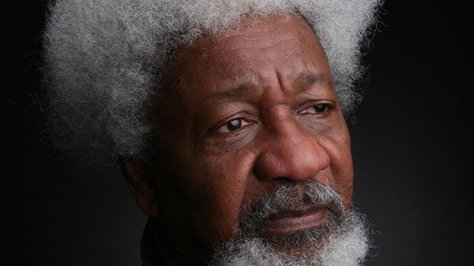
Dr. Morales has called our attention to a special series taking place next week as part of NYU’s Institute of African American Affairs Scholar-in-Residence program. Wole Soyinka, Nobel Laureate for Literature 1986, will be involved in three events beginning with a lecture on October 3rd, a film screening on October 4th, and a conversation on October 7th. All three events will be held at NYU’s Tishman Auditorium at Vanderbilt Hall, which is located at 40 Washington Square South in New York City. I know that most of our students are located at a distance from NYC, but some of you are nearby and others of you might want to journey to attend. I encourage you to attend. The events are free and open to the public but you would want to RSVP at (212) 998-4222. Details can be found on their website linked here.

conversation_wole_soyinka_20100514_624x351

Volunteers needed to share thoughts on the MA program.

The MA program is undergoing what’s called a program self-study. It’s something that all programs at accredited institutions do on a periodic basis. At Mercy we do this process every five years. It involves a number of steps, one of which is an external reviewer (meaning an English faculty member from a different graduate English program) taking a look at every aspect of our program and writing up an evaluation of us. An external reviewer usually wants to talk to a few students to get their take on their MA program. This can include current students and alumni.

So, I’m looking for volunteers to be included on a list of potential contacts for our external reviewer. If you are in the program or have graduated from the program and would like to be on the list, please drop me an email at cloots@mercy.edu indicating your preferred contact method (phone or email) and preferred contact info. I’m looking for as many volunteers as possible. External reviewers usually only reach out to two or three students, but the more volunteers the reviewer has to pick from, the better. Thanks in advance to anyone who volunteers. -CL

Let’s talk about assessment, and how we assess your final 599 thesis paper.

Some of you in the program are already teachers or are employed in fields of education in other ways. If you are, you probably know that American education has become overrun at every level by the current trend, “assessment.” While the basic idea of assessment, the connotation you probably get from reading that word, is something everyone in education has always done–we do it when we give you a grade for any paper or class–this new type of assessment I’m talking about is something very different, very specific, and very difficult to apply to less-linear studies such as of art, music, philosophy–and literature. This new type of assessment involves a reductionist view of what education actually is–one in which students produce “data” which we can presumably “measure” against a set of “learning outcomes” and by which we can then determine whether or not you are “learning.”

That concept works great in many disciplines (math, physics, etc) but less so in others. I and many of my colleagues teaching in the humanities have a hard time seeing your insights, explications, analyses and expressions of such as “data” which can be measured against some fixed yardstick. Many of us harbor a much more complex and varied notion of what learning actually is, of what is actually taking place over the course of your literary studies (and we believe that these things will be diverse and different for each of you, are not able to be homogenized.) Well no matter what I or any of my like-minded colleagues think about it, this type of rigid assessment is something we have to do now because our accrediting body demands it. As a result, over the past year or two we faculty have had to come up with a program assessment structure, a fixed “yardstick” to use to measure whether or not you, our graduate students, are learning, in the sense that our accreditors define the term.

We’ve tried then to appease that directive while also creating a structure that respects diversity and difference, that respects the irreducible complexity and variety of literature, literary studies, learning; that respects you. First, we devised a set of “student learning outcomes” (or SLOs) which we tried to word in a way that both focus in on the things we want you to accomplish during your MA study, while remaining unfocused enough to allow for a variety of ways that you might address (and we might assess) each outcome. So here’s what we came up with as the five SLOs for the program, meaning the things that we hope you’ll all be able to demonstrate by the time you complete the program:

  1. Students will demonstrate critical thinking and interpretive skills reflecting knowledge and comprehension of important British literary texts.
  2. Students will demonstrate critical thinking and interpretive skills reflecting knowledge and comprehension of important American literary text.
  3. Students will demonstrate critical thinking and interpretive skills reflecting an awareness of theoretical trends and criticism.
  4. Students will demonstrate knowledge of some of the literary traditions, and/or cultural situations, and /or historical eras from which the literature referenced in SLO1, SLO2, and SLO3 emerged.
  5. Students will create original research topics, research primary and secondary sources on those topics using digital databases, and produce writings on those topics which demonstrate clear grammatical prose and accurate style.

Then, we had to come up with a way to measure these five SLOs against every student to determine if students are meeting these by the the end of the MA program. We created a rubric which we now use to “assess” papers written in the program’s final course, ENGL 599 Master’s Thesis Tutorial. Mentors and second readers now complete the rubric for each 599 paper at the end of each semester. We file the completed rubrics with a copy of the thesis paper. Eventually our accreditors will come around as they periodically do and when they do we’ll point to the filing cabinet as proof that program assessment is taking place. Students can ask their 599 mentors to show them the completed rubric for their 599 papers. But hopefully your mentor will have made clear whatever strengths and weaknesses your 599 paper showed during the feedback and mentoring process of the 599 tutorial. Nothing you might see on the rubric should be a surprise.

Now because this rubric will be held against every 599 thesis paper, each of you should be aware of what it looks like now, even if you’re in your first semester here. This way you can be aware of the sorts of things we’ll be looking at in the 599 paper and can work on developing these things in your courses leading up to 599. Click here to see the rubric.


Welcome to the 2016-17 School Year

Welcome, everyone, to the 2016 – 2017 school year. I’ve broken this letter down into three parts. The first part touches upon something of what it means to be an MA literature student in the world today, and is meant to encourage you as you head off into the new school year. The second part introduces you to a special theme that we’re hoping to emphasize across all of our liberal arts programs here at Mercy College this year. The third part contains a review of some helpful resources and other practical points about graduate study to keep in mind this and every semester that you’re with us.

I.

I want to begin the year by commending all of you graduate literature students for having the conviction to pursue your goals inasmuch as they include earning the Master of Arts degree. I’ve written of this before, but it’s worth repeating that being a student of literature, which is to say a student of the humanities, which in an overarching sense is to say a student of the liberal arts, is not always an easy thing to be in our world today. Your passion and pursuits are perhaps not always understood or appreciated by those around you, sometimes not even by those closest to you. Our society has a habit of casually marginalizing the importance of the arts as a meaningful pursuit, field of study, or career. English, like most of the liberal arts, is a discipline that in our increasingly data-based and so “pragmatically-geared” society has become a soft target for those who think only in terms of practical outcomes.

We might easily provide a pragmatic rebuttal to such concerns:

  • the MA degree qualifies you to hold a full-time English professorship at the community college level, and those are pretty great teaching positions if you’re looking for a stable college-level position that tends to pay well and usually comes with solid benefits;
  • it allows you to adjunct at four-year colleges which depending on your long-term goals either (a) gives you invaluable teaching experience for when you apply to full-time positions, or (b) can be a satisfying side-job complementing another career or position one might hold elsewhere (some adjunct professors do adjunct work not as a career but as a way to enrich their lives, while earning some money in the process); or (c) can itself be a career, if you can establish yourself enough across multiple institutions that they offer you courses each year—this path though works best if you have a working partner or spouse with whom you pool your income;
  • if your goal is to try for a full-time senior college professorship, the MA degree may be and has for some of our students been the stepping stone to a PhD program;
  • the MA English degree is traditionally a degree held by those in fields such as publishing, editing, journalism, technical-writing, copy-writing, content-writing for media or other outlets, etc.;
  • finally, in a business sense, an MA can be a degree that complements another degree, such as one in management, and so “rounds out” an applicant in the eyes of those hiring for such positions.

But here’s the rub, the thing that I believe many and perhaps most MA literature students feel: the pragmatic, though it matters, is the lesser point. The greater point is that we love literature, we love words. That is where this begins. Life is just better when you’re in the flow of literature, when you’re engaging the words written by humanity’s great poets and thinkers and authors from across the centuries, across millennia—when you’re engaging them alongside others.

And so though we can respond fittingly to questions about practicality and pragmatism, let us more recognize how the impetus to enroll in graduate literary study is fueled by some wonderfully strange and relatively rare element burning in the deep core of your being. If you are here, on some level it is because you’ve felt the mystery, the power, the imperative coursing up through the literature of the past; and you want to stay close to it; you want to be a part of it. To be a graduate literary student is to be in good company with what Emerson would call “the like minded,” which bespeaks not reductionism or homogenization of difference but rather simply a shared appreciation for the wonder of the written word, and a desire to explore and explicate humanity’s writings and wisdoms alongside others who feel similarly.

II.

As some of you know, our school of liberal arts (which is one school out of five here that together constitute the greater Mercy College) welcomed a new Dean at the start of last year, Dr. Tamara Jhashi. If you’re curious to attach a visual to the name you can see her pictured here in the blog post for our spring 2016 graduate English symposium. Dr. Jhashi is a stalwart defender of the liberal arts and of the importance of the liberal arts in our lives. One thing that she has brought to our school is the idea of an annual school “theme,” not as something to which any individual or class must necessarily adhere, but rather as an inspirational idea around which some of us—if inspired to do so—might rally and to which we might together tend.

The theme this year is borders. This theme of borders was arrived at holistically through feedback among the faculty and a faculty vote, all which was organized through a committee that Dean Jhashi created.

I don’t have to tell you English grad students that whatever that word borders signifies or inspires is entirely up to each of us to define and pursue in our own way. It’s meant to be a broad and general theme, something that sparks ideas and doesn’t curtail or force them into any particular frame.

So why am I telling you this? Well for one it’s because as students in the MA program, which is housed in the school of liberal arts, you are of course students of the liberal arts. So this is your theme to pursue, if you wish and in whatever way you wish, as much as it is mine and the other faculty here and all of the students in all of the liberal arts courses running here at Mercy College, undergrad or graduate. Perhaps you can use this theme to help you focus in on a research topic for whatever class you’re in this semester. For example in my Search for Identity Course I’m going to encourage (but of course not require) students to keep the theme in mind when designing a research topic this semester.

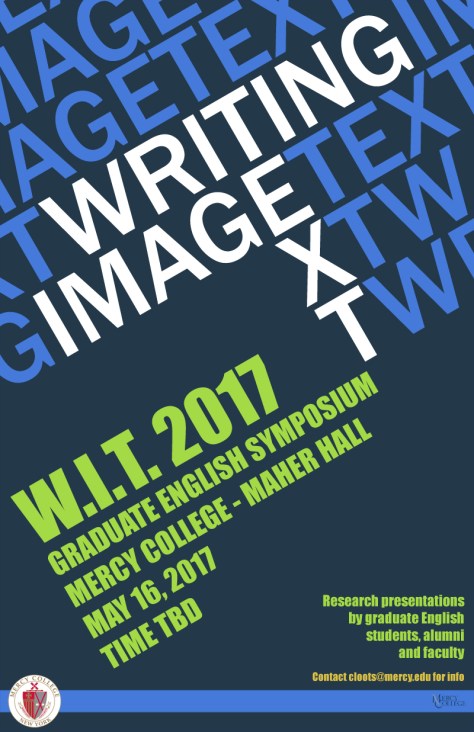
For another thing, our Writing/Image/Text (W.I.T.) 2017 Graduate English Symposium will be on the theme of borders. Now that doesn’t mean that, if you were to come and be a part of the W.I.T symposium in the spring, that you would have to write a paper that tends to that theme—I already know that some of you are working on papers for the symposium and if that’s the case, keep on with whatever you’re doing. But we’re going to encourage you all to find some way to make your papers relate to the theme of borders. And if you’re planning on attending the W.I.T. symposium well the easiest thing to do would be to write some paper for a class over this or the next semester somehow involving the theme of borders, and then to just show up and share that paper with us at the symposium. I’ll be talking more about the symposium here on the blog in early 2017.

III.

Finally, let me collect here links to information and resources that you should all be aware of. This blog post linked here contains a rundown of resources and contact-info that Mercy College provides for its students, whether on-campus or online. This support ranges from basic student services, to mental counseling, to registering accessibility accommodations, to getting online writing and research tutoring, to our online research facilities. On this post linked here you’ll find information about the incomplete “I” grade which some of you might occasionally receive. As I explain in that post, it’s critically important that any incomplete be remedied within one year of earning it; otherwise you lose the potential course-credits and lose the money you paid for the course. For those approaching their last semester, you must pay attention to your required comprehensive exam, to the instructions for how to enroll in the final 599 course, and to the application you must complete in order to graduate. For those hoping to enter the college teaching job market check out this post here where I introduce a variety of resources and information on that topic. If you’re going to be applying to anything in any academic field you’ll need to have your curriculum vitae (CV) polished up and also need to know the difference between a CV and a resume. I talk about that here. Finally let me link you here to a post about the waitlist feature that you may encounter when you try to register for a course with no empty seats.

Although you should all have contact with advisors in the Student Services department, I serve as faculty advisor to every student in the MA program. Just keep that in mind if you have any questions or issues with anything in the program. If you’re having issues in any particular course you should always first communicate with and work to resolve any issues with the professor of that course. But again, I am here for each and every one of you as your faculty advisor, so feel free to contact me at any time at cloots@mercy.edu if you have any questions or have something you’d like to discuss. Okay that’s it! Have a great semester, everyone,

-CL, 9/9/2016

Fall Semester Begins this Wednesday, September 7

In the next few days I’ll be putting up a letter here on the blog welcoming you all to another school year and sharing some thoughts about the upcoming year. But I wanted to take a quick moment here on this Tuesday, the eve of the semester, to just remind you all that the fall semester begins on Wednesday 9/7. At some point this Wednesday your professors will unlock the Blackboard sections for your courses. One of the strengths of online learning is its asynchronicity; that is, that you are not all required to be online at any particular day or time during a weekly unit. It is still a good idea, though, to check in to your courses as early as possible during the first week of classes so to read the syllabus, see the required books, and get into whatever first week activities your professor has set up. If you have any questions about your courses after going over the initial materials posted for them, ask your professors for clarification. Of course keep in mind that I serve as faculty advisor to all students in the program so if you ever have more general questions about your coursework or the degree, or need help with something, drop me a note at cloots@mercy.edu. I check there all the time. More soon, -CL

Reading lists for some fall 2016 courses:

I know that some of you like to get a jump on the fall course readings over the summer, so below you will find the book orders for some of the fall courses (some profs haven’t finalized their reading lists yet, and so those courses aren’t listed here). The list will be updated over the summer as necessary. Some students prefer to wait and read the selections as assigned during the semester, and that’s fine too. Even those in the latter group, though, can benefit from seeing these readings ahead of time and perhaps doing a little preliminary research into the authors and scholarship related to them. All professors will be submitting their book orders to the Mercy bookstore throughout the summer, so that’s where the official reading list for each course can be found.

ENGL 500, Theory/Criticism:

  • Leitch, Vincent B., et al, eds.  The Norton Anthology of Theory and Criticism.  2nd ed. New York: W.W. Norton, 2010.  ISBN: 978-0393932928.

ENGL 510, Theory/Practice of Expository Writing:

  • Miller, Susan. The Norton Book of Composition Studies. New York: W.W. Norton& Co., 2009. ISBN: 978-0-393-93135-8.
  • Oates, Joyce Carol, ed. The Best American Essays of the Century. Boston: Houghton Mifflin, 2000. ISBN: 978-0-618-155587-3.
  • Shakespeare, William. Hamlet. NY: Simon and Schuster, 2010 (Folger Library Shakespeare). ISBN: 978-0-7434-7712-3.
  • Tyson, Lois. Using Critical Theory: How to Read and Write About Literature, 2nd ed. . London: Routledge, 2011. ISBN: 9-780415-6167171.

ENGL 521, Themes & Genres of Medieval Literature:

  • The Norton Anthology of English Literature: The Middles Ages. Volume A. 9th Edition. ISBN: 978-0393912494.

ENGL 524, Reason/Imagination:

  • Blanning, Tim. The Romantic Revolution: A History. New York: Modern Library Chronicles, 2010. ISBN: 9780812980141.
  • Clarke, Susanna. Jonathan Strange & Mr. Norrell. New York: Mass Market Paperback, 2006. ISBN: 0765356155.
  • Sax, Boria. City of Ravens: The True History of the Legendary Birds in the Tower of London. London: Overlook, 2012. ISBN: 9781590207772.
  • Shelley, Mary. Frankenstein. New York: Dover, 1994. ISBN: 0486282112.
  • Thomas, Keith. Religion and the Decline of Magic. 2 ed. New York: Penguin, 2012. ISBN: 0140137440.

ENGL 541, Search for Identity in American Lit:

  • Baym, Nina. The Norton Anthology of American Literature: Shorter Eighth Edition. Norton, 2012. ISBN: 9780393918854. [Students do not have to read from this specific text and can procure the various semester readings from other anthologies or texts, if preferred; specific readings will be shared shortly before the semester begins in the syllabus, which will appear when the Blackboard section goes live in late August.]