Currently the fall ENGL 500 theory course is full with six additional people on the waitlist. If you were needing to take 500 this fall be sure to get on the waitlist too. Once the waitlist number reaches a certain point, we can work to open a second section of 500 to make sure that everyone gets a seat as needed. But we need the evidence of the people on the waitlist to justify to the administration opening the second section.
All posts by madirector
Seeking Feedback About Spring Symposium / Gathering
In years past the graduate English program has put together a symposium, sort of a mini-conference right here in Maher Hall, for interested MA English students at which to gather and read aloud a scholarly paper, as well as to simply meet some fellow students and professors. Graduate students and professional scholars often attend and read at local, regional, and national conferences, so this symposium can provide a friendly small-scale introduction to the conference experience. And for anyone who reads a paper, it becomes a line-item you can list under the scholarship section on your CV (click here to read more about the CV). The issue in recent years has been that, because our student-body has shifted in the past decade from being traditional/on-campus to being entirely distance-learning, we don’t necessarily have enough students within convenient driving/traveling distance of the campus who are interested in participating in the symposium.
Well, maybe this year will be different, and that’s what I’m seeking feedback about. If you would be interested in attending a program-hosted symposium, please send me a note at cloots@mercy.edu letting me know. If we get enough student interest we’ll schedule an afternoon, perhaps near to commencement in May so that anyone traveling to walk in the commencement ceremony can attend, during which we’ll have a catered reception and have a few panels sharing a bit of our scholarship/writing aloud to one another. Any topic, really any type of writing would be appropriate to share, including creative. Again, if you’re interested, just write me a note letting me know, please. I’ll update everyone here on this blog later this semester based on the feedback I receive.
Fall and Summer Registration Opens On Wed. March 2.
Fall and summer registration open at the same time this year, Wednesday March 2, usually at 9am eastern (when the Registrar comes to work and activates the system that morning). We’re running six courses in the fall and three in the summer. We don’t run as many summer courses because overall many of our students don’t take summer classes. The course offerings are as follows:
Fall 2016:
ENGL 500, Theory/Practice of Literary Criticism
Dr. Yunus Tuncel
An introduction to major movements and figures of the theory of criticism. The question “what is literature?” is the primary concern of this course. Such an inquiry necessarily engages other, closely affiliated signifiers such as work/text, writing, reading, interpretation, and signification itself. After brief encounters with ancient antecedents and seminal moderns, influential contemporary approaches to the question concerning literature and its cultural significance are engaged. An assessment of the relative strengths and weaknesses of current trends in the practice of literary criticism, and their theoretical groundwork, is the ultimate objective of this course. 3 credits. (Core course: required of all students for the MA degree).
ENGL 510, Theory/Practice of Expository Writing
Dr. Sean Dugan
The course is especially encouraged for any student who is a teacher or who aspires to teach secondary school or college. The course will address the techniques of expository writing as reflected in academic discourse. Ideally, students will learn the general practices of critical writing, but focus their work in their individual fields of interest. These interests may include feminist approaches, deconstructive approaches, research in culture, education, etc. The course will specifically address techniques of analytic organization, and will consider the pedagogy and andragogy of writing. 3 credits. (Completes either the Writing & Literary Forms field requirement or an elective).
ENGL 521, Themes & Genres of Medieval Lit.
Dr. David Fritz
This course is designed to cultivate students’ awareness of the themes, genres, and issues related to the study of medieval literature. Students will study the major genres of medieval literature, including epics, lays and romances. 3 credits. (Completes either a Literature Group 1 field requirement or an elective).
ENGL 524, From Reason to Imagination
Dr. Boria Sax
This study of English literature between 1650 and 1850 examines Neoclassicism and Romanticism as two opposed aesthetic and philosophical stances. It traces the political, ideological, and literary roots of Neoclassicism in the English “Glorious Revolution” of 1688, the late seventeenth-century growth of rationalism and empirical science, followed by the flowering of Neoclassicism and then the shift in sensibility that led to the emergence of Romanticism. 3 credits. (Completes either a Literature Group 1 field requirement or an elective).
ENGL 541, Search for Identity in American Lit.
Dr. Christopher Loots
This course will study the search for identity, individually and collectively, as it manifests in American literature from Colonial times through the turn of the twentieth century. Attention will be paid to the changing historical/cultural contexts from which such literature emerged, as well as to different literary movements (Romanticism, Realism, etc). Readings this fall will likely include works by Anne Bradstreet, Edward Taylor, Olaudah Equiano, Jonathan Edwards, Thomas Paine, Alexander Hamilton, James Madison, Phillis Wheatley, Philip Freneau, Poe, Emerson, Margaret Fuller, Whitman, Frederick Douglass, Henry James, Charlotte Perkins Gilman, Charles Chestnutt, W.E.B. Du Bois, and Paul Lawrence Dunbar. 3 credits. (Completes either a Literature Group 2 field requirement or an elective).
ENGL 542, Classics of African American Lit.
Dr. Donald Morales
Toni Morrison states in an interview with Paul Gilroy [Small Acts, 1993] that “My parallel is always the music because all of the strategies of the art are there.” It is no accident that her reference to music is echoed by other African American artists, for the music is the trope that best illuminates contemporary African American writing. Richard Powell in The Blues Aesthetic: Black Culture and Modernism specifies the blues as providing “much contemporary literature, theater, dance, and visual arts with the necessary element for defining these various art forms as intrinsically African-American.” It is from this perspective that this course analyzes various African American authors and texts, emphasizing those of the twentieth century. 3 credits. (Completes either a Literature Group 2 field requirement or an elective).
ENGL 599, Master’s Thesis Tutorial
Enrolling in 599 requires a different process which is explained in detail here.
Summer 2016:
ENGL 509 Perspectives on The Essay
Dr. David Kilpatrick
The course will study the essay as a distinct literary genre; its characteristics and types; its history; and its role in reflecting authorial consciousness. This course will examine the taxonomy of the essay in terms of its medium (verse or prose), its tone and level of formality, its organizational strategies, and its relationship to its audience and to particular modes of literary production (speech, manuscript, pamphlet, book, magazine, newspaper). It will trace the development of the essay from its origins to the modern era. 3 credits. (Completes either the Writing & Literary Forms field requirement or an elective).
ENGL 515, Lit. of the Spanish Golden Age
Dr. Celia Reissig-Vasile
This course will focus on two of the best known 16th and 17th century writers of the Spanish Golden Age, Miguel de Cervantes and Sor Juana Ines de la Cruz, and their most important literary works. Miguel de Cervantes (1547-1616) is best known for his novel Don Quixote de la Mancha, regarded as the first modern novel and one of the world’s literary masterpieces. Through a close reading and analysis of this novel, we will focus on questions of literary, linguistic, cultural, and historical heterogeneity. We will come to understand why so many celebrate Cervantes for teaching us “to comprehend the world as a question.” It is both a parody of classical morality and chivalry and critique of Spain’s rigid social structures. Sor Juana Inés de la Cruz (1651-1695) was a poet, playwright, essayist and scholar. She is considered one of the most important literary figures of the American Hemisphere and Spain. Although she lived in a colonial era when Mexico was part of the Spanish Empire, she is considered today both a Mexican writer and a contributor to the Spanish Golden Age. Sor Juana Inés de la Cruz was an exceptional seventeenth-century nun who set precedents for feminism long before the term or concept existed and is considered the first feminist writer of the Americas. Two of her most important works will be examined in this course: A Philosophical Satire and Reply to Sor Filotea. 3 credits. (Completes an elective).
ENGL 517 Advanced Creative Writing
Dr. Kristen Keckler
This course is intended for writers with some background or preparation, whether personal or formal, in creative writing. The course continues to develop each student’s creative writing ability through a close study of various writing styles and techniques, matched with assignments and workshops which encourage the students to further develop their own creative writing informed by such literary study. The emphasis of the course will shift depending on the expertise of the professor running it, and could involve poetry, narrative, or other forms. 3 credits. (Completes either the Writing & Literary Forms field requirement or an elective).
Special Event: Harper Lee Book Discussion / Gathering at Dobbs Ferry Public Library, 2/25, 5:00pm.
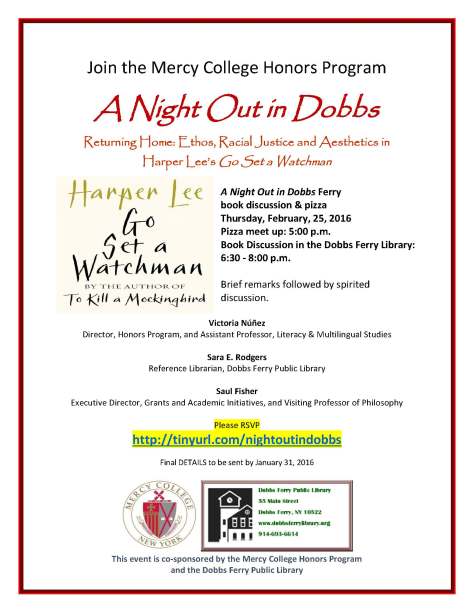
For anyone who might be in the Hudson Valley/New York City area on Thursday, February 25, the College’s Honors Program is hosting a book discussion and pizza dinner in Dobbs Ferry, the village in which Mercy College’s main campus is located. The book under discussion is Harper Lee’s Go Set a Watchman. Lee passed away today, 2/19, and so this will also surely involve people sharing other reflections on their experiences with Lee’s work. The Dobbs Ferry Public Library and Mercy College have long collaborated in a “Town & Gown” series bringing together college faculty, students, and community residents. Everyone is welcome, and in particular English literature students of both graduate and undergraduate level are encouraged to attend. Click here to RSVP for this event.
Reminder about our tutoring and support services here at Mercy College
As we begin another semester I want to remind everyone of the support structure in place for Mercy students, a structure equally available to those on-campus and those online. Refer to my earlier blog post, linked here, which provides you with a run-down of and contact information for things like our tutoring and writing services, library research help, counseling support, and other things that a graduate student might find helpful. It’s important for you to know that, even if you are a distance-learning student, you are as much a part of the Mercy College student body as anyone on-campus, and have access to the same services and support. Let me know if you have any further questions, -CL
Applying for Degree Conferral
Students entering their final semester should be aware that they must apply for degree conferral in order to receive their degree after completing the program’s degree requirements. The college officially confers degrees at three times during the year: in February (intended for students who completed their requirements in December); in May (intended for students who complete their requirements that spring semester); and in August (intended for students who complete their requirements that summer semester). The application deadline for each of these dates falls well ahead of the conferral date, though.
That means that all students entering their 599 sections this semester should be completing that degree application soon. Should you not apply for degree conferral on time, it just means that your official conferral date would be pushed back to some point after you do actually apply; should you apply and not complete the requirements for the degree that semester, then your conferral is simply paused until a later date. Your advisors in the Student Services offices typically alert relevant students to the need to apply for degree conferral, but you should be aware of this and take ownership of your degree conferral situation. The complete procedures and form can be found here on the Mercy College website.
Your Curriculum Vitae (Not Your Resume):
If and when you apply to a faculty job listing, or when you “cold call” various college’s English programs seeking adjunct (part-time) work, and even sometimes when you apply to PhD programs after earning the MA, you will need to send them your curriculum vitae, or CV for short. A CV and a resume are similar but not the same, and in any academic job setting you will be expected to know the difference and to submit a CV, not a resume, with any job application. Both a CV and a resume have the same role: they present in a single document your work experience, educational experience, and other relevant background information to potential employers. A CV though needs to contain information and organize that information in a way that is relevant to professional academia. I’m going to share with you some basics here about how to organize your CV. For students in ENGL 599, the final course in the path toward the degree, it’s not a bad idea to put together a CV and share it with your 599 mentor, and ask for feedback.
You always want to have your contact information at the top. Make sure you list a phone number at which you can reliably be reached, and an email that you check regularly. Make sure that your email handle reads professionally. If your email is a nickname, or an odd series of letters and numbers, or anything other than simply your real name, you should consider creating a Gmail account that is simply [yourname]@gmail.com. The simple truth is that, as with any job, the hiring consideration begins the moment a person lays eyes upon your CV. Does it have a silly sounding email address? Not good. And on that point, recognize that your CV should be formatted cleanly and crisply, as the format too sends a message to your potential employer. Take ownership of that message.
After your contact info you typically list your education, with your highest degree at the top of the list. Only list your institutions of higher education (do NOT list your high school). If you’ve transferred around to a number of institutions, it’s often appropriate to list only your degree granting institutions. But this is an area of debate, with some thinking you should list every single institution at which you earned credits; so investigate the ethics of it on your own and figure out what seems right to you.
It’s appropriate beneath each degree to include bullet points listing pertinent relevant information. So for example under you MA degree’s mainlisting you should include the title of your master’s thesis (the one you write for 599). You might also include a line listing the literary fields, if any, that you concentrated on during your time in the program. Did you take all of your electives in American literature? Well you’d be justified in noting that you concentrated on American literature here in this part of your CV.
After education you typically want to list your relevant work experience. By relevant we mean teaching experience. The seeming catch-22 of college-level teaching is that you need college-level teaching experience to get a college-level teaching job. But then how is one to gain college-level teaching experience? Adjunct work is usually the answer. Before you get adjuncting work you won’t have much to list here on the CV. If you’ve got experience teaching any K-12 that can be useful and is definitely something to list here. But getting even a course or two of college adjuncting work under your belt is your main goal after securing the MA, if you’re aiming to teach long-term at the college level. See the links in the first sentence of this post for more on how to go about finding work.
Be careful about what else you list in your work experience. Once you get some teaching under your belt you want to list nothing else except that teaching on your CV. A CV that includes your time working at Barnes & Noble, the two years as a contractor, the three years you were a barista, is a CV that risks being tossed into the “no” pile immediately, because it bespeaks someone who doesn’t understand that a CV is not a resume. A resume lists every single job you’ve done; a CV is supposed to list work relevant to professional academia. When you’re just starting out, though, when you need to list something for your work experience, it’s not a bad idea to list significant jobs you’ve held as long as you can frame them in a way where you make it clear how this information is relevant to your potential employer. Use the space on the CV to provide a succinct explanation of your duties, and make sure those duties somehow coincide with things that might relate to teaching and academia. If for example you’re applying to a community college, and have experience working at a community center in the area, that can be relevant work experience to list if you take the time to describe how. You don’t want your CV to turn into a book, but it is okay to give several sentences that narrate how the work experience connects to the job for which you’re applying.
Your next section tends to be scholarship. Whenever you do get something published, you will want to lead with that in this section. Publications are the coin of the realm in English. List any publications first, making sure to employ a documentation style when you do (MLA, Chicago, etc.) and then list any conferences at which you’ve read a paper. This section might be empty for you right now: that just lets you know that you should really try to get out there and read a paper at a conference somewhere to earn an item to list in here.
You might include a section after this on other relevant activities, such as conferences you’ve attended, professional workshops you’ve been a part of, perhaps service you’ve done in the world which doesn’t quite fit under work experience or scholarship. That sort of thing. Make it relevant. People reading these can smell nonsense a mile away. If you’re working on turning your thesis paper into a published paper, or working on a book, or anything like that, you might take a few lines here to describe this. If it shows that you’re actively working toward something relevant and academic, it might be useful.
You want to include a section listing any awards or grants or scholarships you may have received at any time during your college career. For example each year we award one thesis paper with the Thesis of the Year award. That is something you would want to list here, if you were awarded that.
You want to include a section listing whatever professional associations you might be a member of. The Modern language Society is standard one that most professional English academics join, but there are dozens if not hundreds of others out there. Find organizations that are relevant to your area of interest, and join up. It shows potential employers that you’re committed to your field: e.g., if you hope to be an expert on Irish literature, well find and join scholarly societies related to Irish literature, and list them here.
Finally you’ll want to include a list of at least three professional references, which should be professors or other people in the field. Make sure that you’ve asked your references if they would in fact agree to be references, and whenever you apply to any job it’s a good idea to email your references and just let them know that you’ve applied. This way it won’t be a surprise if/when someone calls up asking to provide a reference on your behalf.
So that overall is how a CV tends to be structured. There are variations of course, and over time you often add categories to this, and move these around. But the main lesson here is to recognize that a CV and a resume are not the same thing, and that when you’re applying to any faculty position in higher education, they will expect you to send a CV and not a resume.
Attention New Students taking Distance Learning Courses for the First-Time
Students taking a distance learning course with us for the first time, please be aware that our Office of Online Learning has injected something into the Blackboard virtual classroom environment where it knows if you’re just beginning with us, in which case it then forces you to take a 20-ish minute tutorial to make sure you’re versed in the tools and procedures of navigating the online class. I’m mostly pointing this out so that you’ll all know that you only have to do this ONCE, not each semester, and to also make it clear that I have nothing to do with forcing you to undergo this tutorial. -CL
Comp Exams Have Been Mailed to Spring 599 Students
If you’re planning to take the 599 thesis tutorial course in spring 2016 you should check your email now. I have just today sent out the comprehensive examination to everyone I have listed as entering the 599 in the spring (everyone who has not already completed the exam, that is). You must successfully pass the exam in order to be able to enter the 599 course. So if you’re planning to take the 599 course in the spring go check your email now and verify if you’ve received the exam. I sent it to whatever accounts you have on record with the college, so you might see the same email in multiple places. Please read the email fully and reply to it immediately to confirm receipt. The email as well as the exam attachment include thorough instructions and the due-date. If you’re reading this and (a) do not see any exam awaiting you in your email inbox, and/or (b) do not see a 599 section on your spring schedule yet, you should contact me at cloots@mercy.edu to clear this up.
For Those taking 515 Graphic Novel in the spring
Here is Dr. Medoff’s book order for those taking ENGL 515 Graphic Novel this spring:
- Bechdel, Alison. Fun Home: A Family Tragicomic. New York: First Mariner Books, 2006. ISBN 0618871713
- Eisner, Will. The Contract with God Trilogy. New York: Norton, 2006. ISBN 0393061051
- Gaiman, Neil. The Sandman: Brief Lives. New York: Vertigo/DC, 1993. ISBN 1-56389-138-7
- Moore, Alan, and Dave Gibbons. Watchmen. New York: DC, 1987. ISBN 9780930289232
- Spiegelman, Art. Maus I. New York: Pantheon, 1986. ISBN 0394747232
- —. Maus II. New York: Pantheon, 1991. ISBN 0679729771
- Tomine, Adrian. Killing and Dying. New York: Drawn and Quarterly, 2015. ISBN 9781770462090
- Ware, Chris. Jimmy Corrigan: The Smartest Kid on Earth. ISBN 0375404538
 Program Director's Blog for the Mercy University MA in English Literature Program