All posts by madirector

A Word on Advising, Support, and Resources

Let’s make sure everyone knows the support structure in place here at Mercy. First, although each of you are (or should be) connected with advisors in the Student Services offices, as the program director I am the faculty advisor for all students in the MA program. Your Student Services advisors are the people who likely contacted you when you first began the program (people like Jennifer Mack, Krystal LaDue, others). You can reach out to them or me or all of us with questions about course selection, your progress toward the degree, or anything else. The main phone for Student Services is (888) 464-6737 (check the website for their hours, all Eastern time). As always I’m at cloots@mercy.edu or less likely at (914) 674-7423.

The College’s Office of Accessibility is the place to contact if you need to discuss or register any accommodations.

We also have an office of Counseling Services for those in need.

The Center for Academic Excellence (CAE) provides tutoring and other such assistance. The CAE provides assistance to our online students as much as to our on-campus students, and has online tutoring facilities in place, so don’t hesitate to contact the center when working on papers for your MA courses. Sometimes your professor might require that you contact the CAE to get help with your writing. Professor Steven Witte is the contact person for the online tutoring, so you can contact him at switte@mercy.edu if you need further help.

Mercy has extensive online library resources. All of you have already been or soon will be using these to some degree, as each course (except perhaps for Creative Writing) requires some form of research paper. You should also always be reading beyond your course syllabus and doing independent study of further readings in support of your syllabus readings. You can find a wealth of sources through the online library portal. The JSTOR and MLA are the two primary databases for literary research, though there are others you’ll find in there. Additionally, Mercy has digitized versions of many scholarly books. To search the ebook selection use the advanced search option for the library catalog and under “format” select “EBook.” Then search away and check-out/download any useful books you find.

Your professors will provide their own contact information in each of their courses, and you can also obtain contact information at the end of the Graduate Student Handbook accessible in the left-hand column of this blog.

Okay I think that covers the basic online support structure in place here at Mercy College. Hope you’re all getting up and excited for another semester, which starts soon… Best, -CL

Seeking Alumni News and Updates: Let Us Know What You’re Doing!

We here in the MA faculty often wonder what our MA grads are up to, where you are in the world, what you’re doing (whether with the MA degree, or otherwise). A number of former students do keep in touch with some professors, and each of you should always be trying to build some rapport with at least one of your professors, if even just for the practical reasons that (a) you’ll need to pick one of us to lead your final 599 thesis course, and (b) you should have at least one faculty member to turn to with professional questions and concerns after your time in the program. But on the program-level I’d like to build a better alumni-relations system, something by which we here can get and maintain a sense of what our graduate community is up to. One immediate reason is that the Mercy College School of Liberal Arts in which our program is housed is starting up a newsletter and wants to be able to list some alumni news; for another thing, the MA program itself might in the future put together its own alumni newsletter if we can get a large enough response to this call.

So, if you’re a graduate of the MA program, do me a favor and keep in touch. At the very least it would be good to have updated contact information for each of you. Beyond that we’d love to hear about anything you’re doing or achieving or working on beyond the MA. Have you gone on to a PhD program? Earned a PhD? Are you teaching anywhere whether part time or full time be it in K-12, community college, or beyond? Finished or published any poems, stories, or critical essays? Written a book? Done any stage performance? Read aloud at a spoken-word event? Any other professional or non-professional accomplishments to note? Drop me an email, now or at anytime in the future, at cloots@mercy.edu and do let me know. At the very least I’ll finally be able to answer when this or that professor asks me in the hall “hey what have our MA graduates been up to lately?” We want to know!

Where the Want-Ads Are: Job Listings for College Teaching Positions

All of you are here in the program because of your love for literature and academic study, and for many of you that intellectual enrichment is the point, is the reason why you pursue the MA. Some of you, though, are also here with career hopes. This post is for that latter group. There are a few “industry” job sites which you should know about, and some words of advice I can give you about hunting for jobs in the field. Read on, if interested:

First, be aware that the MA degree qualifies you to apply to most full-time junior college/community college professorships, and to adjunct (i.e. teach part-time) at most senior/4-year colleges. I say “most” because though I’ve never encountered a situation where the MA didn’t qualify you for these things, I’m sure that there are some exceptions somewhere out there in the world. In most cases though you’ll see in want-ads that community colleges require the MA in English for English professorships, same for senior college adjunct pools. To apply to full-time English professorships at senior/4-year colleges, the terminal degree, meaning the PhD, is required; except, upon occasion, for creative writing positions for which the MFA is sometimes considered the terminal degree.  Even that’s changing though.

Side note: the term “adjunct pool” refers to the pool of adjunct professors any particular college keeps on file, and from which it draws teachers each semester to staff many of its courses. Few institutions have enough full-time faculty to staff all their courses, and so most institutions rely (sometimes heavily) on adjunct professors to teach a significant portion of courses each semester. Some people adjunct to gain experience for when applying to full-time positions or PhD programs; some do it to provide a stimulating supplement to some other job they might hold; some do it as a secondary income source for a household; and some actually adjunct “full time” by which I mean they put themselves into multiple institutions’ adjunct pools and so weave together a full-time schedule each year teaching across different colleges.

So, where does one even begin to search for any of these teaching positions? The most popular and common job site is probably the Chronicle of Higher Ed. The Chronicle is the most popular news source for college academia, and maintains a popular job-board which I’ve linked there. Another popular site is Higher Ed Jobs. Both of those sites are free to use, and have a variety of search features which allow you to rarify your search, including by geographical region. A third site is the Job information List of the MLA however be advised that this is a paid subscription site. Those are the big three national job boards.

Additionally, all sorts of less centralized boards exist, and these you just have to discover by searching. For example California maintains the most brilliant example of a dedicated state-specific community college job board, the CCC Registry. And some institutions don’t necessarily post every job opening on the big national boards, but rather just post them on their Human Resources website (see for example Occidental College’s current faculty openings listed only on their HR site). Oftentimes calls for adjuncts will only be posted on a college’s HR site, and no-where else. Other local job boards exist, for example the California State Careers job board which lists all faculty openings in the Cal State system, some but not all of which are cross-listed on the national job boards. My examples are from California since that’s my old state, the one I know best, but the point is you should search the national job boards and also just do detective work and search around your state and local college websites to determine what more local job boards might exist near you. Always look for the Human Resources section of any college’s website; that’s almost always where they either list their job openings, or list a link to relevant job boards for their institution.

Here’s a final way to go about the job search, particularly in terms of adjuncting: the cold call. Many institutions don’t even post want-ads for adjuncts on any board or even on their HR site because it’s relatively common practice for people interested in adjuncting to simply put together the paperwork (a cover letter and a curriculum vitae, which is not the same thing as a resume) and cold-call a department or program head (or whomever does the course staffing, which you’d want to determine beforehand through your detective work). It’s not inappropriate to approach, either in person or through email/phone, the staffing person of a dept./program and simply present yourself for consideration for future adjunct work.

One last thing to explain is the annual hiring cycle. Full-time professorships for 4-year colleges typically post in the fall semester, starting in September. Community college professorships usually post in the spring semester, as early as January or February. Adjunct calls will post year round. Anomalous timing happens so it’s always good to keep an eye on the boards year-round if you’re in the job hunt. For example there’s often a small burst of job ads at the end of spring, early summer, which bespeak unsuccessful earlier searches they’re now trying to fill quickly prior to the start of the fall semester. Faculty positions almost always begin in whatever is the next/upcoming fall semester.

Okay, in a future post I’ll go into the difference between a curriculum vitae, or CV, and resume. For now, that’s your overview of how to search for a college teaching position. Best, -CL

The New Wait-list Feature

You may have noticed the new wait-list feature available in the online course registration system. Some of you probably know more about how this works than I do, from your first-hand experience with it, but this is what I’ve been told: when a course is filled to its seat-cap you can opt to sign up for the course’s wait-list. The order in which you get on the wait-list matters. If a seated student drops the course, the person atop the wait-list will be notified (via email I would imagine, and using whatever you’ve indicated is your “preferred” email address) that the seat is open. You are NOT auto-enrolled in the open seat; you must actively go in and enroll in the course as you would for any other course. It’s simply that the recently opened seat is reserved for you for a limited time. I’m still trying to determine exactly how long that is but I believe it’s 24 hours. If you do not claim the seat within the time-limit, the next person on the wait-list gets notified and now has the chance to take the seat. If that person doesn’t claim the seat the system keeps going down the list, notifying each next wait-listed person, until either someone claims the seat, or no one does, at which point the seat becomes open to anyone. I’ll correct this information as I learn more about this new procedure, but this is my current best understanding of how it works. -CL

It’s time to take the Comp Exam (Those who plan to take 599 this fall)

If you’re planning to be in ENGL 599 Master’s Thesis Tutorial this fall, now is the time to request and complete your comprehensive exam (if you have not already done so). You obtain the exam by emailing me at cloots@mercy.edu and simply informing me that you need to take the exam. All potential 599 students must do this, and must successfully complete the comp exam before beginning the final 599 tutorial course. As with all elements in the program, you can complete the exam via distance learning. Upon your email prompt I reply with the exam instructions. You then have a limited amount of time in which to complete the exam following the instructions I provide, after which you email your exam responses back to me. Faculty here then evaluate the exam. So if you are approaching your final semester and are getting ready for 599, make sure you contact me asap to request and complete the comprehensive exam. -CL

Degree Conferral Procedures

Grad Advising has been pretty reliable about informing students nearing degree-completion of when they need to apply for graduation, and how to go about doing so, but now and then a few students slip through their net and end up missing the appropriate deadline. The procedures, dates, and links are all in the Graduate Student Handbook (always accessible as a downloadable PDF through the left-hand column of this blog). Just for simplicity I am also linking right here the page explaining degree conferral procedures. So for example, as that linked page reads, students for whom the fall semester will be their last should submit their conferral application by October 15. Students ending on the traditional schedule, following the end of a spring semester, would need to submit the conferral application by February 2. -CL

For those in ENGL 500 and on the waitlist:

Due to the large number of students on the wait list for this fall’s ENGL 500 we’ve decided to split off a new section of 500. Since the single section had 20 students and 7 waitlisted, each of the two sections will now have approximately 14 students when we’re done setting this all up. Both sections are being taught by the same professor, our theory specialist. Some of the 20 currently registered students will be moved to the new section to balance the student ratio, and it will all be the same regardless which section you’re in unless you were trying to get into a section with a particular friend of yours. If that’s the case let me know (cloots@mercy.edu). Otherwise we’ll do everything here behind the scenes and come fall, all of those currently enrolled and currently on the waitlist will find themselves in one or the other 500 section. We usually run 500 once each fall but this was an unusual situation and some students were desperate to take it this semester in order to graduate. Next fall we’re planning to enroll students in 500 from our side of the system, in order to ensure that no students who need the course in order to graduate on schedule find themselves closed out of the course, as happened this time around. No worries, all will be well, and now all of you on the waitlist will be able to take 500 this semester as you hoped to do. -CL

Recent Publications of Mercy MA Faculty

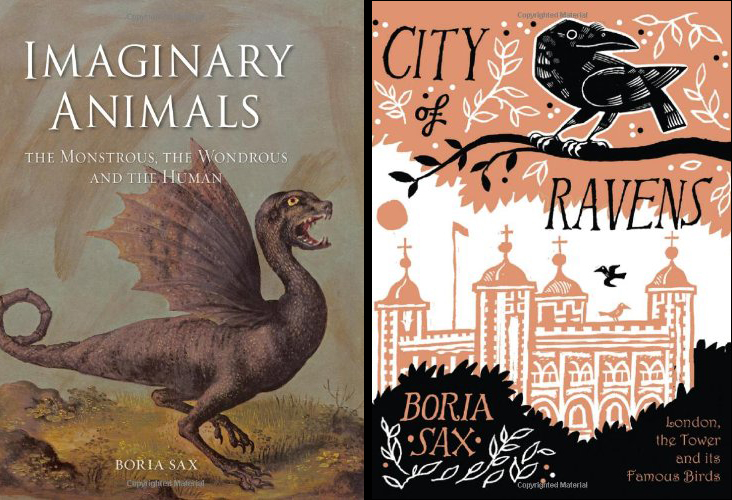
Dr. Boria Sax, who as many of you know teaches a wide range of literature in our program, is beyond the virtual classroom a renowned scholar on the topic of animals in literature, as well as of hermetic literature. He publishes frequently on these topics. Two of his more recent publications are Imaginary Animals: the Monstrous, the Wondrous, and the Human (ISBN: 1780231733) and City of Ravens: The Extraordinary History of London, the Tower, and its Ravens (ISBN: 9781590207772).

boria1

The publisher of Imaginary Animals writes: This book shows how, despite their liminal role, griffins, dog-men, mermaids, dragons, unicorns, yetis and many other imaginary creatures are socially constructed through the same complex play of sensuality and imagination as ‘real’ ones. It traces the history of imaginary animals from Palaeolithic art to the Harry Potter stories and robotic pets. These figures help us psychologically by giving form to our amorphous fears as ‘monsters’, as well as embodying our hopes as ‘wonders’. Nevertheless, their greatest service may be to continually challenge our imaginations, directing us beyond the limitations of our conventional beliefs and expectations.

And the publisher of City of Ravens writes: Boria Sax shows how our attitudes to the raven and to the natural world have changed enormously over the centuries. By describing the distinct place of this special bird in Western culture, he shows how blurred the lines between myth and history can be. This is a unique and brilliantly readable story of the entwined lives of people and animals.

david

Dr. David Kilpatrick, who in addition to having taught in the MA program since its inception is currently the Chair of the Dept. of Literature and Language in which our MA program is housed, is a diverse scholar of literature and philosophy. He is also a published poet, and his most recent publication is an epic poetic effort informed by the 2014 World Cup as much as by his life-long love for the beautiful game: Obrigado: A Futbal Epic (ISBN: 0996205802).

Dr. Kilpatrick provides the following: “Written as a response to the 2014 FIFA World Cup in Brazil, each match becomes a poem and each poem from each match becomes one epic poem, a narrative of heroes and villains emerging as the tournament unfolds as and through poetry.  Obrigado is for lovers of poetry and lovers of the Beautiful Game. ” Or as it reads on the back cover: “64 games, 32 teams, 30 days, 65 poems, 1 epic.”

Obrigado also comes in the form of an audio CD  which Dr. Kilpatrick recorded himself.

David-Kilpatrick-recording-Obrigado-A-Futebol-Epic

Also worth looking into is Dr. Kilpatrick’s Writing with Blood: the Sacrificial Dramatist as Tragic Man (ISBN 8792633099). The publisher writes: tragic writing emerges as a representation of a sacrificial crisis that calls into question the human relation to the divine. The process of dramatization that exposes this crisis places the subject and language at risk. Writing with Blood explores the birth and death of the tragic subject in antiquity and the modernist reanimation of the sacrificial in Nietzsche, Bataille and Mishima.

2015 Thesis of the Year Award

The winner of the 2015 Thesis of the Year award is Wayne Catan for his paper “Class and Culture: A Marxist Reading of The Sun Also Rises.” All thesis papers completed during the summer and fall of 2014 and spring of 2015 are eligible for the Thesis of the Year title. The final paper is selected by program faculty who read over drafts of papers from which the authors’ names have been removed. The award allows the student to list this honor on his or her curriculum vitae. Congratulations, Wayne. You can read more about the process and about last year’s winner on the blog here. We will begin a new cycle of consideration starting this summer.

Congratulations on the 2014-15 school year

I just want to congratulate each of you on the completion of another semester of graduate study, and on the completion of the 2014-15 school year here in the Mercy MA program. I hope that over the past year each of you has experienced something profound, read something fascinating and new, discussed something you’d never have discussed had you not been here together. I hope that each of you has experienced moments of awe, wonder, reflection, and epiphany over the course of the semester and school year.

In the next week or two we’ll be announcing the Thesis of the Year award for 2014-15 theses projects, and we’ll soon be starting up the summer session for those of you who have decided to take a summer course or two. Some of your are gearing up for your final semester and your final 599 Thesis Tutorial course. If you’re at all unsure what you’re supposed to be doing for this, or when, check out the blog posts related to the Comp Exam and the Thesis Tutorial, and read up on those sections in the Graduate Student Handbook. As always, if you’ve got any questions just ask me at cloots@mercy.edu.

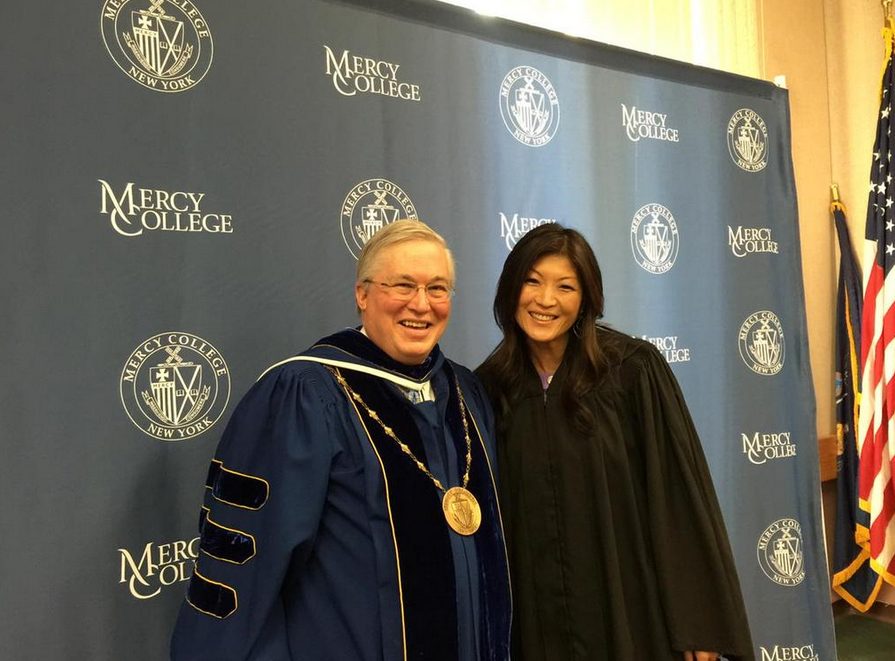
To Sarah, Josh, and Nicole: it was great to  see you walk the stage at commencement this year. I hope you heard me and the other MA English faculty clapping our little hearts out up on the faculty bandstand as you walked past. Sarah it was wonderful talking to you when you found me before the ceremony. I’ll say to everyone what we talked about then: you are all a part of Mercy College, and you should always know that I and the faculty are here to help and guide you as best as we can, while you’re in the program and after. Don’t hesitate to contact me or other faculty with whom you’ve taken courses for advice or letters or recommendation or anything else of the sort. I hope each of you will take a moment now to congratulate yourself, treat yourself to something nice, here at the end of a year of graduate study and scholarship. I leave you with a shot from before the School of Liberal Arts and School of Social and Behavioral Science Commencement of our president Tim Hall with the keynote speaker JuJu Chang from ABC news. You can see a brief video she uploaded from the stage at the end of the ceremony on her Instagram account (it’s dated May 20, 2015).

JuJu Chang and Tim Hall